
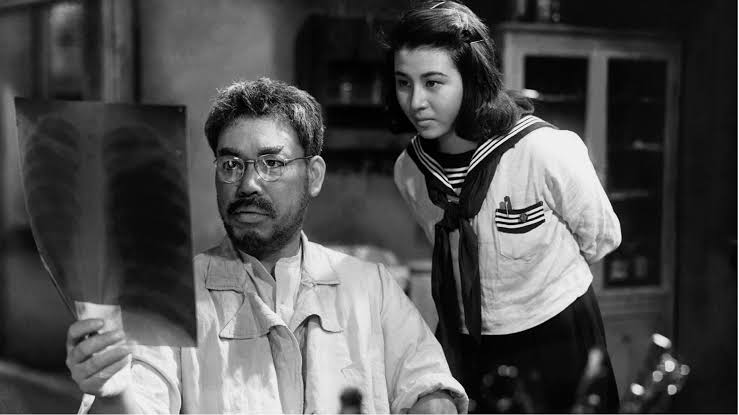
During the Kurosawa marathon, I finally came to the famous 1948 film Yoidore Tenshi (Drunken Angel), which is praised highly by cinema historians and ignited the legend of Toshiro Mifune. I went in front of the screen with great expectations, but to be honest, it was a completely bad movie for me and frankly, it felt like it didn’t tell me anything. This production, which everyone sees as a masterpiece, had a story that was messy and didn’t know where to connect, in my opinion, far from the philosophical depth of his old movies.
A Disorganized Story That Is Not Knowing Where It’s Going To be frank, the pace and editing of the movie exhausted me. On the one hand, there is an alcoholic neighborhood doctor, and on the other hand, a yakuza leader who cannot accept that he has tuberculosis… Throughout the film, we watch the endless bickering of these two, constantly returning to the same place. The story is neither a crime movie nor a drama. The events are so static and disjointed that I even had a hard time catching the motivations of the characters.
Mifune’s famous yakuza character (Matsunaga) seemed to me like a raw and annoying man who was just yelling around. I think Kurosawa wanted to tell the underworld of post-war Tokyo, but the story was drowned in a confusion that went nowhere and did not know what it was defending. When the movie ends, you look at the screen and say, “So, what did I watch now, what was the purpose here?” I couldn’t help but say. Philosophy and Symbolism Notes from My Perspective (Things I Still Tried to Catch) Even though the movie was bad and didn’t tell me anything, I didn’t want to pass by without making sense of the few visual details that the master director had hidden in the frame in my own world.
The symbols that caught my eye in this empty story were: That Dirty Swamp in the Middle of the Neighborhood: There is a stinking, stagnant swamp right in the middle of the neighborhood where the movie takes place. The story didn’t tell me much, but I think that swamp was a symbol of the corrupt, incorrigible, and slowly poisoning social structure of post-war Japan. No matter how hard the characters struggled, the smell of that swamp seemed to permeate them all.
Matsunaga’s Nightmare Scene: There is a scene in Matsunaga’s dream where he sees a coffin on the beach and a copy of himself comes out of that coffin and chases him. In my opinion, this was the most bearable part of the movie, the only part that approached dream logic. In my opinion, it was a naive subconscious scene that showed that the man could not escape from that swamp life and that he actually knew deep down his own death and decay.
Colorful Clothes and Empty Elegance: In my opinion, Matsunaga’s stylish western-style suits and colorful ties were completely a mask. It seemed to me that the fact that a man who died of tuberculosis, whose insides were completely rotten, decorated his exterior so much actually showed the false magnificence and helplessness of the underworld at that time. Last Word Long story short; Considered the “turning point” in cinema history, Drunken Angel was my first serious moment of hitting a wall in my Kurosawa marathon.
I could never find the human hope, naivety or clear philosophical stance of the previous films in this film; It was a complete waste of time and a bad experience for me. However, I promise you that this marathon will not be left unfinished. I’m ready to put this disappointment in my pocket and move on to Kurosawa’s next step. Next up is The Quiet Duel, made in 1949. Let’s see if that movie can clean up this mess.





Comments
You can write your views about this story. Comments may be moderated according to site settings.