
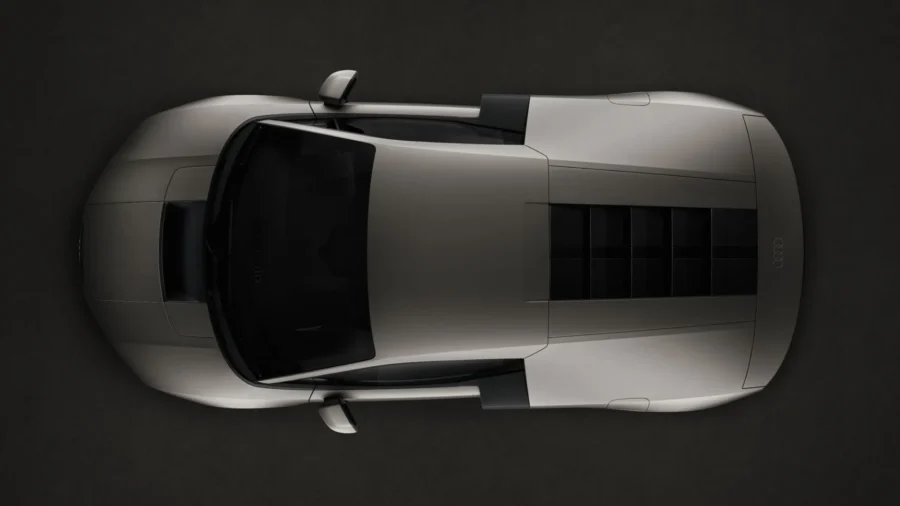
Audi introduced Nuvolari, its first supercar with a high-performance hybrid powertrain. Offering 1,001 PS system power, the model will be the most powerful and fastest mass production car in Audi history with a maximum speed of over 350 km/h. Deliveries of the car, which will be produced limited to 499 units, will begin in the first half of 2027. Audi Nuvolari combines the V8 engine with three electric motors. Audi Nuvolari comes with a high-performance hybrid powertrain system that combines a 4.0-liter twin-turbo V8 engine with three axial flux electric motors.
The total power of the system was announced as 736 kW, that is, 1,001 PS. The internal combustion V8 engine alone produces 588 kW of power. This value corresponds to 800 hp. The V8 engine provides 730 Nm of maximum torque and can reach up to 10,000 rpm. Audi defines this rev range as a level previously reserved for motor sports. Each of the three electric motors used in the hybrid structure produces 110 kW power. The system is powered by a lithium-ion battery with a gross capacity of 7.3 kWh.
There are two oil-cooled axial flux electric motors on the front axle. These engines can provide up to 2,150 Nm of torque and support variable torque distribution as part of the quattro system. The third electric motor is placed between the V8 mid-engine and the transmission. Nuvolari accelerates from 0 to 100 km/h in 2.6 seconds. It takes 6.8 seconds to accelerate from 0 to 200 km/h. The maximum speed of the car is over 350 km/h.
Audi states that these acceleration data are valid in conditions where the battery initial temperature is above 28 degrees and the charge level is above 80 percent. Audi Nuvolari was introduced as the first mass production car bearing the brand’s new design philosophy. The mid-engine placement determines the car’s proportions. Tensioned surfaces, technological parts integrated with the body and aerodynamic solutions are used in the body.
Audi’s new signature color Titanium was preferred in the exterior design. This color was previously used in the Audi Concept C and Audi Formula 1 race car. In the body architecture of the car, Audi Space Frame technology was combined with the carbon outer body. Audi announced this structure as a first for its mass production portfolio. Almost all of the external body parts are made of carbon fiber reinforced polymer.
Carbon parts were prepared with prepreg autoclave technology developed with Formula 1 experience. In this process, carbon fibers pre-impregnated with resin are shaped, then cured under high pressure and temperature. Carbon parts are produced through precise manual placement processes. Audi states that this stage is critical for both structural integrity and visual quality. The use of carbon fiber reinforced polymer enables the creation of complex geometries, from door panel structures to vertical frame members that direct air to the hidden S-duct section.
Special heat-resistant materials were used in parts exposed to high temperatures. Audi Nuvolari has an active aerodynamic system. Front splitter, rear diffuser, air intakes and S-duct structure are among the parts of the aerodynamic layout. Front air intakes contribute to brake cooling and thermal management of the internal combustion engine and hybrid components. The S-duct structure in the ventilated front section creates additional downforce on the front axle, reduces lift at high speeds and helps cool the powertrain.
At the center of the active aerodynamic system is the retractable adaptive rear wing. The wing operates in three different positions: Closed, Low Downforce and High Downforce. In the closed position, the wing is retracted into the fuselage and drag is reduced. In Low Downforce and High Downforce settings, different downforce levels are created depending on the selected driving mode and driving dynamics. In Dynamic, Dynamic and Track modes, the rear wing operates automatically.
On the plains, the system switches to Low Downforce mode. DRS, or Drag Reduction System, known from Formula 1, can be activated manually with a special button on the steering wheel. During braking and cornering, the wing switches to High Downforce position. Audi announced that in this configuration, more than 400 kg of downforce is achieved, depending on the driving situation. Nuvolari uses a new driving dynamics system called quattro predictive ride.
The system processes sensor data such as steering angle, acceleration, yaw rate and current grip level. When a possible loss of grip is detected in a corner, the powertrain, brakes and aerodynamic parts work together. Torque is distributed in both longitudinal and lateral directions. The brakes stabilize the vehicle with targeted interventions. The aerodynamic system adjusts the downforce according to the driving situation.
The driver can switch between E-Hybrid, Balanced, Dynamic and Dynamic modes via the rotary controls on the steering wheel. E-Hybrid mode provides fully electric driving for urban and short-distance use. Balanced mode offers comfort, efficiency and performance together. Dynamic mode sharpens system responses. Dynamic mode operates the powertrain with a performance focus. In Track Mode, traction control can be adjusted according to driving style and current road grip.
Settings range from Wet, Dry, Race and Traction Control Off. This structure allows traction control to be regulated at different levels in track use. Nuvolari’s energy management system was also developed with the approach taken from motor sports. Boost and recuperation strategies work together with torque distribution. The system manages the relationship between power transfer and energy recovery according to driving conditions, handling level and driver demand.
Electric deceleration at the front axle undertakes the significant part of braking. Energy is recovered at the rear axle during gliding, partial load and traction control phases. Audi has announced that all-electric deceleration of up to 0.3 g is possible. In the Launch Control function, the system uses the stored energy with controlled traction during acceleration. The brake-by-wire structure inspired by motor sports is used in the braking system.
In this system, the brake pedal is functionally separated from the actual braking force on the wheels. Thus, the distribution between recovery and hydraulic braking is managed variably. The new Audi Ceramic Pro braking system consists of ten-piston fixed calipers working with 420 x 40 mm discs on the front axle. 410 x 32 mm discs and four-piston calipers are used on the rear axle. The brake discs are based on a long-fiber carbon structure taken directly from Formula 1.
The internal cooling system increases heat dissipation by up to 21 percent compared to traditional carbon ceramic systems. The energy absorption capacity of the braking system is up to 2.8 megawatts. A driving-oriented layout was used in the interior. Controls have been reduced to basic functions and positioned close to the driver’s field of vision. Digital screens and physical controls were placed with the same usage logic.
The color accents on the HMI side refer to the Auto Union Type C racing car of the 1930s. There is a two-zone color approach in the cabin. Dark tones were used in the front section. On the back, a light tone called Shadow Dune was preferred. The frame of the middle screen is made of anodized aluminum. Lightweight seats have a carbon fiber seat base and backrest structure. The structure of the seats was developed for low weight, high rigidity and lateral support.
Audi Nuvolari took its name from Italian racing driver Tazio Nuvolari. Tazio Nuvolari is among the leading names in the history of motor sports. Audi announced that the introduced near-production prototype was developed in a short time and with close work of international teams. According to the preliminary data shared by Audi, Nuvolari’s combined weighted fuel consumption is 11.3 l/100 km, combined weighted electricity consumption is 7.8 kWh/100 km, and combined weighted CO₂ emissions are 270 g/km.
CO₂ class was announced as G. Fuel consumption with the battery empty is given as 14.7 l/100 km.



Comments
You can write your views about this story. Comments may be moderated according to site settings.