
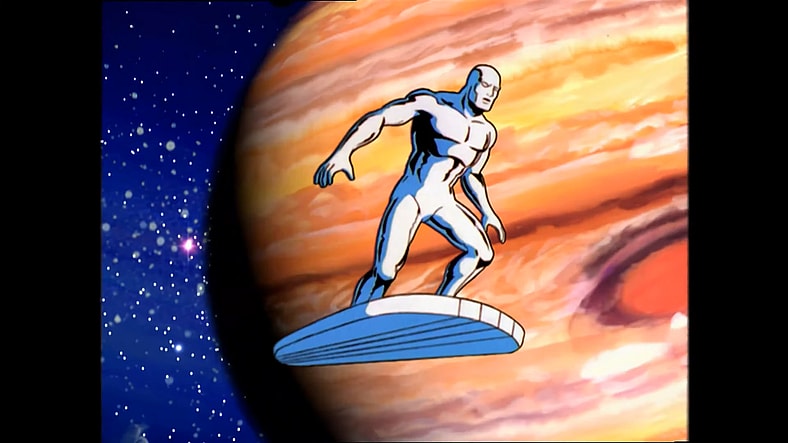
The Silver Surfer animated series started on Fox Kids in February 1998, before I was even born. This single-season series, which finished in May (13 episodes in total, was canceled before it had a finale), is the most mature and philosophical production in the history of Marvel animation. It was born in the creativity of Larry Brody and under the direction of Roy Allen Smith, but there is a lot of Jack Kirby influence and it is as if Stan Lee was among the creators.
These people contributed a lot to Silver Surfer and put a lot of effort into it. It’s completely different from other Marvel cartoons (X-Men’s team dynamics, Spider-Man’s street heroism): Here, the action is secondary, the dialogue heavy. It uses serialized storytelling, each episode is connected to the previous one, there are cliffhangers and arcs. The animation style is legendary: Classic cel-shading and computer-aided cosmic effects (Galactus is completely CGI, the glow of the surfboard is hypnotic) They tried to imitate Kirby’s pencil exactly and they succeeded.
The music is by Deddy Tzur, the epic symphonic tells about the silence of space and inner storms, but I think it’s a bit weak, especially with the classic X-Men intro and Spiderman 94 intro. The series is based on Stan Lee and Jack Kirby’s 1966 Galactus Trilogy, but is original. There is no Fantastic Four (I guess because of copyright), instead cosmic giants such as Kree, Skrull, Watcher, Eternity and Thanos are on the table.
Themes are Serious: Imperialism (Kree colonialism), slavery (Trolls’ rebellion), environmental destruction (Galactus’ entropy), pacifism (Surfer’s rebellion), illusion, etc. reality. Greetings to Asimov. Marvel’s bankruptcy crisis in 1998 and legal dispute with Saban Entertainment. Ratings were good, critics praised it, but production stopped while 8 more episodes were written (second season scripts: Re-creation of the universe, the full story of Thanos and Lady Chaos).
Today it can be watched on Disney and has cult status. Why is it so important to me? Because just as I said: Cosmic journey is not a physical quest here, but a spiritual quest. Sacrifice is Norrin Radd’s DNA, loneliness is the price of Power Cosmic, discovery is a new secret on every planet. Compared to the MCU’s Eternals and Guardians in 2026, this series is still the poet of the universe, not the deeper superhero. It’s timeless, with its animation quality, philosophical dialogues (“The balance of the universe would be disrupted without the sacrifice of the individual”), music, and those iconic solo surfing scenes.
This series captured Marvel’s “cosmic” spirit in its purest form and is a holy grail for those who love it as one. Character Analysis: Reflections of the Universe and Universal Values Represented by Silver Surfer Norrin Radd / Silver Surfer (Voice: Paul Essiembre): Your heart, your soul. Zenn-La’s idealistic scientist and philosopher; He is restless even in utopia, looking at the stars and saying that life is meaningless without discovery.
The peak of sacrifice: He leaves his lover Shalla-Bal, his people, and his own happiness to Galactus. Power Cosmic turns your body into silver but erases your memory and moral compass, the greatest metaphor of modern man: Power makes you a god but steals your identity. When memory returns, the rebellion begins; he is no longer Galactus’ slave, but the conscience of the universe. Things it represents: Free will etc. fate (Nietzsche’s “overman” but his tragic state), loneliness (that look while surfing alone in space, like Camus’ absurd hero), discovery (each new planet is a question of existence).
That’s why he’s your favorite superhero: He’s not a hero, he’s the silent poet of the universe. His sacrifice is pure, his loneliness is universal. Galactus (Voice: James Blendick): Devourer of Worlds, a giant being fully CGI animated. Entropy itself is dressed up in the second law of thermodynamics. It’s not evil, it’s necessary: It balances the universe by destroying it. His relationship with Surfer is like father-son, more like a toxic Turkish father; oppression and rebellion.
Philosophical depth: Is extinction necessary for existence? (Heraclitus’ change and the concept of entropy). The irony is at its peak when the Surfer saves him (Antibody), protecting his enemy means protecting the universe. Shalla-Bal (Voice: Camilla Scott): Emotional center. Norrin’s mirror in Zenn-La; The female version of sacrifice. Even though it seems limited in the series, it increases loneliness at every turn.
Represents: Love and loss – humanity left behind on the cosmic journey. Thanos (Voice: Gary Krawford):*Mad Titan, servant of Lady Chaos (in place of Death). The hunger for power and chaos is not like Infinity War, do not watch it with wrong expectations. The infiltration of Surfer’s mind with Ego triggers the memory, full of irony. Represents: Ego disrupting balance Other Cosmic Beings: Uatu the Watcher (Colin Fox) neutrality that watches but does not intervene (like Kant’s morality).
eternity Nova/Frankie Raye, Adam Warlock, Drax, Pip the Troll Surfer’s companions; Enriches exploration and alliance. All together, they define the Surfer as the helpless power of the individual against the cosmos. Philosophical Core: Secrets of the Universe, Sacrifice, Loneliness and Infinity of Discovery The series blends classic science fiction with Marvel cosmic. Galactic politics like Asimov’s Foundation series, war absurdity like Haldeman’s Forever War, illusion like Plato’s cave, etc.
reality. Main themes: Sacrifice: Can individual happiness be sacrificed for the continuation of the universe? Norrin’s origin is the answer to this question; Like Kierkegaard’s “leap of faith”. Loneliness: A being equipped with Power Cosmic but disconnected. On the contrary, Sartre’s “hell is other people”: hell is loneliness. It resembles “disconnection” in Buddhism. Cosmic Journey Presenting these to children in 1998 makes the series timeless.
For you: These themes mirror your Marvel journey, cosmic exploration draws you in because the secrets of the universe are hidden within us. Now, each episode has detailed spoilers. Those who haven’t watched it immediately read another article. 1-3. Episode: The Origin of the Silver Surfer (Origin Trilogy) The Birth of Sacrifice Uatu the Watcher opens: Some secrets are meant to be kept. Zenn-La, utopia of peace; Norrin Radd and Shalla-Bal look at the stars and say, Life is empty without discovery.
Galactus comes, the sky darkens, the energy core trembles. “Let me be the herald, find the planets without you,” Norrin says to the council. Shalla-Bal is crying but can’t stop it. Galactus accepts: Power Cosmic gives, silver leather, surfboard. But memory fades, morality disappears. Surfer finds unconscious planets, swallows Galactus. Unrest inside. Thanos and Ego infiltrate his mind; mental warfare brings back memory.
Surfer protects Earth, attacks Galactus. “I allow it, but Zenn-La has moved,” says Galactus. Surfer left alone, vows to find Shalla-Bal. Analysis: This trilogy is the backbone of the series, the allegory of existence. Norrin’s sacrifice is Plato’s exit from his cave: being thrown from utopia into the cosmic shadow world. Amnesia, Heidegger’s “forgetting”, is a modern identity crisis. Galactus is entropy, Surfer is rebellious consciousness.
This is where loneliness is born: Being strong means being disconnected. Discovery is at its peak; Every planet is the secret of the universe. It fits perfectly with your themes: sacrifice is pure, loneliness is painful, discovery is endless. Series value: A philosophy lesson on a children’s channel, a rare serialized depth in 90s animation. Episode 4: The Planet of Dr. Moreau Critique of Slavery and Imperialism Surfer goes to the Kree colony for knowledge of Zenn-La.
The Kree enslave him and employ him with genetic Trolls (Pip and Kili). Genetic experiments, cruel guards. Surfer forms an alliance with the Trolls and becomes the leader of the rebellion. The Kree fall, Eternity and Infinity watch in the shadows. The Surfer tastes freedom, but loneliness remains. Analysis: Direct criticism of slavery and imperialism. Kree galactic colonizer; Trolls represent the rights of “created” beings (like Mary Shelley’s Frankenstein).
The Surfer’s alliance is the transition from solitude to community – the sacrifice is now collective. Discovery physical: Genetic engineering What does it mean to be human? he asks the question. Is rebellion necessary for freedom? Surfer’s conscience grows stronger and the sacrifice he represents evolves. Meanwhile, Dr. I have a review of the film adaptation of Moreau H. G Wells’ novel, 5-6. Section: Learning Curve Knowledge vs.
The Freedom Dilemma They go to the Universal Library (the Watchers’ repository of knowledge). Virals are infested, self-evolving blob creatures. Mentor teams up with Drax and Nebula. The Surfer wants all the knowledge to find Zenn-La, but there is a warning that “taking all knowledge destroys the soul.” Fight the virals, Surfer gets blobbed but escapes with Power Cosmic. Uatu’s secret is revealed: Knowledge is dangerous.
Analysis: A nod to Asimov’s Foundation, Faustian agreement. Information vs. Freedom: Does knowing all the secrets set you free or enslave? Virals represent “controlled evolution.” Darwin’s critique of transhumanism. The Surfer’s choice is the price of discovery: Infinite knowledge but a lonely soul. The most philosophical arc of the series; Searching for the secrets of the universe means losing yourself. Loneliness is the peak.
Chapter 7: Innervisions Illusion vs. Reality: From the planets destroyed by Thanos to Harmony. The people live in happy illusion with their dream machine. Surfer enters the dream and defeats Thanos with Beta Ray Bill. He turns the machine off. “Confront the real pain,” he says. People are making peace with reality. Analysis: Plato’s cave is right here: Happy lie or bitter truth? Anti-escapism message. Sacrifice: The Surfer destroys their happiness so they can reach the truth.
Discovery is the spiritual inner journey. The secrets of the universe are hidden in pain; Loneliness is facing this reality. Chapter 8: Antibody Entropy and Equilibrium Galactus is dying. Surfer (with Nova and Gamora) acts as an antibody with the Draconians. The Harlan Ellison story: Why save it? Civil war, decision of sacrifice. Analysis: Entropy and balance. Saving Galactus, protecting the universe is the irony of sacrifice.
Loneliness: Saving your enemy. Philosophy: There is no existence without extinction. Cosmic cycle, like Heraclitus. Episode 9: Second Foundation Illusion With Nova to the place they thought was “Zenn-La”. It’s actually the Skrull homeworld. Themes of reproduction, war. Nova is divided by loyalty to Galactus. Analysis: Asimov salute. The illusion of identity persists. Discovery: The secrets of the universe are illusory.
Sacrifice: Fighting for false hopes. Loneliness is increasing. Episode 10: Radical Justice Court of Conscience judges Galactus victims Surfer. He believes he is guilty, Draconian justice. Prison planet. Analysis: Justice and conscience. Surfer questions his own crimes: hero or murderer? Philosophical court: The morality of the universe. Sacrifice is internal. Chapter 11: The Forever War The Absurdity of War To the Supreme Intelligence for aid to the Kree.
Adam Warlock is active. Kree-Skrull war. Analysis: Haldeman’s Forever War. War cycle. Sacrifice: The eternal struggle for peace. Discovery: The secrets of galactic politics. Chapter 12: Return to Zenn-La The Pain of Imagination The Ego’s illusion reaches home. Meeting with Shalla-Bal but fake. Virals, sacrifice. Analysis: The most emotional. The peak of loneliness: Even dreaming is not enough. Sacrifice: Shalla-Bal’s sacrifice.
Secrets of the universe: Real house or cosmos? Episode 13: The End of Eternity Apocalyptic Climax Eternity



Comments
You can write your views about this story. Comments may be moderated according to site settings.