
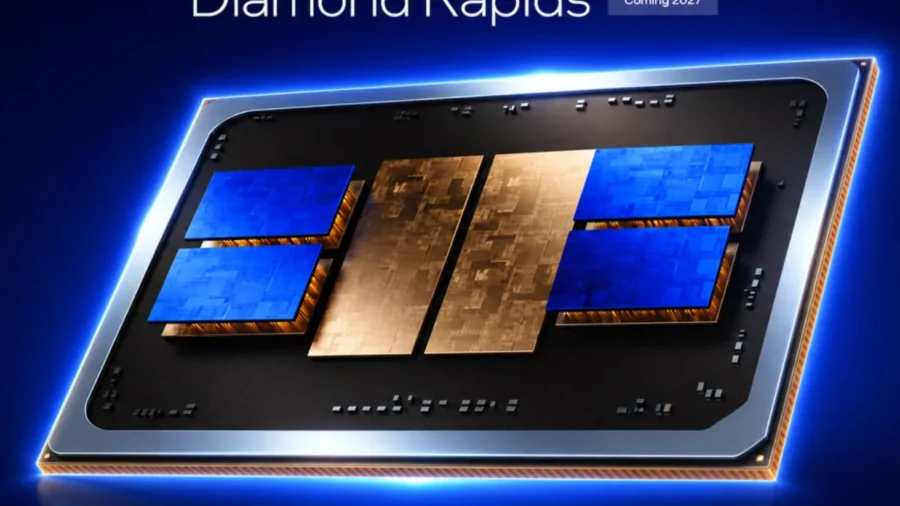
Intel shared the first technical information for the new generation Xeon 7 processor family Diamond Rapids on the data center side. The new processors to be released in 2027 are prepared with the Intel 18A-P production process. The Diamond Rapids family includes up to 192 P-core cores, 16 channel memory support and PCIe Gen6 connection. In the road map shared during Computex 2026, the company positioned Diamond Rapids as the next generation Xeon platform to be released in 2027.
The new processors will be one of the first major Xeon 7 steps forward using Intel’s 18A-P manufacturing process. 18A-P is listed as the updated version of Intel’s 18A manufacturing technology. While Intel 18A side comes to the fore with Panther Lake on the client processors and Clearwater Forest on the data center side, Diamond Rapids carries this line to the P-core based high-end Xeon platform. According to the information shared by Intel, 18A-P offers up to 9 percent higher performance at the same power or up to 18 percent lower power consumption at the same performance compared to 18A.
The Diamond Rapids family comes with a 50 percent higher core count than the current Granite Rapids generation. On the Granite Rapids side, the high-end models go up to 128 cores, while a 192 P-core limit is spoken for Diamond Rapids. Different variants with 256 P-core and 512 cores were previously introduced. New information gives the upper limit in P-core based Diamond Rapids models as 192 cores. In the chip image shared by Intel, four CPU chiplets and two large I / O dies are seen in the middle.
This layout is associated with four compute chiplet structures, each containing 48 cores. A new compute tile structure called CBB, or Core Building Block, is used on the Diamond Rapids side. While the memory controller is located on the same tile in Granite Rapids, this section is separated in the Diamond Rapids design. The new processors are associated with the Panther Cove-X P-core architecture. This core structure is prepared for high single-thread performance and IaaS-focused data center workloads.
There is no Hyper-Threading or SMT support in the Diamond Rapids family. In Intel’s roadmap, multi-threading support is expected to return with the next generation Coral Rapids. On the memory side, one of the most important differences of Diamond Rapids will be the 16 channel design. Intel had also previously planned an 8-channel variant for Diamond Rapids. This option was canceled and the platform focused on the 16-channel design.
With faster DIMM support, memory bandwidth will be doubled compared to Granite Rapids. This structure was prepared especially for data center, HPC and artificial intelligence workloads that are dependent on memory bandwidth. The Diamond Rapids platform also includes PCIe Gen6 support. The new connectivity standard provides higher bandwidth for I/O-intensive server systems, accelerator cards, high-speed network connections and storage infrastructures.
In this respect, Intel’s new Xeon 7 platform renews the CPU, memory and I/O sides within the same generation. Early platform information included LGA 9324 socket, multi-socket system support and TDP values up to 650 W. Diamond Rapids’ 16-channel standard models and higher core density variants are expected to be supported on the same platform. In this way, there will be no need for a separate socket or a separate platform for different processor configurations on the data center side.
After Diamond Rapids, Coral Rapids is on Intel’s road map. In this generation, the P-core structure will be preserved and SMT support will return. The period of 2028 is marked for Coral Rapids. Following Intel CEO Lip-Bu Tan’s statements regarding the demand for artificial intelligence-focused processors, it was also on the industry agenda that the Coral Rapids schedule could be accelerated. On the competitive side, Diamond Rapids will be positioned in the same data center market as AMD’s EPYC Venice family and NVIDIA’s Vera platform.
AMD is talking about up to 256 cores for Zen 6-based Venice processors. On the Intel front, Diamond Rapids will be the new link of the data center processor roadmap with 18A-P production process, 192 P-core, 16 channel memory and PCIe Gen6 under the Xeon 7 brand. Intel’s plans on the Xeon side are not limited only to Diamond Rapids. It was also reported in industry sources that the company is working on a special x86 SKU with NVLINK support for NVIDIA.
NVIDIA’s evaluation of x86 and Arm options together in artificial intelligence infrastructures will expand the data center CPU competition to a wider area in 2027.






Comments
You can write your views about this story. Comments may be moderated according to site settings.