
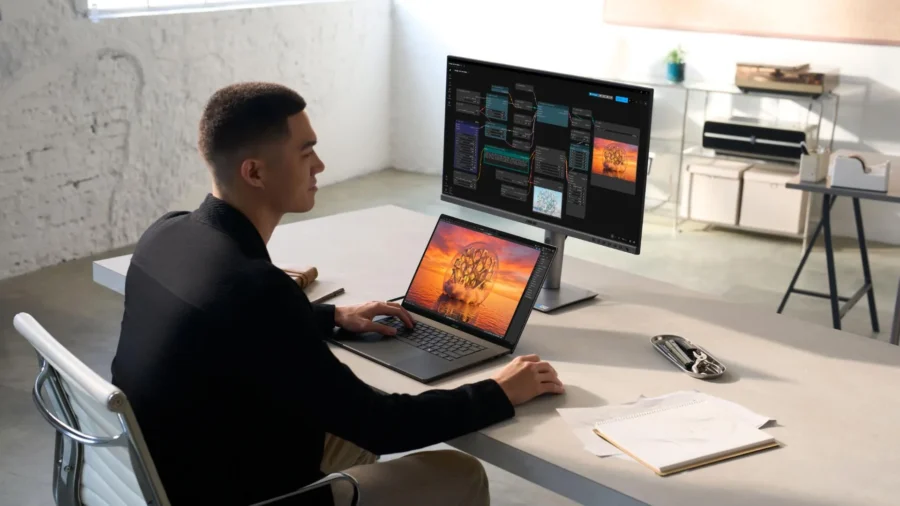
ASUS announced its new artificial intelligence-focused computers added to the ProArt series at Computex 2026. ProArt P16, ProArt P14 and ProArt Mini PC, powered by NVIDIA RTX Spark technology; It was included in the new product family developed for local artificial intelligence agents, large language models, 3D rendering, video production and professional content workflows. ASUS ProArt series was renewed with RTX Spark.
ASUS introduced ProArt P16, ProArt P14 and ProArt Mini PC models within the scope of Computex 2026. The new products come with NVIDIA RTX Spark infrastructure and are among the Windows computers prepared for personal artificial intelligence agents. The series is developed for content creators, AI developers, creative professionals, and users working with native AI workloads. NVIDIA RTX Spark is at the center of native AI performance in ASUS’ new ProArt models.
Platform; It brings together NVIDIA CUDA, NVIDIA RTX, DLSS, FP4, NVIDIA TensorRT, NVIDIA OptiX, Reflex and G-SYNC technologies in the same structure. According to the information shared by ASUS, RTX Spark is used with an architecture that offers all-day battery life in thin Windows laptops and high efficiency in desktop form. RTX Spark-based ProArt computers have up to 1 petaflop of artificial intelligence computing power and up to 128 GB combined memory support.
This structure ensures that system and graphics resources are used in the same memory pool. According to the data provided by ASUS, new ProArt devices can work with large 3D scenes over 90 GB, produce 4K artificial intelligence videos, and natively run large language models with 120 billion parameters with a context window of up to 1 million tokens. ProArt P16 and ProArt P14 were announced as NVIDIA RTX Spark-based ultra-thin Windows laptops.
The models include NVIDIA Blackwell RTX GPU and high-performance 20-core NVIDIA Grace CPU. On the GPU side, there are 6,144 CUDA cores and fifth generation Tensor cores with FP4 precision. The CPU and GPU are connected to each other with NVIDIA NVLink-C2C chip-to-chip connection technology. The new ProArt P16 and P14 are prepared for professional video and graphics workflows as well as artificial intelligence-supported content production.
According to the information provided by ASUS, devices can render 3D scenes over 90 GB with the help of local agents, edit 12K 4:2:2 video, create 4K artificial intelligence videos and run large language models on the device. The systems also have the hardware power to provide performance of over 100 fps at 1440p resolution in AAA games. Special work is also being carried out on the Adobe side for the RTX Spark architecture.
According to the information shared by ASUS, Adobe is redesigning Photoshop and Premiere applications for the RTX Spark architecture. This work will increase artificial intelligence and graphics performance by up to 2 times. ProArt devices will be offered with a 3-month Adobe Creative Cloud subscription. ASUS has also made the software side of the ProArt series focused on artificial intelligence. ProArt Creator Hub organizes system resources for demanding workflows.
MuseTree and StoryCube applications accompany the devices as artificial intelligence-supported production tools in content production. The ProArt ecosystem also comes with partner solutions such as Adobe Creative Cloud, Goodnotes and GoPro Cloud. The new ProArt devices are optimized to work with more than 1,000 accelerated applications and games, including Adobe, Blackmagic Design, Blender, CapCut, ComfyUI and OTOY. ASUS offers this software support as part of the expanding ProArt ecosystem with ProArt displays, motherboards, cases and peripherals.
On the design side, ProArt P16 and P14 come with a thinner and lighter body than the previous generation. According to the information provided by ASUS, the new laptops are 13 percent thinner and 16 percent lighter compared to the previous generation ProArt P16 H7606 model. The body, prepared with CNC production processes, has Nano Black and Neo White color options. A special coating is used on the surfaces, which gives a smooth touch feeling and is stain-resistant.
There are ASUS Lumina Pro OLED panels on the screen side. ProArt P16 comes with 4K 120 Hz VRR display options with NVIDIA G-SYNC support. The ProArt P14 model offers screen options up to 3K resolution. The panels have Delta E 1 color accuracy, brightness up to 1,600 nits and anti-reflective coating. Laptop models offer a battery capacity of up to 99.9 Wh. The devices feature a touchpad that provides precise haptic feedback, multitasking performance optimized for content creator workflows, and an artificial intelligence-supported Windows experience.
On the thermal side, special cooling modules are used that protect the thin body structure. Another product that ASUS showed at Computex 2026 was ProArt Mini PC. The compact computer offers up to 1 petaflop of AI performance in a small chassis. The model is prepared for content creators, developers and users working with artificial intelligence workloads. ProArt Mini PC comes with a unified memory architecture of up to 128 GB.
This structure enables dynamic memory usage between system and graphics resources in generative AI and large language model workloads. The device features a cooling architecture that offers up to 140W thermal capacity for heavy rendering and intense artificial intelligence operations. The case of the mini PC measures 150 × 150 × 51 mm. Despite the compact body, the device features 10GbE wired network connectivity, M.2 PCIe Gen 5 x4 expansion slot and high-speed storage scalability.
This structure positions the device in a form suitable for small studios, desktop workstations and edge artificial intelligence environments. The new ProArt P16, ProArt P14 and ProArt Mini PC models will be exhibited during Computex 2026. According to ASUS’s statement, the products will gradually go on sale in certain regions starting from autumn 2026. Additional technical specifications, configuration options and regional availability information will be shared at a later date.




Comments
You can write your views about this story. Comments may be moderated according to site settings.