
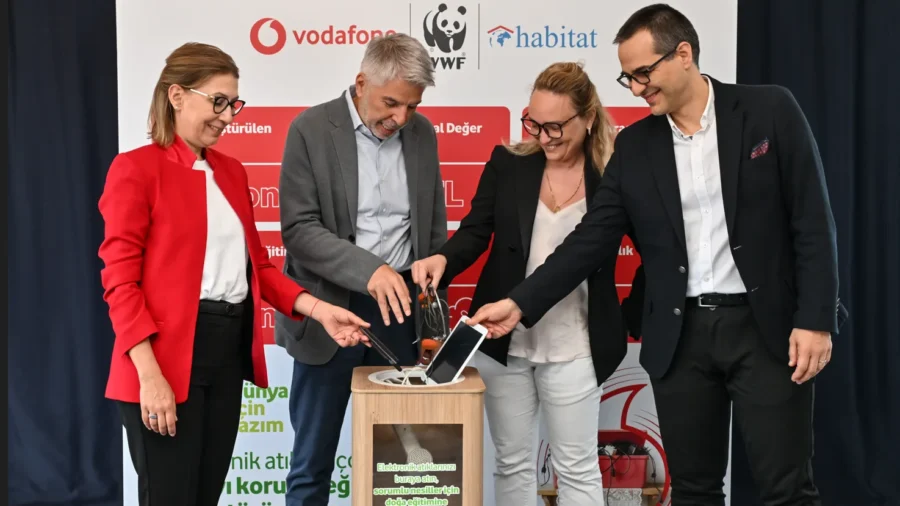
The first year of the “Necessary for the World” project, carried out in cooperation with Vodafone, WWF-Türkiye and Habitat Association, has been completed. More than 37 tons of e-waste has been collected so far in the project, which was initiated to recycle electronic waste and raise awareness of nature conservation in children. While the number of people reached through nature conservation training within the scope of the project exceeded 75 thousand, the number of volunteers supporting the project exceeded 500.
In the second year, it is aimed to reach 68 thousand more children with 650 volunteer trainers and to recycle 50 tons of e-waste. More than 37 tons of e-waste was collected in the project. In the first year of the “Need for the World” project, collection efforts were carried out throughout Turkey through Vodafone stores and digital channels for the recycling of electronic waste. According to Vodafone’s statement, 32 tons of the over 37 tons of e-waste collected in a year came from stores.
E-waste collection points were established in 760 Vodafone stores across the country. It was reported that a total of 15 thousand people participated in the campaign and an average of 2.5 kilograms of e-waste was collected per person. Users who donated e-waste by filling out the form through the Vodafone Yandım application were given a 5 GB mobile internet gift. Nature conservation training was given to more than 75 thousand people.
Within the scope of the project, e-waste and sustainability trainings were organized for children between the ages of 7-14, parents and educators. The topics of nature conservation, sustainable living, climate change, e-waste and upcycling were discussed in the trainings. In addition, trainer trainings, webinars for parents and teachers, workshops attended by children and the “Necessary for the World – GreenFest” event were held.
It was aimed for children not only to learn environmental issues theoretically but also to transform them into behavior in daily life. The social impact of the project was measured. According to the social impact analysis shared by Vodafone, every 1 TL investment made in the project produced 4.56 TL of social value. While an average increase of 50 points in the knowledge level of the participants was measured, it was stated that the e-waste awareness rate increased from 39 percent to 81 percent.
In the analysis, it was reported that e-waste collection behavior increased by 86 percent and the rate of taking steps to protect the environment exceeded 95 percent. These results show that the project aims not only to raise awareness but also to create behavioral change. The AI for Planet module will start in the new period. A new module called “AI for Planet” will be launched in the second year of the project. Within the scope of this module, events focusing on artificial intelligence, climate and sustainability themes will be organized in 4 provinces in rural regions.
Additionally, the “Nature Ambassadors” program will be expanded. The 23 Nature Ambassadors selected in the first period, together with their mentors, started to produce creative works focusing on e-waste, nature conservation and sustainability. 20 more Nature Ambassadors will be selected in the new period. It is aimed to reach 68 thousand more children. Vodafone Turkey Deputy Chief Executive Officer Hasan Süel stated that they aim to reach 68 thousand more children with face-to-face and online training in 81 provinces in the second year of the project.
Süel also said that 50 tons of e-waste is planned to be recycled. WWF-Türkiye General Manager Ömür Kula stated that they see children’s connection with nature and spreading awareness of nature protection as a common responsibility. Habitat Association Chairman of the Board of Directors, Emre Koyuncu, stated that a measurable transformation was achieved in knowledge, attitudes and behaviors in the first year of the project.
The “Necessary for the World” project stands out as an important example in the recycling of electronic waste and environmental education for children. However, the long-term impact will become clear with a sustainable increase in the amount of e-waste collected, permanent transformation of training into behavioral change, and continued local participation.




Comments
You can write your views about this story. Comments may be moderated according to site settings.