
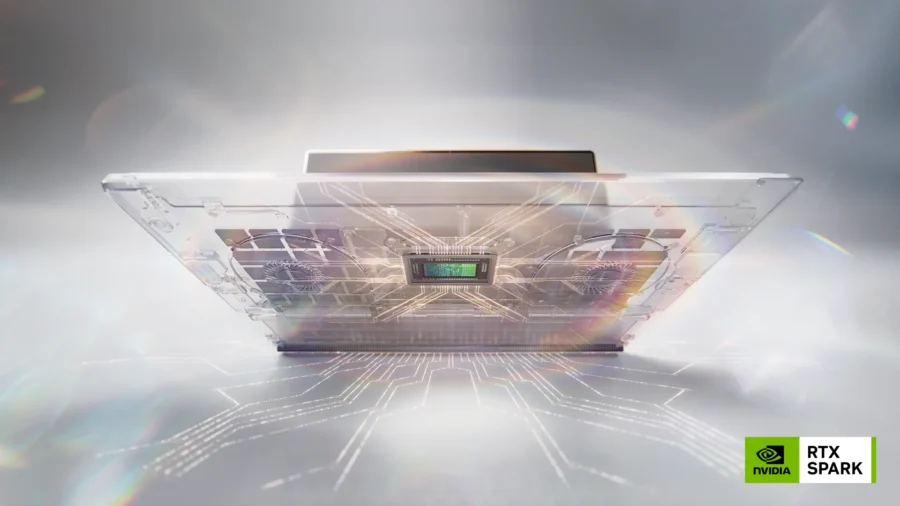
NVIDIA introduced perhaps the most important product family of the year at Computex 2026. The GPU manufacturer launched the RTX Spark platform, thinking that artificial intelligence agents would radically change the way users interact with the PC. The Windows on Arm-based platform turns Windows into an agent-based AI platform. The company claims that RTX Spark is “the most efficient platform ever built.” You will hear the word “agent” more often in the future.
If NVIDIA has invested heavily in this business, it is because it sees a future. The technology giant says artificial intelligence agents will reshape the relationship between humans and PCs. What is AI Agent? The future of artificial intelligence agents Mice and keyboards, which have been used in personal computers for years, seem to be replaced by agents, although not completely. From now on, people will leave some tasks to agents instead of relying on these peripherals.
AI agents will act as a new interface that allows humans to command their systems and find information through natural language. In simple words, everything will become more “automatic”. Artificial intelligence aside, chips called RTX Spark will also change the future of laptops and, to some extent, desktop computers. These chips have both a large number of cores and very powerful internal graphics. With artificial intelligence performance, we are greeted with an all-in-one platform.
What is RTX Spark? NVIDIA RTX Spark is a heavily modified version of the NVIDIA GB10 Superchip that runs the DGX Spark artificial intelligence development and local inference machine. While DGX Spark is positioned as an extremely compact workstation or AI accelerator, RTX Spark is a full-performance consumer processor designed for laptops and mini desktops. NVIDIA worked closely with Microsoft during the development of the platform.
The new PC processors will be used exclusively in laptops and desktops that are fully ready for Copilot native acceleration and that PC OEMs have labeled as Windows 11 AI PC. Green Jewelry is working extensively with ISVs (Independent Software Vendor) and game developers to create new Arm-based versions of popular applications that take full advantage of RTX Spark’s architecture-level advancements. In addition, Microsoft has an operating system-level translation layer that allows you to use x86-64 applications on Windows for Arm.
NVIDIA has included a powerful integrated GPU (iGPU) in this processor based on the GeForce RTX “Blackwell” architecture. Thus, in addition to full DirectX 12 Ultimate features such as ray tracing and path tracing, it will also be possible to run AAA games at 1440p resolution with DLSS 4.5 and the future DLSS 5. RTX Spark Superchip features You can think of Spark Superchip as an all-inclusive system or a CPU complex.
Just like its name, the platform was a “super” project. The AI processor offers up to 20 Arm CPU cores, a Blackwell GPU with 6,144 CUDA cores, 128 GB LPDDR5X RAM and up to 300 GB/s memory bandwidth. 20 cores are a combination of performance and efficiency cores. There are 48 Streaming Multiprocessors (SM) in the internal GPU built on Blackwell architecture. While each SM contains 128 CUDA cores, a total of 6,144 cores are obtained.
We can say that the internal graphics, which reach FP4 AI performance up to 1 petaFLOP, are roughly similar to the desktop GeForce RTX 5070 graphics card. The platform uses an LPDDR5X memory interface with 300 GB/s bandwidth. It utilizes 600 GB/s NVLink technology configured to provide five PCI-Express Gen 5 lanes. The chip supports up to 128 GB of unified memory, so it will be able to run AI models with 200 billion parameters natively.
There is also a low-power NPU on the silicon; Microsoft Copilot requirements are met. Spark will also provide support for nearly every suite of software NVIDIA has developed to date, including CUDA, Tensor RT, NVFP4, DLSS 4.5, RTX ray tracing, Reflex, and G-SYNC. By the way, let’s add that GB10 Superchip is produced with TSMC’s 3 nm EUV technology. The CPU complex is based on NVIDIA’s “Grace” microarchitecture and was developed in partnership with MediaTek.
NVIDIA will announce various silicon-based processor models that differ from each other by processor cores and iGPU SM values. PC manufacturers will be able to launch these chips with memory options ranging from 16 GB to 128 GB. Spark gaming performanceNVIDIA claimed that the new chips can run AAA games at 1440p resolution and 100 FPS. Jensen Huang even showed off some laptops that run 007 First Light and Forza Horizon 6 on battery power.
Spark release date: The first computers with the new chip. Similar to DGX Spark, RTX Spark will bring the artificial intelligence-supported Windows on Arm experience to compact and powerful desktop computers. The company expects a total of more than 30 laptops and “about 10” desktops to lead when the platform launches. There is a reference laptop model that each manufacturer follows to launch the first wave of Spark-powered laptops.
Leading PC manufacturers such as ASUS, Dell, HP, Lenovo, MSI and Microsoft Surface have already announced their first products. Manufacturers have launched their top brands such as ASUS ProArt, Dell XPS, HP Omnibook, MSI Prestige, Lenovo Yoga and Microsoft Surface Ultra. These laptops will be available from autumn 2026. Laptop models feature 14-inch or 16-inch displays with 16:10 aspect ratio, supported by OLED panels that meet NVIDIA G-SYNC standards; HD cameras will come with all-day battery life, matte glass touch surfaces, precision-machined aluminum casing, and modern high-bandwidth connectivity features such as USB4.
Unlike DGX Spark, there will be no ConnectX network connection. Instead, more modern network interfaces such as Wi-Fi 7 and GbE up to 10 Gbps were included. NVIDIA did not provide detailed information about processor models and differentiation within the product range. According to information in the technology world, the green team aims to bring RTX Spark to the mainstream with memory sizes starting from 16 GB and create plenty of space for mid-range models.
You can expect multiple laptop models to compete with at least the Apple MacBook Neo and MacBook Air. RTX Spark platform rivalsThe RTX Spark’s closest x86 rival will be the AMD Ryzen AI Max 400, which features an RDNA 3.5 iGPU with up to 16 “Zen 5” CPU cores (32 threads) and 40 compute units. RDNA 3.5 graphics architecture and 40 processing units will not be able to cope with the “Blackwell” architecture and 6,144 CUDA cores offered with RTX Spark in terms of graphics performance.
On the other hand, Intel does not have a direct competitor against this chip. There is the Core Ultra “Panther Lake” Series with 4P 8E 4LPE CPU cores and 12 Apart from the RTX Spark Superchip, new generation CPUs (more precisely SoC) will also arrive in the coming years. In fact, a road map was shown outlining the next three generation technologies of the Spark family. In 2027, the Vera CPU architecture will replace Grace.
It is unknown whether NVIDIA will continue its partnership with MediaTek or develop cores in-house. The company is expected to continue its collaboration with MediaTek and the upcoming Vera CPU for laptops will be paired with the Blackwell architecture. In 2028, a switch to Rubin graphics architecture can be made. NVIDIA aims to launch the Rosa CPU architecture in 2029. This architecture will be combined with the Feynman architecture in 2030.
While the 20-core Grace CPU is based on old ARM designs, we may also witness newer designs with the launch of Vera. There is no information on whether there will be a new memory standard in the roadmap. We said that LPDDR5X memory technology will be used for now, but it will be switched to LPDDR6 with future series.






Comments
You can write your views about this story. Comments may be moderated according to site settings.