
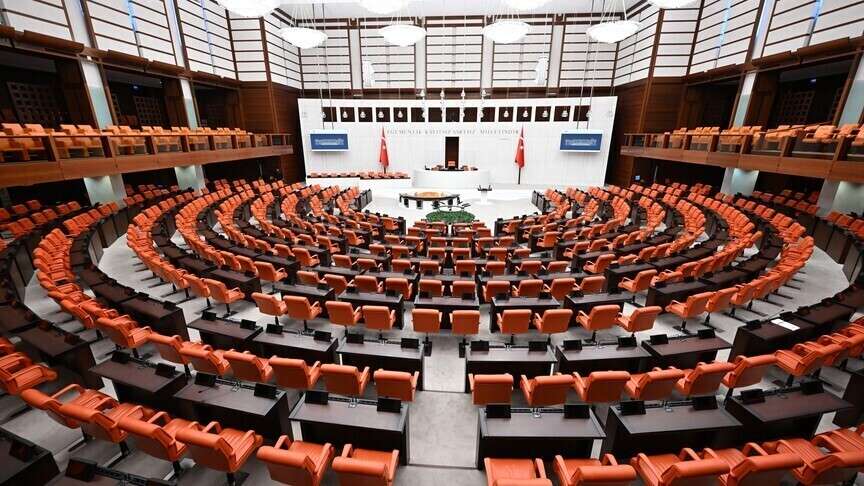
The Bill on the Amendment of the Specialist Private Law and Some Laws, including the regulations regarding the Turkish Armed Forces (TAF), signed by AK Party deputies, was submitted to the Presidency of the Turkish Grand National Assembly. With the proposal, changes are made to the Law on the Execution of the Style of Shuabati Arts in line with the annulment decision of the Constitutional Court. Accordingly, those who were educated in faculties of medicine and dentistry on behalf of the Ministry of National Defense or the Ministry of Internal Affairs and were appointed as officers, those who were dismissed based on the decision of the court or disciplinary board before completing their obligation period, and those who resigned in accordance with the legislation they are subject to, will not be able to practice dentistry or medicine for the period obtained as a result of multiplying the ratio of the period of education in the name and account of the Ministry of National Defense or the Ministry of Internal Affairs to the obligation period by the remaining obligation period.
All calculations regarding durations will be made on a daily basis. According to the amendment made to the Law on Allowance, no additional accommodation expenses will be paid in accordance with the regulation regarding “per diems to be given in the country” to those who are paid daily within the scope of the provision of “per diem in operation in military units”, except for the personnel who cannot be provided with accommodation on the ship in domestic ports on submarine ships.
With the regulation made in the Turkish Armed Forces Internal Service Law, army quarters, military casinos and barracks casinos, shift dormitories, veteran adaptation houses and private, local and winter training centers will also have the characteristics and nature of military places, since they are military buildings. While there is a clear provision in the Turkish Armed Forces Personnel Law that petty officers who leave the Armed Forces for whatever reason cannot be re-commissioned into the Turkish Armed Forces service on an active basis, changes are being made due to the lack of a provision regarding officers.
Accordingly, except for those who are doing their military service within the scope of the Recruitment Law, officers who leave the Armed Forces for whatever reason will not be able to be re-commissioned into the Armed Forces service on an active basis, except for the exceptions stated in the Law. The additional course fee has been extended until the end of the 2029-2030 education and training period. The additional course fee, which is paid in return for giving lessons in the education and training institutions within the Ministry of National Defense and its affiliates, in line with the needs determined by the administration and within the conditions specified in the relevant legislation in the subjects and fields determined by the administration, has been extended until the end of the 2029-2030 education and training period.
With the amendment made to the Administrative Procedure Law, regarding the personnel and their candidates working in the central, provincial and overseas organizations of the Ministry of National Defense and affiliated, related and affiliated organizations, as well as the military students studying at the National Defense University and their candidates, the personnel serving in the Gendarmerie, Coast Guard and Police departments and their candidates, and the students and their candidates in the Gendarmerie and Coast Guard Academy, Police Academy and affiliated education and training institutions, the Presidency of the National Intelligence Organization.
Administrative cases against its personnel, regarding those who are not appointed to public office, or those who have resigned or been dismissed from public office or profession, or whose contracts have been terminated, on the grounds of being in unity of action with terrorist organisations, aiding these organisations, using or having others use public facilities and resources to support these organisations, making propaganda for these organisations, and the Decree Law No.
375’s affiliation with or contact with structures, entities or groups that are determined to operate against terrorist organisations, or the national security of the state. to those who are considered to be The procedures to be established in accordance with the court decisions given in the cases filed against the administrative action in question as a result of the negative evaluation of the security investigation and archive research procedures carried out in accordance with the relevant legislation by the administration and which result in reinstatement, will be carried out after the final decisions are finalized.
The full registry score will need to be 60 percent or more. With the proposal, with the temporary article added to the Expropriation Law, immovable properties that have been actually allocated to public service in accordance with the purpose of the expropriation laws, without relying on expropriation transactions, will be deemed to have been expropriated on the date of allocation on behalf of the relevant public institutions and organizations.
The construction of a facility or structure on the real estate in accordance with the nature and purpose of the public service will be considered as de facto allocation for the implementation of this regulation. The record holders or heirs of those registered in the land registry, the possessors or heirs of immovable properties not registered in the land registry, can only request the market price of the real estate on the actual allocation date, within the period determined by the Law on Real Estate Actually Allocated to Public Services by Public Legal Entities or Institutions, which was annulled by the Constitutional Court, provided that the conditions for acquisition by possession have been met as of the allocation date and 10 years have not passed from the actual allocation date.
The provisions of this regulation will apply to the lawsuits regarding the immovable properties within the scope of this regulation, which were filed until January 12, 1963 and are pending, including those under legal review. Claims made about immovable properties deemed expropriated after January 12, 1963, including the price, will not be accepted. This provision will also apply to pending cases, including those filed after January 12, 1963 and those under legal review.
In cases filed and ongoing within the scope of this provision, court and enforcement fees and all kinds of attorney fees will be determined as a lump sum. If the immovable properties deemed expropriated are registered in the land registry, they will be registered in the name of the relevant administration in a lawsuit filed upon the request of the relevant public institutions and organizations. If immovable properties that do not have title deed registration are subject to registration due to the nature of the allocation, registration will be established in the name of the relevant administration.
These transactions will not be subject to fees. With the proposal, changes are made to the Specialist Private Law. Due to the shortening of the military service period on June 26, 2019, the requirement for sergeants, corporals and privates who have completed active duty to become specialist sergeants is to be “under the age of 27 as of the first day of January of the year in which the application is made”. With the regulation made on this issue, people who are exempt from military service, especially the relatives of martyrs, can apply to become specialist sergeants.
The positive regulation made for those exempt from military service is aimed to prevent loss of rights in applications to become specialist sergeants. The title “Registry” is added to the Specialist Law. With the regulation, the registry year for specialist sergeants will cover the period starting from May 2 of the relevant year until May 2 of the following year. A registration certificate will be issued for specialist sergeants as of May 2 following the signing of the contract and their appointment to duty.
However, if the period between the date of appointment and the following May 2 is less than 3 months, the first registration documents will be issued on the date when the three months are completed. The subsequent registry will be prepared in due time. The full score will be 100. The average of the grades given by the superiors will constitute the registry score of that year. In order for the record to be positive, the record score must be 60 percent or above of the full record score.
Issues regarding the registry superiors authorized to write registry for specialist sergeants, issues regarding the preparation of the departure record in case the registry superior or the personnel who receives the registry leaves his/her duty within the registry period, and the forms and procedures of the registry to be issued will be regulated in the regulation. According to the bill proposal, which also includes the regulations regarding the Turkish Armed Forces (TAF), those who have completed at least 7 years of service as contracted sergeants and privates and have a positive qualification certificate can be appointed to public institutions and organizations’ positions as enforcement and protection officers, market and neighborhood guards, forest conservation officers, administrative surveillance personnel, protection and security officers, police officers, firefighters, drivers and support personnel, within the quota and appointment permits.
The Proposal on Amending the Specialist Private Law and Some Laws, signed by AK Party deputies and submitted to the Presidency of the Turkish Grand National Assembly, regulates the procedures, principles and conditions regarding the promotion of expert sergeants to the rank of petty officers in the Specialist Private Law. Accordingly, a record score will not be required for the promotion of specialist sergeants to the rank of petty officer.
The number of specialist sergeants who have been registered as a specialist sergeant for at least 4 years as of the date of application for the examination for the petty officer position and whose average of the current registry grades must be 90 percent or more of the full registry score will be appointed to the rank of petty officer sergeant, in the amount required by the force commands, Gendarmerie General Command or Coast Guard Command.
On the date of application to the petty officer vocational school entrance exam, the average of the current record grades received since the date of being appointed as a specialist sergeant and the amount required by the force commands, Gendarmerie General Command or Coast Guard Command from the specialist sergeants who meet the requirement of 90 percent or more of the full record score will be appointed to the rank of petty officer sergeant following the education and training to be given in the petty officer vocational colleges.
Qualifications to be sought in the personnel, application form and time, acceptance of the application, reasons for making and terminating the contract, forms and procedures of the record to be given, actions to be taken in cases of failure in duty, failure to adapt and not being able to benefit from them, principles applied in the extension of the contract, necessary conditions for specialist corporals to become specialist sergeants, principles applied for those to be promoted to the petty officer class, subordinate-superior relations and the procedures regarding these matters.
The form and other related issues will be regulated by the regulation prepared jointly by the Ministries of National Defense and Internal Affairs. With the amendment made to the Law on the Regulation of Public Finance and Debt Management, it is aimed to authorize the Minister of National Defense or the Minister of Internal Affairs, depending on their interest, to manage the accounts opened in foreign currency at the Central Bank in order to ensure more effective, economic and efficient use of the funds allocated to the budgets of the ministries of National Defense and Internal Affairs in order to initiate, maintain and develop relations with friendly and allied countries within the scope of grants and aid activities for defense and security purposes to be made to foreign countries and organizations on behalf of Turkey and to direct the following periods.
Accordingly, the President or individuals and organizations determined by the decision of the President will be authorized to negotiate and sign agreements regarding grants and aid for defense and security purposes to foreign countries and organizations on behalf of the Republic of Turkey. Grants and aid provisions to be given to foreign countries for this purpose will be covered from the appropriations to be placed in the budgets of the ministries of National Defense and Internal Affairs.
These agreements will come into force upon the decision of the President. The cash grants and aid specified in the agreement can be recorded as an expense in the budget and transferred to a foreign currency account opened at the Central Bank. The relevant minister to whom appropriations are placed in the budget will be authorized to manage the opened accounts. Payments will be made from the relevant account within the framework of the provisions of the agreement and the principles to be determined by the Ministry of Treasury and Finance.
Public institutions and organizations will allocate 10 percent of the total quota and appointment permits. An amendment is being made to the “Public Employment” provision of the Contracted Private and Private Law. Accordingly, without prejudice to compulsory situations arising from mobilization, war or the fight against terrorism, those who have completed at least 7 years of service as contracted sergeants and privates, those who have a positive qualification certificate, and provided that they meet the conditions other than the exam conditions in the relevant legislation and are not over 41 years of age as of the date of application, public institutions and organizations will be employed as execution and protection officers, market and neighborhood guards, forest conservation officers, administrative surveillance personnel, protection and security officers, police officers, firefighters, drivers and support personnel.
can be appointed to contracted positions within the framework of the procedures and principles in this article, within the quota and appointment permissions. Applications of those who want to benefit from this provision will be received every year and their personal information regarding the recruitment conditions will be notified to the Ministry of Labor and Social Security by the Ministry of Internal Affairs or National Defense by the last day of October.
It will be essential to renew the application every year. Reporting the information of the relevant personnel will not constitute a right for appointment alone. Public institutions and organizations will be obliged to allocate 10 percent of the total quota and appointment permits to be recruited within the scope of this provision in the personnel recruitments to be made that year for the staff and contractual titles of execution and protection officers, market and neighborhood guards, forest conservation officers, administrative surveillance personnel, protection and security officers, police officers, firefighters, drivers and support personnel, and notify the Ministry of Labor and Social Security with the recruitment conditions until the end of December.
Provided that 10 percent of the quotas or appointment permits from the previous year reported to the Ministry are used in the new year, they will not be subject to the new year’s open and transferred appointment numbers. For those on the list sent by the Ministry of Internal Affairs or National Defense, placement will be made or will be made at once, in the quotas notified by public institutions or organizations, to determine the candidates who will be subjected to an oral examination by the Ministry of Labor and Social Security until March 1 of each year.
Among those who meet the conditions in the guide to be published, candidates 4 times the quota will be determined by lottery method, taking into account their preferences. Information about those who are appointed among those who are successful in the oral exam to be held within 3 months by the commissions formed by the relevant institution, will be notified by the relevant public institution and organization to the Ministry of Labor and Social Security, the institution where the public personnel information system is located, and the Ministry of Internal Affairs or National Defense, depending on its relevance, by the relevant public institution and organization within one month of their appointment.
In the oral exam to be held by the commission established by the relevant institution, candidates will be evaluated based on their “general culture and general ability”, “understanding and summarizing a subject, ability to express and reasoning power”, “merit, representation ability, suitability of their attitudes and behaviors for the task”, “self-confidence, persuasion ability and credibility”, “openness to scientific and technological developments”.
Each member of the examination board will evaluate the candidates out of 20 points for each of the characteristics written in the paragraphs, and the scores given will be recorded separately in the minutes. It will be calculated how many points each member gave to the candidate in total out of 100 full points. The oral exam score of the staff will be determined by taking the arithmetic average of the scores given by all members out of 100.
Contracted sergeants and privates who leave after completing 7 years of service will not be required to have a private security basic education consisting of theoretical, practical and weapons training, not less than 120 course hours in the Law on Private Security Services. For those who will perform unarmed duties, at least 8 years of primary or secondary school education will not be required, and for those who will serve with weapons, they will not be required to be at least a high school or equivalent school graduate.
The appointed personnel will benefit from the financial and other rights of the staff or position to which they are appointed, starting from the date of commencement of duty. Their service periods as contracted sergeants and privates will be evaluated in determining their earned rights, salaries, grades and levels, by counting as 1 step advancement for each year and 1 grade increase for every 3 years, provided that they do not exceed the degrees they can be promoted to according to their education status stipulated in the Civil Servants Law.
Within the scope of this provision, those appointed to civil servant positions cannot be appointed to another title for at least 4 years. Those who do not start their duties despite receiving appointment approval and those who leave their duties for any reason after starting cannot be re-employed within the scope of this article. Those who are appointed to these titles declared by public institutions and organizations, in any way, will be deemed to have used the right granted in this regulation.
Procedures and principles regarding applications, notifications, draws, appointments and other transactions will be regulated by a regulation to be jointly issued by the ministries of Labor and Social Security, Internal Affairs and National Defense. The Ministry of Labor and Social Security will be authorized to resolve any doubts that may arise within the scope of this provision, to request the necessary information and documents, to conduct research and examination, and to direct the implementation.
Procedures and principles regarding promotion to specialist sergeant. According to the change in the procedures, principles and conditions regarding the promotion of contracted sergeants and privates to the rank of specialist sergeant, success in the physical qualification and evaluation test and written and/or interview exams will be required. The regulation also determines the evaluation principles for physical qualification and evaluation tests, as well as written and interview exams.
Accordingly, if a written exam is held, the written exam will include general culture subjects and professional knowledge subjects. At least 50 points out of 100 will be required in the written exam. The written exam may be administered by the Ministry of Internal Affairs or National Defense, or by other public institutions and organizations or universities, depending on the interest. In order to be considered successful in the physical qualification and evaluation test, the candidate must get at least 50 points out of 100 from each of the tests to be applied and the arithmetic average of the scores obtained from these tests must be at least 60 points.
In case of an interview exam, the chairman and members of the interview team will be determined by the Ministry of Internal Affairs or National Defense, depending on their interest. More than one delegation may be formed depending on the number of candidates. During the interview, candidates will be evaluated out of 100 full points in terms of general appearance, ability to understand what is asked of them, self-confidence, CV, personality, psychological structure, ability to express themselves, ability to use body language, emotional balance, extroversion, adaptability, responsibility, openness, suitability for the profession and willingness.
The interview exam score of the candidate will be determined by taking the average of the grades evaluated independently by each member. The candidate participating in the interview exam will be required to score a minimum of 70 points. The proportions of the physical qualification and evaluation test and written and/or interview exams within the evaluation score based on success ranking will be determined by the Ministry of Internal Affairs or National Defense, depending on their relevance.
In case of equality of evaluation scores based on success ranking, priority will be given to the one with the higher physical qualification and evaluation test scores first, and if the equality continues, to the one with longer actual service time, and if this is also equal, priority will be given to the one taking into account the education level, rank status and reward or penalty points, respectively. Source: AA






Comments
You can write your views about this story. Comments may be moderated according to site settings.