
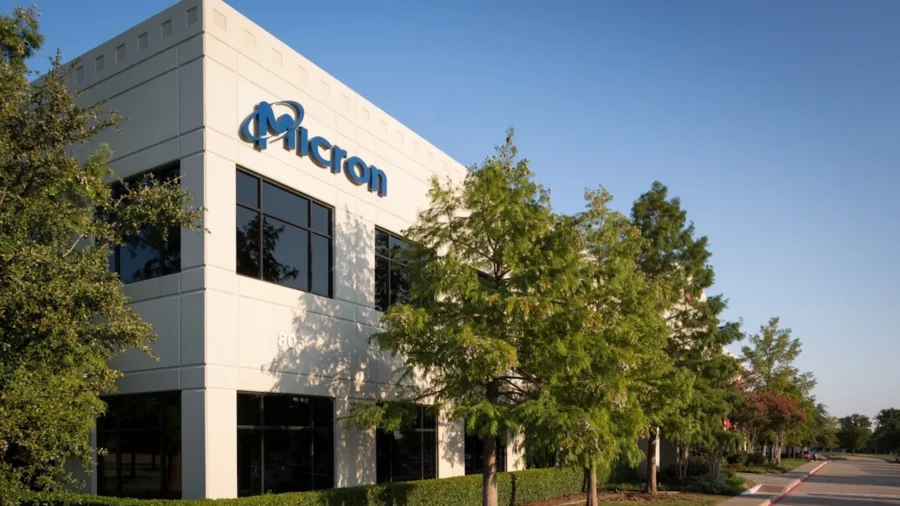
Micron began production of 1-alpha DRAM at its Manassas facility in Virginia. The new production line, commissioned as part of the company’s expansion plan in the USA, will produce DDR4 and LP4 memories locally for critical sectors with long life cycles. DDR4 wafer capacity at the Manassas facility will be quadrupled by the end of the year. 1-alpha DRAM production started in the USA Micron Technology started 1-alpha DRAM production at its manufacturing facility in Manassas, Virginia.
The company positions this production as the most advanced memory technology ever produced in the United States. Micron is also the only company that produces memory in the USA. The 1-alpha DRAM node is used to meet long-lifecycle memory needs for DDR4 and LP4 products. According to Micron’s statement, this technology will quadruple the DDR4 wafer supply at the Manassas facility as the most advanced DDR4 technology in the world.
The company expects qualified 1-alpha DRAM production at the Manassas facility to be online by the end of calendar year 2026. The Manassas expansion is being carried out as part of an investment and modernization program worth more than $2 billion. The project is supported by federal, state and local incentives. According to the information provided by Tom’s Hardware, the expansion is also connected to the $ 275 million support concluded within the scope of the CHIPS and Science Act.
The production line in Virginia will serve the automotive, defense and aerospace, industrial systems, network infrastructures and medical device sectors. Since the platforms used in these areas have longer product cycles, the supply of memories such as DDR4 and LP4 follows a different timeline than the consumer electronics market. The period in which Micron increased its DDR4 capacity coincides with a period in which the supply of older generation DRAM is squeezed in the memory market.
Major DRAM manufacturers are shifting production capacity to newer memory technologies such as DDR5, LPDDR5X and HBM. The demand from artificial intelligence data centers is driving wafer allocation in memory production to high bandwidth and new generation products. S in the news of Tom’s Hardware In the same assessment, there is information that the supply of old-generation automotive DRAM will shrink sharply towards 2028, and that automotive and industrial buyers’ DDR4 stock buffers have decreased from 31 weeks to 6 to 8 weeks.
The 1-alpha production process is a technology that Micron has previously put into volume production in its Taiwan facilities. This process offers approximately 40 percent higher bit density compared to the 1z node and is known as the first DRAM technology to achieve sub-15 nanometer cell size. The process uses DUV lithography instead of EUV, which Samsung uses in some of its advanced DRAM nodes. Micron’s newer 1-beta and 1-gamma nodes are dedicated to products like DDR5, LPDDR5, and HBM.
1-alpha production, which moved to Manassas, creates a separate production line in the USA for DDR4 and LP4 memories. This means long-life-cycle memory production does not compete directly for the same wafer startup capacity as the company’s latest AI-focused memory products. The Manassas facility is supported by more than 3,100 direct manufacturing and community jobs as part of the expansion. Micron hosted the event hosted by Sanjay Mehrotra, the company’s Chairman, President and CEO.
US Secretary of Commerce Howard Lutnick, US Trade Representative Jamieson Greer, US Senators Mark Warner and Tim Kaine, and Virginia House of Representatives Speaker Don Scott were also present at the event. The production move in Virginia is progressing as part of Micron’s approximately $200 billion investment plan across the US. The company broke ground on its memory manufacturing complex in New York in January. First wafer output from the first new factory in Idaho is expected in the middle of calendar year 2027.
Ground preparation work has begun for the second Idaho factory. Micron states that a total of 90 thousand direct and indirect jobs will be created with the Virginia, Idaho and New York projects. The company has allocated over 325 million dollars to support the US semiconductor workforce. These programs include the Micron Registered Apprenticeship Program, which is run in collaboration with Northern Virginia Community College and the National Institute for Innovation and Career Advancement.
Micron also supports more than 16 thousand K-12 students in the region through the 2026 Micron STEM Opportunity Fund with the Community Foundation for Northern Virginia. Micron’s US production plan does not include only DDR4 and LP4 production for Virginia. The company has also committed to adding HBM advanced packaging capability to its Virginia facility once sufficient DRAM wafer capacity is established in the United States.


Comments
You can write your views about this story. Comments may be moderated according to site settings.