
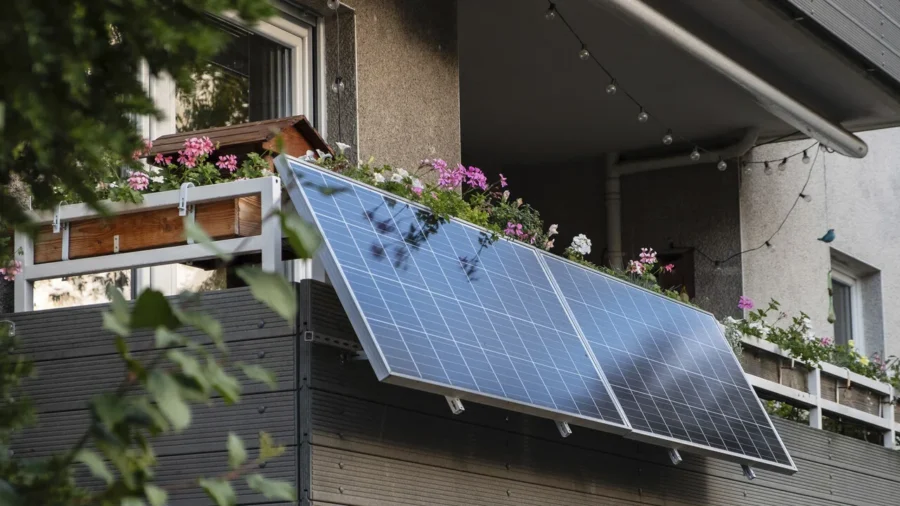
In Germany, solar panels installed on balconies, facades and small open areas quickly became a large market. Small solar energy systems that can be plugged into a socket now enable not only detached house owners, but also tenants and apartment residents to produce their own electricity. The noteworthy aspect for Turkey is bigger. In Turkey, which has a higher solar potential than Germany, similar systems can find a serious response, especially in houses with balconies in the Aegean and Mediterranean regions.
Balcony Solar Power Systems may be more meaningful in Turkey. Balcony type solar energy systems, known as Balkonkraftwerk in Germany, consist of several panels, micro inverters, connection cables and mounting apparatus. The system converts the direct current coming from the panels into alternating current via the micro inverter and transfers it to the house’s power line. In Germany, the process has been simplified for systems that do not exceed 2,000 W DC module power and 800 W AC inverter output.
Systems below this limit can only be commissioned with the Marktstammdatenregister registration. The network operator checks whether there are any old meters, and if a meter replacement is required, the process is managed separately. Despite this, the system can work temporarily. This convenience has rapidly expanded the market in Germany. According to the Renewable Energy Institute’s report based on MaStR data, the number of plug-in PV systems registered in Germany exceeded 1.2 million by 2025.
The total module capacity increased to approximately 1.2 GW DC, and the inverter output capacity increased to over 0.8 GW AC. The report states that this growth accelerated with the simplification of regulations, the decrease in equipment prices and the increase in electricity prices. The attraction of the system is that it does not require a large rooftop solar power investment. A standard 800 W class balcony SPP set generally consists of two crystal silicon panels, 800 W AC micro inverter, cable and mounting bracket.
Current market data in Germany shows that these sets are sold in the range of approximately 300-600 euros, and annual production varies between 600-900 kWh depending on direction, shade and installation conditions. The self-consumption rate in households without batteries often remains in the 30-70 percent range. The picture is stronger for Turkey. According to the GEPA data of the Ministry of Energy and Natural Resources, the annual average total sunshine duration in Turkey is 2,741 hours and the annual average total radiation value is 1,527.46 kWh/m².
The horizontal global radiation average given by Fraunhofer ISE in Germany for the period 2001-2020 is 1,102 kWh/m²/year. This comparison shows that Turkey is significantly more advantageous than Germany in terms of annual solar resources. This difference is also important in balcony and façade type installations. Because balcony systems cannot always be placed at the ideal angle. The panel is sometimes hung vertically on the balcony railing, sometimes it is fixed under the window or on the facade.
In such installations, losses occur depending on the roof systems. However, Turkey’s high sunshine duration can compensate for some of this loss. The annual production of an 800 W class system, especially on south-facing, unshaded balconies on the Aegean and Mediterranean lines, can approach the upper band of the average in Germany. On the residential consumption side, balcony SPP also finds a direct response. The average monthly electricity consumption in residences in Turkey is approximately 200 kWh.
This means an annual consumption of approximately 2,400 kWh. A small balcony system producing 700-1,000 kWh annually can cover a significant portion of the electricity consumption of an average household. The real critical point here is how much of the electricity produced is consumed instantly. If devices such as refrigerators, modems, computers, televisions, air conditioners, chargers, washing machines and dishwashers operate during daylight hours, the effect of the system on the bill increases.
In this respect, the use of air conditioning is important in Turkey, especially in the summer months. The hours when solar production is highest coincide with the hours when air conditioning consumption increases. This makes balcony solar systems more meaningful for summer areas, coastal cities, south-facing flats and houses with high daytime consumption. On the other hand, the entire production of the system is not automatically deducted from the bill.
In an installation without a battery, electricity that is not consumed at the time of production is either wasted or flows into the grid, depending on the legislation and meter structure. In the German model, the economic logic of small systems is based on instantaneous self-consumption rather than selling excess electricity. The German Environment Agency also states that the economic value in these systems comes mainly from using the electricity you produce at home.
The real deficiency in Turkey is not the technical potential, but the regulatory framework. The current unlicensed electricity production model allows real and legal persons to produce electricity without obtaining a license or establishing a company. However, this model includes topics such as the relationship between the production facility and the consumption facility, distribution region, application process and surplus electricity.
The application proceeds through the distribution company in the relevant region or the OIZ that holds the distribution license. In other words, unlicensed solar production is possible in Turkey, but the “buy, install, save, use” system at the consumer product level, as in Germany, has not yet been clarified. This difference directly affects the growth of the market. It wasn’t just solar panel technology that made balcony solar power grow in Germany.
The real breakthrough occurred when the system became accessible to the ordinary user. The participation of tenants and apartment residents in small-scale production without making large roof investments has brought this market to multi-million installations in a short time. According to the data provided by Canary Media, regulations that will pave the way for plug-in solar systems have been brought to the agenda in approximately half of the states in the USA; The relevant law in Maine was signed on April 6, 2026.
If a similar simplification is made in Turkey, balcony solar power plants may turn into a new consumer electronics category. The prevalence of apartments with balconies, especially in the Aegean and Mediterranean regions, the increase in air conditioning consumption in the summer months, the high sunshine duration and the possibility of use under facades/windows make this system a strong option for Türkiye. Even if there is no balcony, large window sills, terraces, garden railings and suitable facade surfaces can be used for small-scale solar production.
However, the security side cannot be overlooked. Since these systems provide energy to the power line of the house, the micro inverter used must comply with the standards, the connection must be made securely, the balcony installation must withstand wind load and the apartment common area rules must be clear. This is why the 800 W AC limit in Germany is important. Installation of small systems by the consumer is only possible with products that do not strain the power line and have clear safety standards.
The most realistic scenario for Turkey is that balcony SPP is not a rival to rooftop SPP, but complements it. It opens a low-cost gateway for tenants, apartment residents, summer house owners and small office users who cannot make a large roof investment. These systems alone do not cover the entire consumption of a house. However, with the right façade, correct consumption habits and simple legislation, it can reduce a significant part of the electricity bill.
The German example showed that balcony type solar systems can become massive even in a country with limited solar potential. In Turkey, the sun is more abundant, the potential for balconies and facades is wider, and summer consumption is more harmonious. So the real question isn’t whether the panels will work. The real question is whether Turkey will open these systems to ordinary users safely, easily and legally.




Comments
You can write your views about this story. Comments may be moderated according to site settings.