
Hudson Institute Senior Defense Analyst Dr. Can Kasapoğlu wrote the new war vision put forward by SAHA 2026 and EFES 2026 for AA Analysis. *** In the 1999 film The Matrix, which has a privileged place among artificial intelligence-themed films, Morpheus, one of the leaders of the movement trying to save humanity from the digital simulation established by machines, tells Neo, the hero who is believed to change the system and who is quite confused at the beginning, “There is a difference between knowing the path and walking that path.” Turkey’s successful level in the field of unmanned systems compared to many NATO allies perhaps reveals the strategic equivalent of this line.
The US and Turkish defense industries are the two leading actors of the alliance in robotic warfare. What distinguishes NATO from other European allies is the depth of their operational experience and their profile intertwined with the sector. Today, political leaders and senior generals of almost every European NATO member country are talking about the age of robotic warfare, autonomous systems and lessons learned from Ukraine.
While Europe is discussing swarms of drones and artificial intelligence-supported warfare, Türkiye is studying this with field-tested systems. In SAHA 2026, the panels are right next to combat platforms such as Bayraktar TB-2; It was done in the shadow of thousands of hours of real war experience. Kamikaze drones and new operational plans The Turkish defense industry did not only produce new platforms in the field of unmanned aerial systems in the first quarter of the 2000s; It also played a role in shaping a new military approach that affected the operational balance of the modern warfare environment.
Turkish UCAVs performed critical tasks in Syria, Libya and Karabakh. The performance of robotic warfare systems; It showed that continuous reconnaissance-surveillance capacity, precision attack capability and low costs compared to manned systems have become essential in the modern battlefield. We are witnessing the emergence of a new robotic warfare paradigm in the second quarter of the 2000s. The Russia-Ukraine War and recent conflict trends in the Middle East reveal that the use of unmanned systems has entered an interesting operational phase.
It is no longer just a matter of having high-cost and high-capability platforms; The aim is to carry out a saturation attack with low-cost, high-quantity, consumable systems. More clearly, the aim is to erode the prevention capacity of air defense through quantitative pressure. The ideal weapon systems of the operational draft in question are kamikaze drones – or wandering ammunition as they are also known. For example, the April 2026 balance sheet of the Armed Forces of the Russian Federation reveals that over 6,500 Iranian-designed Shahid-Geran kamikaze drones were used against Ukraine.
Similarly, Ukrainian kamikaze drones, especially FP-1, continue to target the Russian energy infrastructure at a depth of hundreds of kilometers. It is a common saying in military sciences: armies prepare for the final war. While doing this, in many cases they may not be able to foresee that the requirements of the next war will be very different. Frankly, the question on the minds of those who follow the Turkish defense industry closely was: Could the Turkish defense industry, which gained a critical advantage with the integration of systems such as Bayraktar TB-2 and drones into the conventional warfare environment, capture the spirit of the period in the age of kamikaze drones?
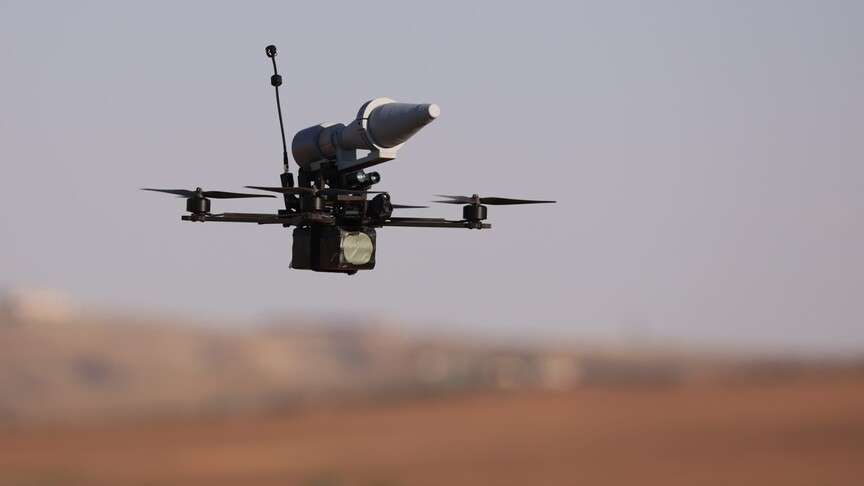
The latest data is quite positive in this regard. From SAHA 2026 to EFES 2026 Signs of transformation in the Turkish robotic warfare ecosystem were first seen at SAHA 2026. It was a remarkable development that Baykar exhibited its Mosquito, Spear and K2 kamikaze systems together at the same event. Because what is at stake here is not just new products, but a new operational architecture. Baykar, the dominant actor in the Turkish UAV sector, entered this field with three different systems at the same time; It has shown that the company considers the field of kamikaze drone and swarm attack as a strategic target.
The new approach in question differs significantly from the design philosophy seen in Baykar’s platforms such as Bayraktar TB-2 and AKINCI. Classic UCAVs; It was built on long-term stay in the air, reconnaissance-surveillance missions, maximum payload carrying capacity and platform survivability. Low cost, high production capacity, high loss tolerance, swarm coordination and air defense systems saturation come to the fore in the design philosophies of new systems.
Moreover, this expansion of the inventory has created a rich range in which different weapon systems can be used in different threat environments. When the systems developed by Baykar are examined, an architecture with different ranges, warheads and mission profiles attracts attention. While the Mosquito is optimized for lower cost and high volume swarm attacks, the Spear stands out as an intermediate layer solution offering longer range and heavier hitting capacity.
K2, on the other hand, attracts attention as part of the heavy kamikaze attack concept aimed at deeper targets. The resulting structure; It points to a multi-layered attack profile, with large numbers of Mosquito swarms advancing at the front, followed by Spear waves, and K2 systems operating deeper. New robotic warfare concepts are being tested. In the EFES 2026 Exercise, it was seen that the swarm drone capabilities of not only the Turkish defense industry but also the Turkish Armed Forces (TAF) have begun to mature.
In one part of the exercise, 20 CARGUs produced by STM took off simultaneously, under the control of a single operator, and autonomously deployed and attacked the target area, with national algorithms and distributed swarm architecture. Of course, it is clear that the data sharing and command-control capability behind such an attack is high-level. Likewise, it has been observed that Baykar systems are used effectively.
The Russia-Ukraine War revealed that night attacks, especially those carried out with dense kamikaze drone packages, produced not only damage but also psychological and operational pressure. Another trend seen in Ukraine is the increasing centralization of autonomy, herd coordination and low-cost consumable systems. This picture radically changes the cost-equation in the modern warfare environment. Kamikaze systems with relatively low unit costs can exceed hundreds of thousands of dollars of air defense ammunition by forcing consumption.
Future targets and horizons When SAHA 2026 and EFES 2026 are read together, the picture that emerges is clear: The Turkish defense industry does not only produce new drones; It is also rapidly preparing for the paradigm of the new era. The advantage in the battlefield of the future will be not only on the side with the most advanced platform, but also on the side that can produce the largest number of smart, coordinated and low-cost systems.
In this context, platforms such as AKINCI and KIZILELMA are likely to serve not only as direct attack systems but also as air command-control platforms that manage swarm drone operations in the future. Of course, especially considering the recent increasing interest of NATO member countries in UAVs, it would not be surprising to see Turkish kamikaze drones in the inventories of NATO allies following the alliance’s Ankara Summit.
The article started with a quote from the movie Matrix, so be it. The line uttered by Agent Smith, one of the cult characters of the movie, summarizes the age of robotic warfare: “Never send a human to do the job of a machine.” Source: AA






Comments
You can write your views about this story. Comments may be moderated according to site settings.