
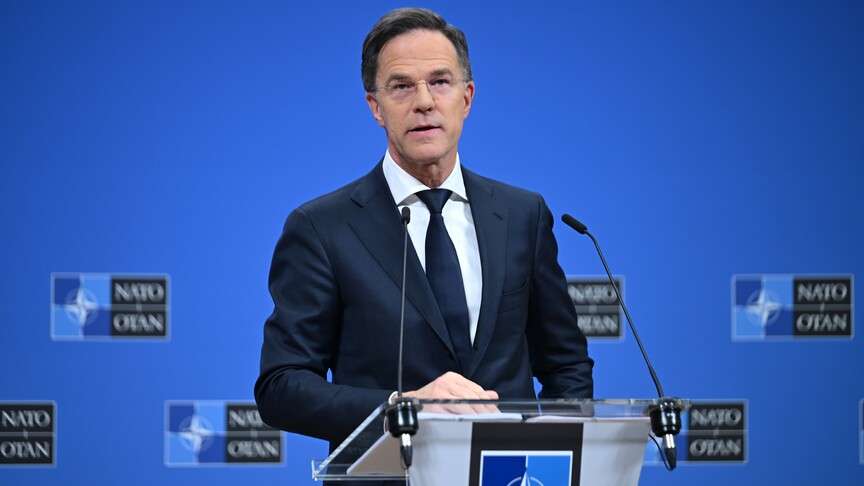
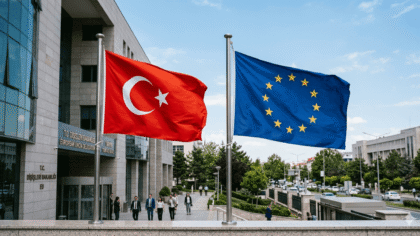
NATO Secretary General Mark Rutte said that the transformation of defense investments into concrete capabilities will be discussed at the Ankara Summit to be held on July 7-8. At the joint press conference he held with Prime Minister Milojko Spajic in Podgorica, the capital of Montenegro, Rutte reminded that approximately 9 years have passed since the flag of this country was raised at NATO headquarters and stated that the country has become a “valuable member” of the transatlantic alliance in this process.
Stating that Montenegro maintains its security with the support of 31 allies today, Rutte stated that warplanes belonging to Greece and Italy contribute to the protection of Montenegrin airspace, and that, in return, Montenegro contributes to collective defense by sending soldiers to NATO’s forward land elements in Latvia and Bulgaria. Rutte noted that Montenegro also contributed to NATO’s Peace Force in Kosovo (KFOR) and played an important role in strengthening peace and stability in the western Balkans.
Emphasizing that the region offers great opportunities and is of strategic importance for NATO, Rutte said that security is never guaranteed and that it must be protected with joint efforts every day. Stating that NATO supports constructive cooperation in the region, Rutte stated that there are actors trying to take the western Balkans back, and that these actors want to disrupt progress and destabilize the region. Rutte stated that NATO will not allow past problems to come to the agenda again and will respond to any malicious activity carried out on alliance territory.
Emphasizing that the world is becoming increasingly dangerous, Rutte noted that Russia continues its attacks against Ukraine, China is taking a more assertive stance, and instability continues in NATO’s southern neighborhood. Explaining that allies should invest more in defense, increase defense production and strengthen support to Ukraine, Rutte stated that he welcomed Montenegro’s allocation of more than 2 percent of its gross domestic product to defense and that he expected this momentum to be maintained.
Thanking Montenegro for its military equipment support to Ukraine and its contributions to NATO’s comprehensive aid package and trust funds, Rutte said, regarding the NATO Summit to be held in Ankara in July, “There are only a few weeks left until the NATO Summit in Ankara. There, we will show that we provide security for 1 billion people on both sides of the Atlantic and that we fulfill our promises today.” he said.
When Rutte was reminded of his statements that some NATO members, including Montenegro, were considering allowing the use of their bases for possible interventions in the Middle East, and when asked what this meant concretely, he said that he used this expression more figuratively. Stating that he did not want to go into details, Rutte stated that Montenegro is one of the most determined allies in NATO, avoiding giving clear information about what exactly this means for Montenegro or other countries.
Rutte argued that Montenegro is seen as a strong and reliable partner by the United States, not only within NATO but also in the context of bilateral relations. Answering a question about the future of NATO, Rutte stated that he was “extremely optimistic” about the future of the alliance and stated that US President Donald Trump played an important role in this. Reminding that at the beginning of last year, major economies such as Canada, Spain, Belgium and Italy had not yet achieved the target of allocating 2 percent of their gross domestic product to defense, Rutte said that today the entire alliance has achieved this target.
Rutte noted that Trump’s re-election had a significant impact on this process. Emphasizing that increasing defense expenditures is critical not only to ensure balance in burden sharing with the United States, but also to strengthen deterrence against potential threats, especially Russia, Rutte stated that it is necessary to be prepared against threats that may come from different actors in the future. Referring to the agenda of the Ankara Summit, Rutte said that continuing support to Ukraine and turning the defense spending decisions into concrete military capabilities will be among the main agenda items at the meeting.
Rutte stated that the development of the defense industry infrastructure will be one of the priority topics of the summit, and noted that the production capacity in both the USA and Europe is insufficient to meet the current needs, and that this is a common problem that both sides of the Atlantic must solve together. Rutte added that the summit will also discuss in detail the development of critical military capabilities needed by NATO and the acceleration of defense industry production.
“I believe that we will be a much more productive member of NATO.” Montenegrin Prime Minister Milojko Spajic said that the capacity of the army has been significantly strengthened in recent years. Spajic stated that all ethnic and religious groups in his country support the army and said, “The most difficult enemy is the enemy within. When we are united, when we act together, when the whole people and the whole state are behind us, we are at our strongest and then we can provide the most contribution to others.” he said.
Stating that they have made serious investments in the army, Spajic stated that the investment process is continuing. Stating that they will make an important intergovernmental agreement with the USA in June, Spajic said: “We will be able to work on dual-use critical infrastructure projects that have both civilian and military use. We will also have investments with Canadians, Germans and some other countries, and these cooperations will continue.
I believe that we will be a much more productive and better member of NATO. We can make significant contributions to reducing tension in the Western Balkans, connecting people and understanding each other better.” Source: AA


Comments
You can write your views about this story. Comments may be moderated according to site settings.