
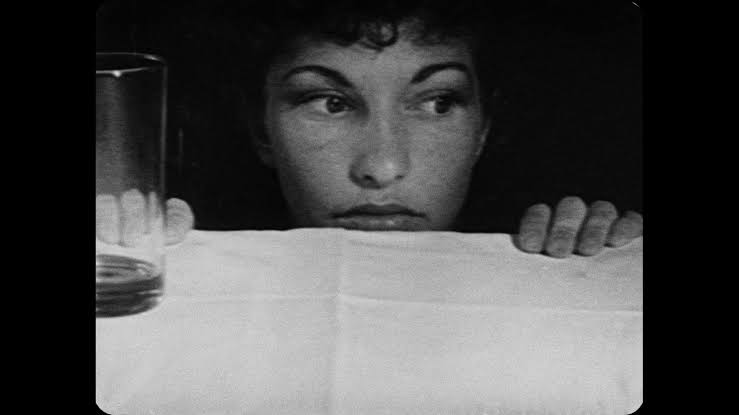
In Maya Deren’s cinema, At Land is a breaking point that consciously disperses the narrative and draws the audience directly into the experience. Here he opens the inner cycle he established in Meshes of the Afternoon to the outside world. The tightness of the interior gives way to a limitless but uncontrolled space. Story The movie begins with a woman washing up on the shore. But this is not a classic start. As soon as the character steps onto the beach, he enters a flow where the logic of space dissolves.
As he climbs off the rock, he suddenly appears in the middle of the dinner table. These transitions are neither purely a dream nor real. In between, there is a third realm: the physical state of the stream of consciousness. Meshes Connection In Meshes of the Afternoon, the character was stuck in a loop inside the house. In At Land, he is outside but still not free. As the area expands, control decreases. This says one thing clearly: physical freedom, not mental freedom.
Sometimes even the opposite. Directing: Deren didn’t just set a scene here, he directed perception. Camera positions are designed to disrupt the classical subject-object relationship. It redefines continuity rather than interrupting it. There are sharp breaks between spaces, but continuity of movement is preserved; This creates a feeling of flow for the viewer rather than a feeling of interruption. Player management is based on minimal intervention: the impression of existence, not performance.
Additionally, editing works like an extension of the shooting phase; In other words, the idea that begins on the film set is completed in editing. This approach makes the film a planned yet intuitive structure. Fiction Classical continuity is completely absent. Scenes connected through movement make disconnected spaces invisible. The object he reaches for continues in another space. This approach is based on intuition, not logic.
The movie wants to be felt rather than understood. Chess SceneThis scene is one of the clearest metaphors of the movie. People are positioned as if they are part of a game. The woman tries to join the game, but either does not understand the rules or rejects them. As a result, they are pushed out of the system. Individual alienation gains a social dimension here. Space and Water Sea and shore repeat constantly. Water uncertainty and transformation.
Land is a temporary stability. But no darkness is permanent. The ground begins to dissolve each time the character reaches it. This directly collapses the idea of fixed identity. Performance No dialogue. No exaggeration. Body language is everything. The character’s relationship with the place turns the film almost into a dance performance. The camera is not passive either; Like part of the movement. Technical Despite the low budget, there is a very controlled aesthetic.
Framing, lighting and transitions are deliberate. But it doesn’t look artificial. A sense of organic flow is maintained. Conclusion At Land shows how meaning is dispersed rather than producing it. He does not give ready answers to the audience. It draws him into the process. When viewed together with Meshes of the Afternoon, Deren’s cinema is not a closed loop; an expanding field of consciousness. This film is the face of that field opening to the outside world.




Comments
You can write your views about this story. Comments may be moderated according to site settings.