
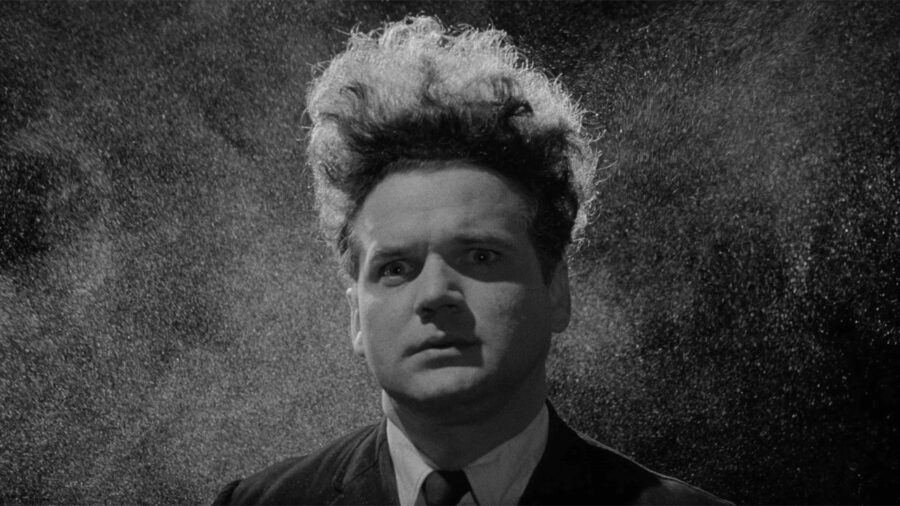
What a strange movie… It’s literally a psychedelic nightmare. David Lynch’s first feature, Eraserhead, shook the cinema to its core when it was released in 1977, and even though almost 50 years have passed, it still has the same impact. Black-and-white, low-budget, industrial madness. While watching, I thought “what the hell is this, am I dreaming or is the movie driving me crazy?” One of those movies you ask. This movie doesn’t tell a story, it goes directly into the mood.
And that mood is a complete psychedelic trip. The story is simple but poisonous: Henry Spencer (Jack Nance), a skinny man with hair always standing on end. He lives in an industrial dystopia. Factories, pipes, constant humming… Rust everywhere, dirt everywhere, strangers everywhere. He marries (or is given in marriage) Mary X and the “child” is born… This is the heart of the movie. He’s not a baby, he’s a living nightmare: Just the head, a bandaged body, a constantly crying, hissing freak.
Henry’s fear of fatherhood, sexual guilt and existential anxiety come true through this mutant baby. Lynch disregards classic horror clichés. The monster is not outside, it is inside your home and it is your responsibility. Characters and mental collapse Henry is the typical Lynch hero: passive, confused, withdrawn. Mary is anxious, angry, trapped in the role of motherhood. The most iconic figure is the “Lady in the Radiator”, a strange singing woman coming out of the radiator.
Is it a part of Henry’s subconscious, salvation or a new nightmare? There are no clear answers throughout the movie. That’s exactly what Lynch wants: to leave the audience in limbo. Symbolism and themes: It’s the layer upon layer of symbolism that makes the industrial psychedelic Eraserhead so powerful. Fear of fatherhood and the body: That baby is the embodiment of the “fear of starting a family” common among young men of the 70s.
It is said that Lynch was inspired by the anxiety she experienced after her own daughter was born. The body is the enemy here; sexuality is a source of both desire and disgust. Industrial alienation: Factory sounds, steam, dark corridors… It has turned post-industrial America into a dystopia. Everything is mechanical, everything is dirty, everything is foreign. Dream logic: The movie does not follow a logical flow. It jumps from one scene to another, reality and dream are intertwined.
It’s like Jung’s collective unconscious: The fears that everyone suppresses come true here. There is a Gnostic atmosphere; The body is a prison, the mind is a strange heaven/hell inside the radiator. The sound design is another madness. That constant humming, baby screams, wind… Watch it with your headphones, it literally enters your brain. Black and white images were used skillfully despite the low budget; The contrasts are so harsh that every frame is like a painting.
Technique and Lynch’s vision Lynch shot everything here himself, even the stop-motion baby is his work. The construction took 5 years. It’s a far cry from Hollywood’s big-budget color shows; A complete indie nightmare. The seeds of the “mood cinema” we saw in The Lighthouse or Serial Experiments Lain were planted here. Story is secondary, atmosphere and symbolism are everything. Conclusion: Eraserhead, after watching it, you wonder “was it good?” It’s one of those movies where you can’t ask: “What did I watch?” you say.
Weird, disturbing, psychedelic… But that’s exactly why it’s unforgettable. It is the cornerstone of Lynch’s career and remains in its purest form. If you like dystopia, body horror, mind bending, don’t miss it. But don’t watch it before you sleep, otherwise that baby will come into your dreams.





Comments
You can write your views about this story. Comments may be moderated according to site settings.