
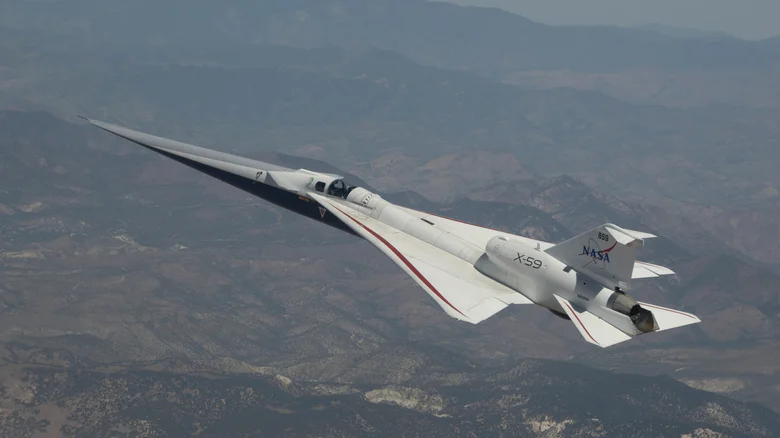
NASA’s X-59 silent supersonic research aircraft will exceed the speed of sound for the first time in early June. The aircraft, developed within the scope of the Quesst mission, will exceed 630 mph at an altitude of approximately 43 thousand feet in the first supersonic test. On the SpaceX side, the FAA investigation process started after the Starship Flight 12 test. The aircraft, developed within the scope of the institution’s silent supersonic flight program, will undergo higher altitude and higher speed trials at this stage.
The first supersonic flight of the X-59 is on the calendar for early June. In the first supersonic flight, the X-59 will accelerate to over 630 mph at an altitude of approximately 43 thousand feet. After this flight, NASA will test mission conditions called “mission conditions”. In this test, the aircraft will reach Mach 1.4, that is, a speed of approximately 925 mph and an altitude of 55 thousand feet. In the next phase of the test program, the maximum speed of the X-59 will also be tested.
According to NASA’s statement, the aircraft will accelerate to Mach 1.6, that is, approximately 1,218 mph, and reach an altitude of 60 thousand feet. All these flights of the X-59 are being carried out to verify the performance and airworthiness of the aircraft as part of the first phase of the Quesst mission. However, NASA will not demonstrate the aircraft’s quiet supersonic capability in these early tests. The X-59 will be accompanied by a conventional supersonic pursuit aircraft.
For this reason, the low-level “thump” sound produced by the This equipment will take the first measurements of the shock wave signature created by the X-59. These data will be used in the second phase of the Quesst mission. X-59 made its first flight in October 2025. After this flight, the aircraft entered the planned maintenance process and took off again in March 2026 and subsequently completed 14 additional flights.
In the tests, stages such as retracting the landing gear, ascending to an altitude of 43 thousand feet, reaching Mach 0.95 and making two flights on the same day were completed. The data obtained from the flights were evaluated for fuel, hydraulics, environmental control systems and eXternal Vision System. In the X-59, an external vision system consisting of cameras and monitors is used instead of the traditional windshield.
Strain gauges placed on the fuselage of the aircraft also recorded the structural loads and the body’s response to these loads during the flight. On the SpaceX side, the FAA investigation began after the Starship Flight 12 test flight. After Starship and Super Heavy separated during the flight on May 22, Super Heavy started its return maneuver. According to SpaceX’s statement, the booster failed to ignite all planned engines during the boostback burn and the partial burn ended prematurely.
Super Heavy landed in rough water in the Gulf of America after trying to re-ignite its engines for landing burn. Starship completed its flight and landed in the planned location in the Indian Ocean. The FAA announced that no injuries or damage to public property were reported in the incident. The FAA requested SpaceX to conduct an accident investigation for Starship Flight 12. The investigation will be conducted by SpaceX, but the FAA will oversee the process and approve the final report along with corrective steps.
The re-flight of the Starship-Super Heavy vehicle will depend on the FAA determining that the systems, processes or procedures related to the incident do not affect public safety. Blue Origin was also on the space agenda of the week. The FAA closed the investigation into the incident on the New Glenn 3 mission and granted permission for New Glenn to return to flight. In the final report of the investigation, the direct cause of the incident was recorded as the cryogenic leak freezing the hydraulic line and creating a thrust anomaly during second stage engine combustion.
Blue Origin determined nine corrective steps to prevent the same incident from recurring. Following this decision, New Glenn exploded during the hotfire test at Launch Complex 36 in Cape Canaveral. Blue Origin announced that an anomaly occurred during the test and reported that all personnel were safe. The cause of the incident has not been disclosed yet. The company will share more information when the review is completed.
The incident in New Glenn is also being followed in terms of NASA’s Moon program. NASA announced three mission plans before the end of 2026 as part of the Moon Base initiative. The Moon Base I mission will be launched with the Blue Origin Blue Moon Mark 1 Endurance lander in the fall of 2026 at the earliest. In this mission, payloads such as stereo cameras and Laser Retroreflective Array for Lunar Plume-Surface Studies will be carried to the Moon’s surface.
The Moon Base II mission will take Astrobotic’s Griffin lander and Astrolab’s FLIP rover to the Moon. The Moon Base III mission will carry the Lunar Vertex probe with Intuitive Machines’ Nova-C Trinity lander. In this mission, bright surface regions called “lunar swirls” on the Moon will be examined, and payloads belonging to the European Space Agency and the Korean Institute of Astronomy and Space Sciences will also be included.
NASA placed a mission order worth 219 million dollars to Astrolab and 220 million dollars to Lunar Outpost for crewed land vehicles to be used on the Moon surface. Blue Origin received a $188 million contract for rover missions to the Moon. The contract also includes an option period of $280.4 million. The James Webb Space Telescope was also among the notable science headlines of the week. Webb, in partnership with NASA, ESA and CSA, studied the motion and composition of gas orbiting the black hole at the center of Abell2744-QSO1.
According to the ESA/Webb announcement, this small galaxy is located more than 13 billion light years away. Researchers reported that the black hole is approximately 50 million solar masses and may have formed before the host galaxy. The findings indicate that this black hole may have formed within the first seconds after the Big Bang, without going through the stellar collapse phase. QSO1 was examined as an example of a “Little Red Dot” that existed only about 700 million years after the Big Bang.
Measurements made with Webb’s NIRSpec instrument determined that the hydrogen gas around the black hole exhibited Keplerian motion. Velocity measurements of the gas allowed a direct calculation of the black hole’s mass. According to the ESA/Webb statement, this measurement was recorded as the first direct measurement of the mass of a black hole in the first billion years after the Big Bang.






Comments
You can write your views about this story. Comments may be moderated according to site settings.