
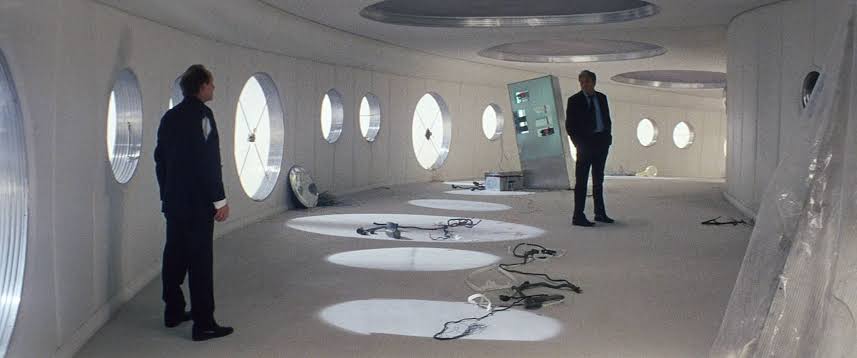
Before us is the magnificent Solaris, directed by Andrei Tarkovsky, one of the greatest geniuses in the history of cinema, and adapted from Stanislaw Lem’s novel. If you are ready, we are in the depths of space, in the middle of a complete existential crisis. You know that I have a particular interest in the science fiction and character psychology genre; Solaris, made in 1972, is one of the rare works that I call a masterpiece in this sense.
Tarkovsky’s Direction and Visual Craftsmanship When it comes to the technical side of the film, especially its direction and visual construction, Andrei Tarkovsky’s vision is literally flawless. Tarkovsky’s cinema is not just a tool for storytelling, it is the art of bending time. The workmanship they created together with cinematographer Vadim Yusov has a completely poetic structure, far from classical science fiction aesthetics.
Shooting Angles: Camera positions are designed to leave the audience alone with the character’s mind in the narrow corridors of the claustrophobic space station. Shooting angles present objects, belongings and faces like paintings. Most of the time, the camera floats slowly like an observer and conveys the character’s current mood to us through the geometry of the frame. Nature and Space Contrast: Tarkovsky portrays water, leaves and nature so well in those long Earth scenes at the beginning of the movie that when we move to the space station, you feel that sterile coldness and alienation in your bones.
The reflections of that vast, conscious ocean of the planet Solaris and the aesthetics of these landscapes are truly fascinating. Sculpting Time Long Shots Aren’t for Everyone. I have to make a warning. If you are not familiar with Tarkovsky’s cinema, we are talking about a long experience, so be careful from the beginning. This style, which the director calls “sealing time” or “sculpting time”, is absolutely opposite to the rapid consumption of modern cinema.
Pace and Patience: The camera sometimes hangs for minutes on floating grass in a puddle, on a swaying leaf, or on the famous highway scene. These long shots are not for everyone. It may tire or even bore a viewer who is addicted to action and expects constant cutting and fast editing. Director’s Purpose: Tarkovsky does not use these long shots to torture the audience. Those long sequences are actually meditation periods for the audience to enter the atmosphere of the film, go into a trance and delve into the inner world of the character.
If you keep up with that rhythm and are patient, you realize the philosophical depth underneath that weight. Why is it a masterpiece of science fiction? From the outside, the story seems like a mystery set in space, but it unfolds layer by layer. While you are trying to communicate with an inhuman intelligence, a cosmic ocean, you are actually confronting your own past, traumas and pure “being human”. Tarkovsky sees science fiction not as a technological show or an exhibition of spaceship designs; He uses it as a journey into one’s own consciousness.
In short; If you are looking for psychological depth, a philosophical subtext and high-level directing in cinema, and if you say “I want to watch mind maps, not laser wars in space”, Solaris, made in 1972, is for you. My advice; Turn off everything distracting around you, silence your phone, and dive into Tarkovsky’s ocean with a calm mind.




Comments
You can write your views about this story. Comments may be moderated according to site settings.