
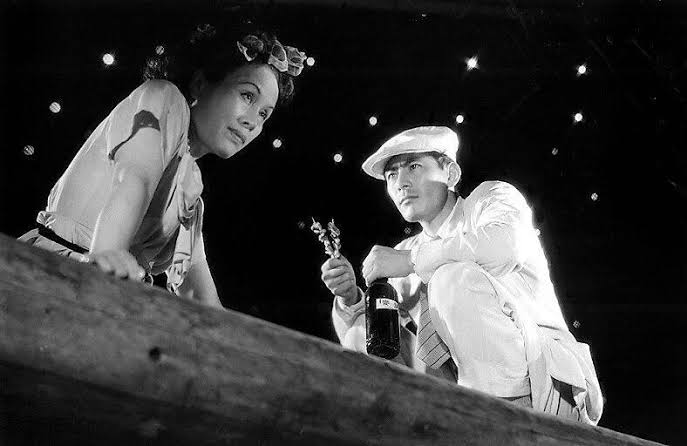
I’m hopefully taking the next step in the Kurosawa marathon, but unfortunately I’ve hit the wall with another “classic” that cinema historians rave about. For me, Nora Inu (Mad Dog), made in 1949, was nothing more than an unclear, empty and extremely bad movie experience, just like Drunken Angel. They say it is one of the first examples of the detective genre, but I think the story progresses so clumsily and aimlessly that I could not find even a single crumb that would draw people into the movie.
They say it is the first detective work, there is also the movie Kolpa du Rififi, there are Sherlock Holmes novels and Agatha Christie novels, strange, were they funded in 1949? A Boring World Dragged After a Gun To be frank, the main idea of the movie seemed completely meaningless to me. We are watching a story that begins with a young police officer (Toshiro Mifune again) having his gun stolen on the bus, and wandering around the hot, miserable streets of Tokyo to find that gun.
The man runs from market place to market place for hours, talking to criminals, but there is neither a proper tension nor a detective intelligence that makes one wonder. In Turkish movies, there is a chase scene, throwing watermelons, melons and apples, just like that. Mifune’s character (Murakami) looks like a raw man, constantly overwhelmed by the extremely hot weather, covered in sweat, desperately running around.
Even his relationship with the old detective Sato next to him was so cliche and static that the dialogues between them completely took me out of the movie. While Kurosawa said he would show the impoverished, spooky underworld and crime scene of post-war Tokyo in a realistic way, I think he completely killed the cinematographic rhythm of the film and drowned the audience in the never-ending depressing atmosphere. When the movie ended, I thought, “Well, was there all this fuss about a gun, what was the real problem here?” Philosophy and Symbolism Notes from My Perspective (Forced Meanings I Inferred to Myself) Even though the movie bored me and was an empty production in my opinion, I would like to note here a few symbolic details that Kurosawa hidden in those sweaty frames, which I tried to make sense of on my own: That Endless Sweltering Heat and Sweat: Throughout the movie, everyone is constantly fanning themselves and wiping their sweat with handkerchiefs.
I think this extreme heat and sweat isn’t just to show off the season; It was a symbol of the stuck, unbreathable, moral crisis of post-war Japan that brought people to the brink of insanity. Society has become so narrow that everyone seems to be walking around like a “mad dog” ready to explode at any moment. Stolen Gun and Twin Souls: Detective Murakami and Yusa, the killer who stole the gun, actually come from the same background, they both returned from the war and lost everything.
I think Kurosawa asks, through that stolen gun, “Why does one of two people who suffer the same pain become a police officer and the other a murderer?” It seemed to me that he was trying to ask the question. Here, the gun was a concrete symbol of the potential for violence arising from that desperation. Mad Dog Metaphor: I think the mad dog issue, which is also mentioned in the title of the movie, was telling about the murderer Yusa and young people like him who spew anger at society.
I interpreted these people, battered and cornered by life and war, as depicted as stray dogs that attack anyone they come across and spread poison, but are actually in a pitiful situation. Last Word Frankly, after Drunken Angel, Stray Dog turned me off from Kurosawa cinema. Those naive human stories and down-to-earth philosophical stances in his previous films are gone; I feel like it has been replaced by messy works that have no clear meaning and are lost in the streets of crime.
It was again a complete waste of time for me. Even though we hit a bad wall in this two-film crime series, there is no breaking the chronology. I’m ready to leave these bad experiences behind and move on to Kurosawa’s next film. Next up is Scandal, made in 1950. I hope this time I come across something more compact.





Comments
You can write your views about this story. Comments may be moderated according to site settings.