
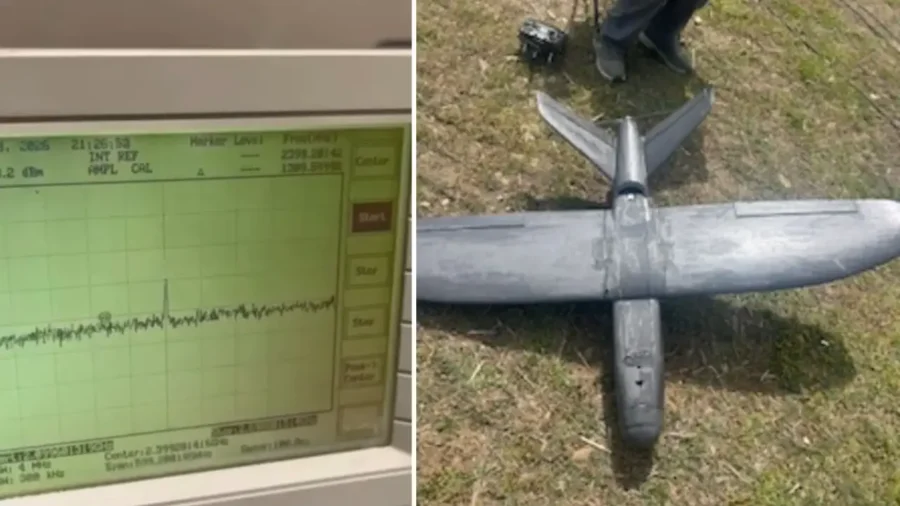
The defense research initiative, led by Turkish researcher Yunus İnce, announced that 43.2 dB attenuation was measured on the spray-on radar absorbing coating named Kürşat 3.0. Test images of the coating developed for drones and unmanned aerial vehicles were shared with The Defense Blog, but there is no published independent verification for the results yet. Kürşat 3.0 is applied to drones like a spray. Technologies that reduce radar visibility normally work with the combination of the geometry of the aircraft body, special composite surfaces, sensitive manufacturing processes and radar absorbing materials.
Kürşat 3.0 carries this structure into a coating form that can be applied directly to the surface. According to the information provided by Yunus İnce, the material can be applied to aircraft and drone surfaces by spraying it like paint and is used to reduce the return signal of the radar. According to the technical information shared by the startup, the coating was tested under the name Kürşat 3.0 after a seven-year development process.
It is stated that 43.2 dB attenuation was achieved in the measurements. On the decibel scale, this level corresponds to a reduction of approximately 20 thousand times when calculated on the power ratio. However, frequency band, measurement angle, surface geometry, coating thickness and test environment are directly decisive in radar performance. For this reason, the announced value remains limited to the test data shared by the company until it is verified by independent laboratory tests and operational scenarios.
It is reported that basalt and pumice stone structures from natural volcanic materials are used in the formula of Kürşat 3.0. It is stated that the material captures electromagnetic waves through its microscopic pore structure and converts them into heat instead of reflecting them back. Materials such as basalt and pumice are among the low-cost and abundant resources. The electromagnetic properties of these materials are also examined in radar absorber material research.
In traditional radar absorber materials, composite panels must be produced in special sizes, attached to the body precisely, surface gaps must be prevented, and maintenance processes must be managed. This method has difficulty finding a practical use in small drones due to both cost and production complexity. Since the coating in spray form can be applied directly to complex and curved surfaces, it offers an approach that reduces problems such as cutting additional parts, gluing and panel gap.
According to the shared information, Kürşat 3.0 can be applied without requiring major changes in the body structure of drones. It is stated that the coating adds low weight and can be used on existing commercial or military drone platforms. This point is especially striking in small and low-cost unmanned aerial vehicles; Because changing the body design from scratch to reduce the radar signature of vehicles in this class is often not a feasible option.
The news also states that academic studies report effective attenuation values in the range of 20 to 30 dB in broadband radar absorbing coatings. The 43.2 dB value announced for Kürşat 3.0 is above this comparison. However, for this comparison to be technically meaningful, measurements must be made in the same frequency band, the same test standard, similar thickness and similar surface conditions. The spread of drone warfare on many fronts, especially in Ukraine, has led to the faster development of radar-based detection, electronic warfare and layered air defense systems against small unmanned aerial vehicles.
Reducing the radar signature is considered among the technologies that can enable drones to be detected later in the detection chain. Studies in this field are not limited to large military platforms; Lower-cost solutions are also sought for small drones with commercial body structures. Turkey’s defense industry ecosystem also provides a strong basis for the emergence of such sub-technology studies. Turkish defense and aerospace industry exports increased to 7.2 billion dollars in 2024; Unmanned aerial vehicle platforms such as Bayraktar TB2 played an important role in the global recognition of the sector.
The critical issue for Kürşat 3.0 at this stage will be whether the announced attenuation value will be repeated in independent tests. How the material performs at different radar frequencies, different surface geometries, temperature and vibration conditions, open field tests and long-term use has not yet been seen with publicly available data.




Comments
You can write your views about this story. Comments may be moderated according to site settings.