
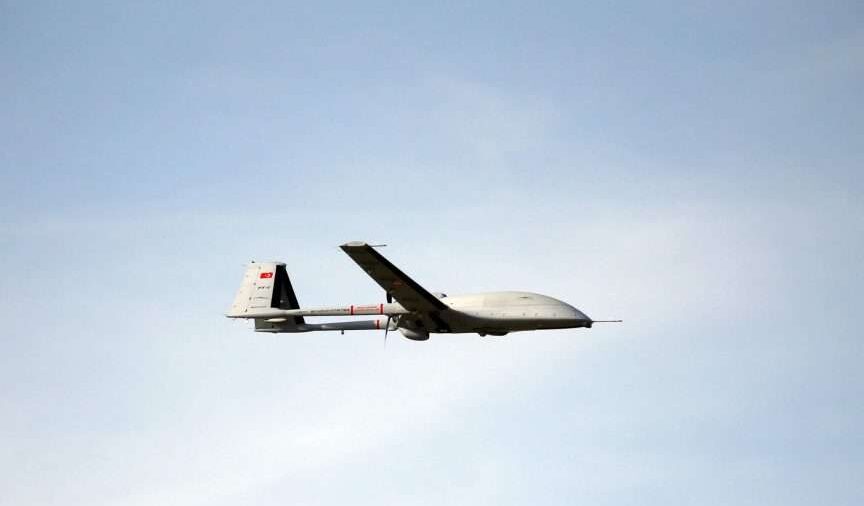
Italian defense and security experts agreed that the integration of the Armed Unmanned Aerial Vehicle (UCAV) Bayraktar TB3, produced by Baykar by the Italian Navy and currently developed with Italy’s Leonardo company, into the Cavour aircraft carrier in the Italian Navy will bring important capabilities to the force in question. The statement of the Commander of the Italian Naval Forces, Vice Admiral Giuseppe Berutti Bergotto, at the session of the Senate’s Foreign Affairs and Defense Committee, the upper house of the Italian Parliament, on March 25, that TB3 UAVs had recently carried out operations by taking off from the TCG Anatolia ship, and that these systems could be used on the Cavour aircraft carrier, had a wide impact in the country.
AA correspondent asked defense and security analysts about the Italian Navy’s interest in Bayraktar TB3. Italian defense and security analyst Paolo Mauri stated that the Commander of the Italian Naval Forces, Vice Admiral Bergotto, confirmed that the Italian Navy is progressing in the Bayraktar TB3 purchasing process and said, “This aircraft is the ship-deployable version of the TB2, produced by Baykar and frequently featured in the news for its use in Ukraine.
TB3 will therefore be deployed on the Cavour aircraft carrier and integrated into the air group consisting of F-35B fighter jets, providing surveillance and attack capabilities in low-risk environments.” he said. Mauri stated that TB3 will offer important capabilities thanks to its long flight duration ranging from 21 to 32 hours and the payload capacity it can carry, including MAM-L guided munitions. Stating that two simultaneous factors were most likely effective in the Italian Navy’s focus on TB3, Mauri said, “The first of these is LBA Systems, the joint venture between Leonardo and Baykar, which was established in March 2025 and headquartered in Italy.
“This company, which has a 50-50 partnership structure between Italy and Türkiye, is responsible for the design, development, production and maintenance of unmanned aerial vehicles (UAV) payloads.” he said. Mauri stated that the second factor is more related to practice and said: “During the (NATO) 2026 Steadfast Dart exercise held in the Baltic Sea on February 15, TB3 appeared operationally for the first time. During this exercise, for the first time in European history, an attack UAV took off from an aircraft carrier, performed an attack mission, and then returned to the ship.
This demonstration of capability demonstrated by TB3 by taking off from the Turkish UAV ship Anatolia proved that such a UAV can function effectively on an aircraft carrier that does not have a launch mechanism and capture system, but has an upward-leaning take-off ramp at the bow, as on the Cavour ship. “In addition, it showed that it could perform operations in the difficult climatic conditions in the Baltic Sea in February.” Mauri mentioned that until this year, the Italian Navy had a plan to add new ships to the inventory that could carry out intelligence, surveillance and reconnaissance operations as part of the renewal and development program that extends until 2035, and stated that the interest in TB3 indicates the acquisition of new capabilities.
Mauri continued: “This new will to acquire additional capabilities is considered to be in the same strategic direction, considering the change in the international security environment and the large-tonnage naval platform that can carry UAVs, such as the ‘Type 076’, which some countries such as China have recently launched.” “TB3s are expected to become an important force multiplier, especially for the Italian and Turkish navies.” Defense expert and Italian journalist-writer Luca Peruzzi, who follows maritime issues closely, reminded that Vice Admiral Bergotto gave a comprehensive overview of the development lines of the Force in the presentation made in the Senate on March 25.
Stating that the Italian Navy is turning to the commissioning of new platforms with multi-mission areas and different types of unmanned systems, especially for the protection of critical infrastructure under water, Peruzzi said: “These systems create a force multiplier and allow to reduce the risks and workload of the personnel. Vice Admiral Bergotto’s statement that TB3s to be produced in cooperation with Baykar-Leonardo can be used on the Cavour aircraft carrier, will allow the flight crew in question to expand the range of tasks that the aircraft carrier task group will perform.
This will benefit the joint force capabilities of both the fleet and the army. “TB3s, which are the product of this strategic cooperation of LBA Systems, are expected to become an important force multiplier, especially for the Italian and Turkish navies.” “This is, so to speak, a logical development of cooperation in the field of industry.” Alessandro Politi, Director of the NATO Defense College Foundation and military strategy expert based in Rome, also emphasized that the idea of producing TB3 systems in Italy and using them on the Cavour aircraft carrier is based on the good and deep-rooted relations between Ankara and Rome.
Regarding Baykar’s TB3 unmanned aerial vehicle system to be developed in Italy with the Italian Leonardo company and the Italian Navy’s great interest in this system, Politi said, “This is, so to speak, a logical development of cooperation in the field of industry and has clearly received political approval from both governments.” Because defense industry cooperation is clearly a political issue.” he said. Reminding that Turkey and Italy have been cooperating for a long time, including within the NATO Peace Force in Kosovo (KFOR), Politi said: “This attention to Turkey has existed for a long time, not only during this government period.
Therefore, we have a very strong tradition. We share the Mediterranean basin, we share the same concerns in this region. In addition, there is a very well-established relationship between Ankara and Rome based on mutual understanding. Moreover, we are definitely allies within NATO and Türkiye is always a potential partner of the European Union.” Source: AA





Comments
You can write your views about this story. Comments may be moderated according to site settings.