
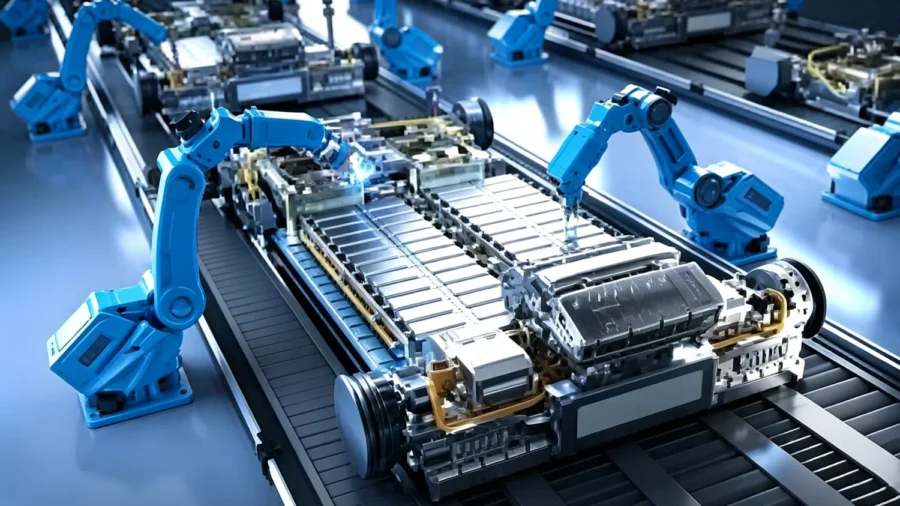
Chinese Ganfeng Lithium has moved to a new phase in its solid-state battery studies. The company’s battery with an energy density of 400 Wh/kg has reached more than 1,100 charging cycles and completed engineering validation. The 10Ah lithium metal battery in the 500 Wh/kg class entered small-scale production. Ganfeng solid-state battery reached the 500 Wh/kg level. Ganfeng Lithium shared the latest developments on the solid-state battery side in the investor relations record published on May 20.
According to the announced data, the company’s battery cell with an energy density of 400 Wh/kg has survived more than 1,100 charging cycles. This cell also completed the engineering verification process. One of the company’s most notable announcements was the 10Ah lithium metal battery in the 500 Wh/kg class. Ganfeng announced that this product has entered small-scale production. According to the company’s statement, this cell is the world’s first 500 Wh/kg class 10Ah lithium metal battery in its category to be put into small-scale production.
Ganfeng is simultaneously advancing two different technical lines in its solid-state battery strategy. The first of these is lithium metal anode, and the other is silicon-carbon anode based structure. The lithium metal anode line is one of the company’s core technologies for the commercialization of batteries with higher energy density. Ganfeng had previously shared that it used metallic lithium as the anode material in its second generation semi-solid battery.
The company also produces lithium metal materials that can be used as raw materials in solid-state batteries. On the silicon-based side, Ganfeng is working on cells with energy densities ranging from 320 Wh/kg to 480 Wh/kg. According to the announced data, the cell at 320 Wh/kg reached more than 1,000 cycles. 480 Wh/kg technology is under development. This distinction shows that the company establishes different balances between energy density and cycle life for different usage scenarios.
The usage areas that Ganfeng points out for these batteries include upper segment new energy vehicles, drones, eVTOL aircraft, robotic systems and consumer electronics. What these areas have in common is the need for high energy density and lower weight. An increase in the Wh/kg value, especially in electric vehicles, can mean a longer range with the same battery weight or a lighter battery pack for the same range. The solid-state battery race in China has become more visible in 2026.
Battery manufacturers and automobile brands are taking more concrete steps on the side of pilot production and vehicle integration. Ganfeng has previous supply and cooperation relationships with Dongfeng and Changan. Dongfeng started extreme cold tests with vehicles with 350 Wh/kg solid-state batteries. On the Changan side, it is on the agenda to test 400 Wh/kg solid-state batteries by installing them in vehicles in 2026.
However, traditional lithium ion chemistries are still far ahead in the Chinese electric vehicle battery market. In April 2026, electric vehicle battery installations in China reached 108.9 GWh. This figure means a 25.8 percent increase on an annual basis. LFP batteries constituted 74.2 percent of the market with 80.8 GWh installations. NMC batteries took a 25.6 percent share with 27.9 GWh. This table shows that while solid-state battery investments are accelerating, LFP and NMC-based lithium-ion batteries maintain their dominance in the current market.




Comments
You can write your views about this story. Comments may be moderated according to site settings.