

Artificial intelligence has spent the last few years living mostly inside apps, chat windows and cloud services. Microsoft’s new Project Solara suggests the next step may be very different. Instead of asking people to open an app every time they want AI help, the company is exploring a future where AI agents live across dedicated devices built around fast, simple and always-available interaction.
At Build 2026, Microsoft introduced Project Solara as a platform for “agent-first” devices. That phrase matters because it signals a shift away from the app-first model that has defined phones, tablets and PCs for years. In Microsoft’s view, the future device may not be something that launches lots of apps. It may be something that gives people direct access to AI agents that understand tasks, context and priorities.
That is a big idea, but it becomes easier to understand when looking at the hardware concepts Microsoft revealed alongside the platform.
One of those concepts is a portable badge-style device. Microsoft describes it as a lightweight, always-connected companion designed for workers who move through busy environments. The company says the badge concept includes a touchscreen, a fingerprint sensor for secure access, a privacy switch, microphones, a speaker, a side-facing camera and wireless connectivity including Wi-Fi, Bluetooth and 5G. The point is not to create another phone. It is to create a simpler access point for agents that can stay with a person throughout the day.
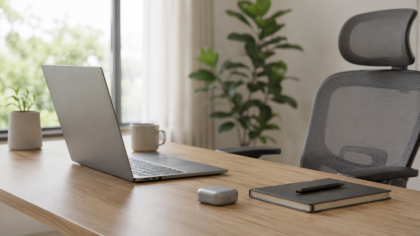
The other concept is a desk device. Microsoft says this design is intended to sit where many people already spend most of their time: at a desk. It includes a touchscreen, face authentication, privacy lock buttons, microphone controls, dual microphones, a speaker, a presence sensor and USB-C connectivity. Microsoft also says the desk concept can work on its own, pair with a Windows PC or even become a Windows 365 client when connected to an external display.
These two concepts are important because they show the type of future Microsoft is imagining. One device is mobile and always nearby. The other is stationary and built for flow at work. Together, they suggest AI may soon move into new hardware shapes instead of staying confined to laptops and phones.
Project Solara itself is built around three pillars. Microsoft says those are enterprise-readiness, an agent-driven interaction model with just-in-time UI, and extensibility so developers can bring their own agents. The company also says the platform uses the Microsoft Device Ecosystem Platform, or MDEP, which is an enterprise-grade operating system built on AOSP. That means Solara is not simply Windows in a smaller box. It is a purpose-built system designed for security, manageability and reliability in a business setting.
This matters because the first wave of AI gadgets has often struggled to explain why a new device should exist. Some felt too experimental. Others felt like phones with features removed. Microsoft appears to be trying a more practical route. Instead of selling AI hardware as a novelty, it is framing Solara as a platform for task-focused devices that can fit into real workflows.
That strategy could make sense, especially in workplaces.
A wearable badge could help a nurse, store worker, field employee or office staff member access information quickly without reaching for a phone or sitting down at a computer. A desk device could offer a simpler AI companion for meetings, reminders, notes, task handoffs and voice access to work tools. Microsoft says Project Solara is being designed to support secure access to services such as WorkIQ, and it mentions scenarios where agents can provide briefings, help track projects, record in-person conversations with permission and surface the most important items needing attention.
This is where Project Solara becomes more than just a hardware concept. It starts to look like a new interface layer.
For years, software has mostly assumed that people will open screens, tap menus and switch between apps. Agent-first computing imagines something else. A person expresses intent, and an agent handles part of the work. The interface appears only when needed. The hardware becomes a quick entry point into that experience.
Qualcomm described this broader shift in similar terms after the Build announcement. The company said Project Solara brings together silicon, software and cloud to create AI experiences that are more personal, more aware and always with the user. That framing helps explain why the hardware side matters so much. Microsoft is not only building AI software. It is helping define what devices for that software might look like.
Another reason this announcement matters is the pilot ecosystem forming around it. Microsoft says it plans to begin private pilots in the coming months with companies including AccuWeather, Best Buy, CVS Health, Levi’s and Target. That shows Solara is not only a stage demo. Microsoft is trying to test whether agent-first devices can actually solve useful real-world problems across industries like retail, healthcare and field services.
For consumers, the bigger meaning may come later. Right now, Project Solara is clearly shaped around enterprise needs. Microsoft repeatedly emphasizes security, privacy, control and device management. That makes sense, because businesses are more likely than consumers to test new form factors when the device has a clear productivity purpose.
But enterprise ideas often flow into mainstream consumer tech over time.
If Solara-style devices work well in businesses, similar ideas could reach consumers in more familiar forms. We could eventually see compact AI desk companions for home offices, wearable assistants for travel or shopping, and simplified devices designed around specific tasks instead of general-purpose app stores.
That is why Project Solara is worth watching.
It also creates a new competitive question for the industry. If AI agents become a major computing layer, who defines the hardware and operating systems they run on? Will companies depend on phones and PCs, or will they create a new class of agent-focused devices? Microsoft is clearly trying to position itself early in that transition.
The timing feels important. The tech industry is already experimenting with AI PCs, AI wearables and voice-first assistants. But many of those products still sit on top of older interaction habits. Project Solara points to a deeper shift: not just adding AI to existing devices, but rethinking the device around AI from the start.
That does not guarantee success. Many new hardware categories fail because people do not understand why they need them. Others fail because phones already do enough. Project Solara will still need strong use cases, good partner execution and clear privacy protections if it wants to move beyond prototypes and pilot programs.
Still, the direction is meaningful.
The most interesting part of Microsoft’s announcement is not simply that it built two concept devices. It is that the company is treating agents as something worthy of their own hardware platform. That suggests the next AI competition may not be only about models, chatbots or cloud services. It may also be about who builds the operating systems and devices that make AI feel natural in everyday life.
If that happens, Project Solara may be remembered as an early sign that the AI gadget OS race had officially begun.



Comments
You can write your views about this story. Comments may be moderated according to site settings.