
T.R. STM Defense Technologies Engineering and Trade Inc., Turkey’s national engineering power, which continues its work under the leadership of the Presidency of Defense Industries, brought its capabilities in autonomous systems and swarm UAV technologies to the field in the EFES-2026 Exercise. Held in İzmir Seferihisar Doğanbey Exercise Area; EFES-2026’s Distinguished Observer Day, in which more than 10 thousand personnel from 50 countries participated, witnessed an important activity.
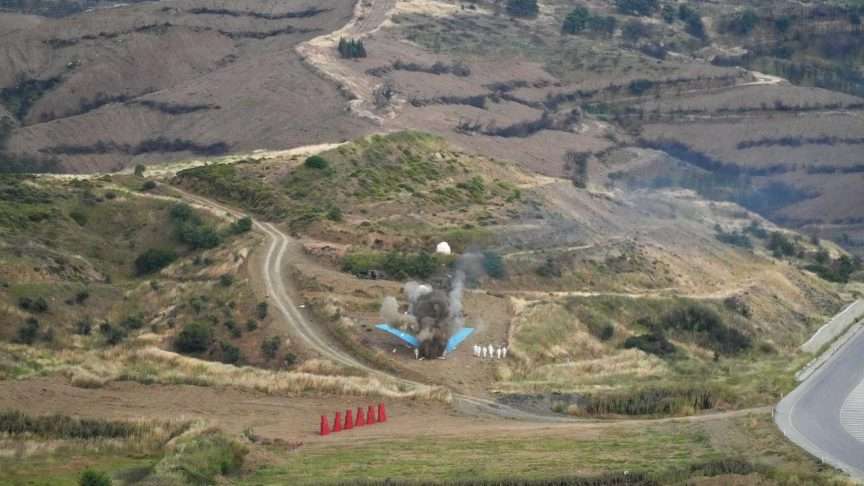
Within the scope of the night phase of the exercise, which was held in the evening hours of May 20, KARGU strike UAVs, developed by STM and actively used by 15 countries, carried out tasks in coordination with the swarm intelligence infrastructure and carried out simultaneous attacks on the determined targets. A First in the World: 20 KARGUs, equipped with completely national algorithms and swarm intelligence with distributed architecture, took off under the control of a single operator and autonomously arrived at the target area.
During the actual firing phase of the exercise, the KARGU swarm, operating in a scenario that was comparable to real combat conditions, coordinated with the ability to autonomously detect and classify targets. UAVs, which communicate with each other in real time and share targets thanks to swarm intelligence, successfully detonated anti-personnel warheads on targets by performing a simultaneous (saturation) attack. This operation was recorded in the world military literature as the first activity in which a swarm operation was carried out with subcloud UAVs with live ammunition during an exercise.
Full Marks from the High-Level Delegation This historical operation, which was carried out on the distinguished observer day of EFES-2026, was followed on-site by Minister of National Defense Yaşar Güler, Chief of General Staff General Selçuk Bayraktaroğlu, Force Commanders and high-level military delegations from different countries. This game-changing capability demonstrated by STM received full marks from international military delegations and command levels.
While the activity demonstrated the operational level reached by swarm systems in the modern warfare field, it also demonstrated Turkey’s competence in autonomous warfare technologies. Güleryüz: We Opened a New Page in the World Defense Literature STM General Manager Özgür Güleryüz stated that this global success achieved in EFES-2026 reinforced Turkey’s technological leadership and said: “Following the successful field tests we carried out in Ankara in January 2026, today we took this capability one step further in Turkey’s most prestigious exercise EFES-2026, a first in world defense history.
20 units The fact that our swarm of KARGU destroyed its targets in a fully autonomous manner is a source of pride not only for STM but also for the Turkish defense industry. The successful execution of a swarm of drone attacks of this scale for the first time in the world has further strengthened our country’s leading position in defense technologies. With this operation, we have proven that we are a country that sets standards and breaks new ground in the field of swarm intelligence and autonomous systems.
We will continue to achieve world firsts with our game-changing technologies and strengthen the power of our heroic Army!” STM Swarm UAV Capabilities Thanks to STM’s unique algorithms and software, tactical UAVs in the STM swarm system can communicate with each other in real time, perform target detection, sharing and prioritization and carry out swarm attacks. STM’s swarm intelligence architecture allows each UAV to make its own mission decisions without being dependent on a central control unit.
This distributed control architecture ensures that the swarm can continue the mission even if one part of the system is disabled and increases mission success. Within the framework of the saturation attack concept, swarm systems aim to saturate and neutralize enemy defense systems by enabling the coordinated navigation of many UAVs to the target area at the same time. Thanks to STM algorithms, UAVs in the swarm engage targets appropriate to the type of ammunition they carry.
For example; UAVs, which can distinguish human or vehicle targets and carry anti-personnel or armor-piercing ammunition, can engage autonomously according to the target type. In the developed systems, new UAVs can be added and removed from the swarm in real time, tasks can be updated, and the swarm can be divided within the mission area and perform different subtasks. STM proved its capabilities in the field of swarm UAVs in the field test conducted in Ankara Polatlı in January 2026.
A flock of 20 KARGU; It broke new ground by hitting its targets with full accuracy with real ammunition, autonomously, under the control of a single operator, with completely national algorithms. Features Swarm Intelligence Algorithms Saturation Attack Concept Distributed Control Architecture Inter-UAV Communication Infrastructure Autonomous Formation Creation and Maintenance Collision Avoidance System Real-Time Target Detection and Classification Intra-Swarm Task Sharing Target Prioritization and Task Assignment CRPA Supported Anti-jam Navigation KKS Independent Navigation with KERKES Integration Swarm Division and Merger Real-Time Joining and Leaving the Herd.
The Choice of the World’s Armies: KARGU. The striking KARGU, also known as the “kamikaze UAV” in public, was developed by STM with local and national resources. KARGU, which entered the inventory of the Turkish Armed Forces in 2018, is effectively used by various security forces in Turkey, especially the Turkish Armed Forces, in the fight against terrorism, special operations and cross-border operations. KARGU, which has successfully proven itself in different geographical and land conditions, has been exported to 15 countries on four different continents to date.
User personnel can remove the anti-personnel ammunition head from KARGU and quickly replace the armor-piercing head, depending on the current situation in the field. KARGU, which is difficult to detect in enemy territory with its low radar cross-section feature, can be easily carried by a single soldier and set up in the mission area within 1 minute. KARGU provides a significant surprise effect and operational superiority with its artificial intelligence and image processing capabilities, silence, and ability to deliver the explosive it carries to the target.
KARGU can operate effectively day and night with its advanced electro-optic and infrared cameras. KARGU, which can stay in the air for more than 30 minutes, has a range of 10 km. KARGUs can also operate in flocks. In addition, KARGU can operate independently of GNSS, without being affected by the electronic warfare environment, with the software developed by STM.




Comments
You can write your views about this story. Comments may be moderated according to site settings.