

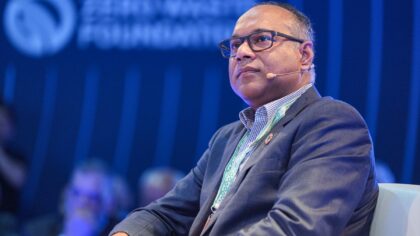
ISTANBUL (AA) – GÖKHAN YILDIZ – Junaid Wahedna, Founder of the digital halal investment platform Wahed, stated that the biggest obstacle to the Islamic finance industry is not capital but licensing processes and regulatory restrictions, and said, “While Muslim countries should be pioneers in Islamic finance, we can implement many innovative products faster in Western countries.” he said. Wahedna told AA correspondent that banks, which are traditional players, often get the first opportunity to introduce new products, but entrepreneurs and smaller companies also need to be supported by governments and regulatory bodies.
Pointing out that the biggest obstacle to the Islamic finance industry is not capital but licensing processes and regulatory restrictions, Wahedna said, “While Muslim countries should be pioneers in Islamic finance, we can implement many innovative products faster in Western countries.” he said. Wahedna stated that they need support to obtain licenses, provide government support and support from regulatory institutions, develop digital products and implement innovative financial solutions, and continued: “The majority of the trillions of dollars talked about in the Islamic economy actually consists of lending activities.
These figures refer to bank loans, not assets or savings. This is how the global Islamic finance assets, the size of 6 trillion dollars, are calculated. However, when you look at the real savings and investment assets held in Islamic financial institutions, you will see that this amount is much lower. This is the basis of The reason is that there are not enough products.” Stating that it is necessary to work to develop new products, Wahedna explained that it is necessary to work with governments to ensure that digital products are allowed, so that more funds can be attracted to the Islamic economy and capital can produce real benefits.
Junaid Wahedna emphasized that Muslim countries should be pioneers in the field of Islamic finance and said, “Unfortunately, this is not the picture we see. “One of the most important reasons for this is the lack of adaptation to technology.” he said. – “Regulatory institutions must be more courageous and open towards technologies and digital solutions” Wahedna emphasized that if a truly Islamic economy is to be established in Muslim countries, regulatory institutions must be more courageous and open towards technologies and digital solutions, and the starting point for this is licensing processes and policy development studies.
Underlining that Western countries are quite successful in this regard, Wahedna said, “For example, it is much faster and easier for a company like us to license and launch a product in America compared to many Islamic countries. This is a truly sad situation. “When it comes to Islamic finance, the opposite should happen, the processes are expected to be easier in Islamic countries.” he said. Stating that Turkey is a very large market, Wahedna continued his words as follows: “We see Turkey as the center of the world and the Islamic world.
For this reason, we are researching the best way to operate in Turkey. Our negotiations with government officials continue. “We need the support of the government and regulatory authorities to obtain a license and start our activities in Turkey.” Stating that there should be more openness to foreign companies in the age of digitalization and innovation, Wahedna stated that the ability of organizations like his own companies to obtain licenses in Turkey without the obligation of a local partner will increase competition and innovation, and this will contribute to the faster development of the Islamic finance ecosystem.
Wahedna pointed out that many Muslim countries still adopt a conservative and risk-averse approach, so they may be reluctant to grant licenses to foreign companies.




Comments
You can write your views about this story. Comments may be moderated according to site settings.