
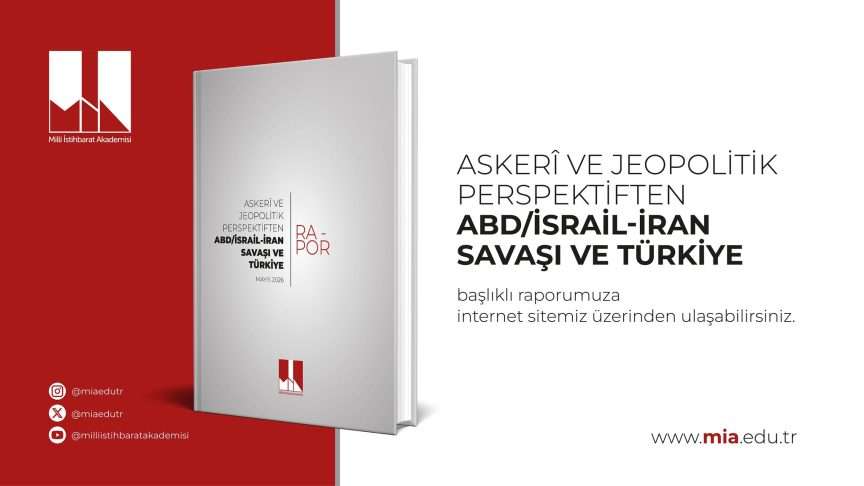
In the report titled “USA/Israel-Iran War and Turkey from a Military and Geopolitical Perspective” prepared by the National Intelligence Academy (MIA), it was stated that the war between the US, Israel and Iran, which started on February 28 and lasted for approximately 40 days, had multidimensional consequences in terms of the modern understanding of war, regional security balances and Turkey’s strategic priorities. In the MIA report, it was emphasized that the war marks a new era not only in military terms, but also in terms of artificial intelligence-supported systems, electronic warfare, critical infrastructure security, energy supply security, cognitive warfare, social resilience and diplomatic balances.
In the foreword of the report, President of the National Intelligence Academy Prof. Dr. Talha Köse pointed out that the predictions in the “12 Day War” report previously published by MIA that the conflict could continue and become regionalized have largely come true. Köse stated that the new war has made the transformation in many areas such as military doctrines, new technologies, intelligence operations, energy security, social resilience and communication strategies more visible, especially with the direct involvement of the USA in the process.
It was also stated in the report that the military technologies, doctrinal tests, political and geopolitical effects observed during the war and the consequences for Türkiye were comprehensively discussed. “The war shaped the modern warfare environment” The report stated that the war between the USA and Israel and Iran showed that the modern warfare environment has evolved from a platform-centered understanding to a new structure centered on data, network, production capacity and operational sustainability.
The report emphasized that the intensive use of artificial intelligence-supported systems in intelligence, surveillance and reconnaissance activities, target detection, prioritization and air defense processes has dramatically accelerated decision-making cycles, and stated that this situation reveals that decision superiority in modern warfare is shaped not only by human capacity, but also by data processing, algorithmic analysis and real-time integration capacity.
The report emphasized that electromagnetic spectrum dominance has become an integral part of modern air power. It was stated that radar systems, data links, SATCOM infrastructure, electronic warfare capability and communication networks were directly decisive on the outcome of the war. The report pointed out that the invisible digital and electromagnetic layer has become as critical as the physical conflict area in the wars of the future, and stated that the understanding of the impenetrable air defense umbrella of war is not sustainable and absolute.
The report noted that Iran was able to overcome multi-layered air defense systems to a certain extent with low-cost kamikaze drones and multiple missile attacks, and it was stated that this situation indicates that modern air defense should consist not only of defense systems, but also of integrated architectures supported by early warning, electronic warfare, cyber security and offensive capacity. The report also stated that large and high-cost platforms remain important, but the strategic vulnerabilities of these platforms have become more visible.
The report points out that the range of action of aircraft carriers, tanker aircraft and airborne early warning platforms may become narrower, especially under intense missile threat, and that low-cost drone systems and kamikaze elements create serious cost asymmetry against high-cost defense architectures. “Energy and critical infrastructures have become direct targets” The report stated that critical infrastructures, energy facilities, radar networks, communication systems and logistics centers have become the priority targets of the war.
It was stated that this situation shows that in modern warfare, not only military elements but also the infrastructure that enables the fighting capacity have become a direct conflict area. The report emphasized that especially the vulnerabilities in energy and communication infrastructures made the relationship between social resilience and national security more visible, and also pointed out that the tensions in the Strait of Hormuz, the Red Sea and the Eastern Mediterranean line turned energy supply security and trade routes into a direct strategic competition area.
The report noted that the protection of energy infrastructures and maritime trade lines has become one of the basic elements of the regional security architecture, and it was stated that connectivity projects such as the Development Road and the Central Corridor have become economic as well as geopolitical and strategic security projects in the post-war period. The report stated that the war has seriously eroded the existing security architecture in the Middle East, which has been maintained for a long time through proxy actors, fragile balances and external security guarantees, and that the multi-layered crises that simultaneously affect Iraq, Syria, Lebanon, Yemen, the Gulf and the Eastern Mediterranean line indicate that the understanding of regional security has been reshaped.
The report stated that Iran’s regional capacity was significantly eroded during the war, but its influence was not completely eliminated. Israel considers the weakening of Iran as a strategic opportunity; The report emphasized that Israel’s tendency to expand its operational area, especially in Syria, Lebanon and the Eastern Mediterranean, made the regional security architecture more fragile, and that Israel’s quest to shape the region in its favor increased the possibility of strategic competition with Turkey.
The report emphasized that the war revealed the necessity of a new generation defense approach for Turkey in the fields of air and missile defense, electromagnetic spectrum dominance, strategic infrastructure security, ammunition sustainability, cognitive warfare capacity and distributed command and control architectures. In the defense industry, not only high technology production; The report stated that mass production capacity, ammunition sustainability, stock capacity and supply security have become strategic imperatives, and that this approach was defined as a “three-dimensional depth” approach.
The importance of Turkey’s multidimensional diplomatic capacity The report also stated that Turkey’s multidimensional diplomatic capacity provided a significant strategic advantage during the war. It was emphasized that Ankara’s ability to simultaneously maintain communication channels with Iran, Gulf countries, Pakistan, Europe and the USA shows Turkey’s capacity to play a balancing and facilitating role in the new regional security architecture.
In addition, it was noted that anti-Türkiye propaganda activities intensified during the war, and that it was important to take the necessary precautions against disinformation and manipulation activities. In conclusion, the report stated that the US/Israel-Iran War heralded a new era in which the international security order began to dissolve and the nature of war radically transformed. It was noted that power is no longer defined only by military capacity, but also by technological production capability, data dominance, social resilience, sustainability and strategic adaptation capacity.
The report emphasizes that Turkey has become one of the “security and stability providing” actors in the new era, thanks to its geopolitical location, defense industry infrastructure, operational experience and diplomatic flexibility. The main issue for Turkey is to understand this historical rupture not only from the perspective of crisis and threat; It was stated that it can be read as a long-term strategic scale-up opportunity.
It was stated that achieving this depends on institutionalizing the multi-layered security approach and developing the existing capacity within the framework of a sustainable, integrated and strategic vision. You can access the report HERE. Source: AA






Comments
You can write your views about this story. Comments may be moderated according to site settings.