
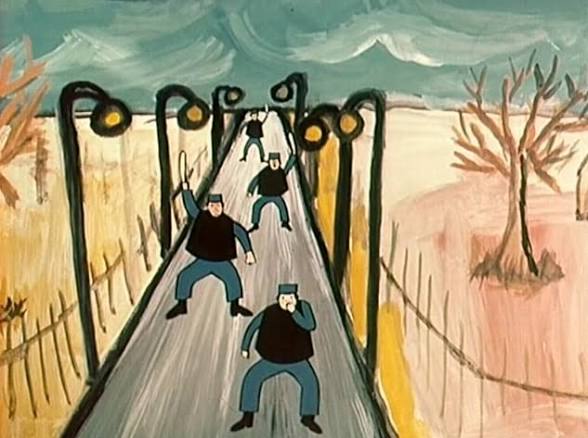
We’ve left Suzan Pitt’s psychedelic, masked circus and haunted asparagus fields behind. If we have sailed far enough in the waters of surrealism, we are now moving on to the most expressionist, most shocking and absurd genius of French animation: René Laloux. Let’s agree from the beginning; I know many of you are asking “If you say Laloux, where is Fantastic Planet (La Planète Sauvage)?” he will say. I watched that masterpiece and studied it for a long time, but at that time I was publishing my articles on Fanzade.
That’s why my legendary review remained in the Fanzade archives, those who are looking for it can find it there with a little research. Here, we will look at how Laloux paved the way to the planet of the blue giants, the dark foundations of his mind, and then we will review his entire cinematography. I watched Tick Tack, The Achalunes, Monkey’s Teeth and Dead Times in a row. Let’s discuss these subconscious tunnels one by one.
Sketches of Time and Place: Tick Tack (1957) In these films, we see quiet but sharp experiments on time perception, routines and absurdity. Just like Suzan Pitt’s first short films, these works are an attempt to create an atmosphere rather than telling a story. Rather than searching for very deep symbolisms, they are valuable for watching how Laloux’s drawing talent and sense of rhythm evolve towards those great dystopias in the future.
Monkey’s Teeth (1960) Now things get really interesting! Les Dents du Singe (The Monkey’s Teeth) is not just an animation, it is a huge experiment where psychology and art history intersect. Why? Because Laloux created this film while working at the Cour Cheverny (La Borde) psychiatric clinic, in collaboration with the patients there. Yes, you read that right. The script, drawings and world of the film come directly from the minds of patients struggling with psychiatric disorders.
That’s why the surreal, disjointed, irrational progression you watch in the movie is not actually a “fictionalized” surrealism; a pure, unfiltered subconscious stream. While talking about Maya Deren’s dream logic, we mentioned “detachment from reality”, but here Laloux brings that detachment directly from the source of madness to the screen first hand. The strange uncanniness you feel while watching is fed entirely by the truth itself.
Dead Times (1964) And we come to the heaviest ball of the four. In my opinion, Les Temps Morts is Laloux’s most brutal, darkest and most cynical work about human nature. This film, in which he joined forces with the famous illustrator and writer Roland Topor, hits us like a slap in the face that animation is not just a “cartoon”. It mixes real archive footage, war footage, stop-motion techniques and Topor’s disturbing charcoal drawings.
What does he say? The morbid passion of humanity for wars, death, destruction and murder, the “cult of death”… Real images of those who lost their lives on the front lines flow side by side with caricatured drawings of the system that feeds the death machine. He criticizes with incredible cynicism how society has turned the wars it watches from afar into a routine and even entertainment. Rather than a surreal nightmare, this is a dystopian collage of that disgusting reality that we try to close our eyes to.
After watching Dead Times, you understand that; In that famous Fantastic Planet, Laloux was not talking about aliens or fantasy worlds, but just pathetic humanity dressed in different costumes.




Comments
You can write your views about this story. Comments may be moderated according to site settings.