
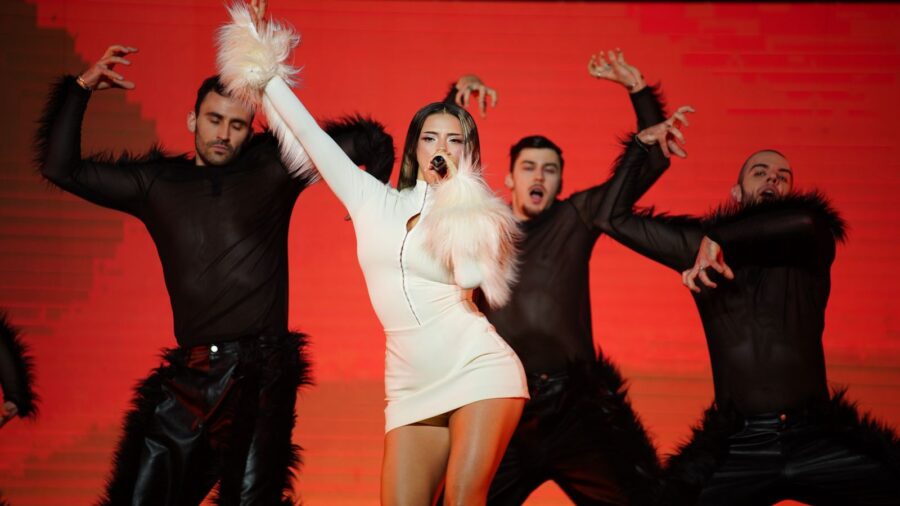
Following the historic victory of DARA, competing on behalf of Bulgaria in the Eurovision Song Contest held in Vienna, millions of music lovers and internet users began to research what the concept of Bangaranga means and the origins of this word. The 27-year-old pop star, who brought her country her first title by collecting a total of 516 points from both the jury and the public vote with her visually explosive performance in the competition, not only won a trophy; It also breathed new life into the global digital jargon.
This expression, which basically does not have a standard dictionary meaning, has today turned into a multi-layered slang (slang exclamation) symbolizing high energy, enthusiasm, breaking the rules and inner strength. Meeting of Tradition and Modernism on the Eurovision Stage DARA, which came to the top on the 70th anniversary of Eurovision history, defines its song, which became a huge viral hit in the competition, as “pop music with folkloric bones”.
The inspiration for the work is based on the ancient “Kukeri” rituals in Bulgarian culture, where men wear fur costumes, bells and animal masks, wander around villages and drive away evil spirits. You can also listen to the song on YouTube. When asked what exactly the word means at the press conference held after the competition, the successful artist stated that it represents a special energy that everyone carries within them, an unshakable belief that everything is possible, and dropping the masks worn while pursuing perfection.
The song became a hit, making the word a common cry of excitement in the modern world. Origins in the World of Cinema and the Legacy of Steven Spielberg Long before this latest explosion in the world of music, we encounter the basic form of the word in a cinematic context. The 1991 cult fantasy adventure film “Hook”, directed by Steven Spielberg and starring Robin Williams and Dustin Hoffman, is considered the first birthplace of the word in popular culture.
In the movie, Neverland is a place where “The Lost Boys”, who are trying to survive in the absence of Peter Pan and organized under the leadership of Rufio, shout “Bangarang!” as war cries and attack cries. They were using the word. In this context, the expression means that children cry out in unison when starting a war, winning a game, or starting a crazy fun; It was a collective shout of enthusiasm carrying the message of “attack”, “make a mess” or “have fun”.
Areas of Use in Today’s Digital World In the internet world, social media communities and game servers, this expression is preferred for the high adrenaline it gives, beyond its literal meaning. Situations where the word is commonly used are listed as follows: Great Enthusiasm and Hype: When a great success is achieved in a sports competition, digital game or in daily life, “That’s it!”, “Let’s go!” or “Amazing!” It is used as an expression of joy.
Meaningless and Fun Nursery Rhyme: It stands out as a fun exclamation that does not follow any strict grammar rules and is preferred only to add joy, style and rhythm to the environment. Inner Power and Madness: It is adopted as an entertainment motto in chaotic and energetic parties where everyone has fun freely, when routine rules are broken. This word, which emerged from the cinematic battle cry of the Lost Boys and turned into a global phenomenon again with the rhythms of the modern pop world, continues to exist in our lives as a universal digital exclamation that transcends borders.






Comments
You can write your views about this story. Comments may be moderated according to site settings.