

Smart glasses have spent years feeling like a technology category waiting for a normal use case. They have been interesting, sometimes impressive and often awkward. But Apple’s reported approach to smart glasses suggests the next phase may be less about futuristic demos and more about making AI wearables feel like ordinary eyewear.
The Verge reports that Apple’s strategy for smart glasses could mirror the way it handled the Apple Watch. Instead of treating the product only as a tech gadget, Apple may aim at the much larger mainstream eyewear market, competing with everyday glasses brands as much as with other technology companies.
That framing matters. Most smart glasses have struggled because they look too technical, feel too niche or ask users to change habits too quickly. A device worn on the face has to meet a higher standard than a phone or laptop. It must be comfortable, socially acceptable, useful and visually normal enough for daily life.
Apple may understand that better than most companies.
The Apple Watch followed a similar path. Early versions were marketed as a mix of fashion, communication and technology. Over time, the product became more clearly focused on fitness, notifications, health-adjacent tracking and iPhone integration. It did not need to replace the phone. It became useful because it extended the phone in small, frequent ways.
Smart glasses could follow that same pattern.
The first mainstream version may not need full augmented reality or heavy mixed-reality graphics. It may only need to make a few daily tasks easier: taking hands-free photos, hearing AI summaries, translating simple phrases, getting directions, checking notifications, capturing reminders or interacting with the iPhone without pulling it out.
That is why Apple’s ecosystem could matter. The Verge notes that Apple has a broad device base and a strong retail presence, giving it an advantage if it decides to push smart glasses beyond early adopters.
For consumers, the big question is whether smart glasses can become useful without becoming intrusive. People may want AI assistance, but they may not want a camera or display that makes others uncomfortable. The best version of smart glasses will likely be subtle, lightweight and clear about when sensors are active.
Design will be just as important as software. Glasses are personal in a way most gadgets are not. They sit on the face, shape appearance and need to work with different styles, prescriptions and comfort needs. A product that looks good in a launch video can still fail if people do not want to wear it outside.
That is why the mainstream eyewear angle is important. The global eyewear market is much larger than the market for experimental AR headsets. If Apple can make smart glasses feel like normal glasses with useful digital features, the category could become much more accessible.
AI may be the missing piece. Earlier smart glasses often had limited reasons to exist beyond recording video or showing small notifications. AI assistants create new possible uses because they can interpret context, summarize information and help users act on what they hear or see.
But the risk is overpromising. Smart glasses do not need to replace the smartphone, laptop or smartwatch. If companies try to make them do everything, they may become expensive, heavy and confusing. The stronger approach may be to make them excellent at a few lightweight tasks.
This is where Apple’s reported strategy could be effective. A mainstream pair of AI glasses could act like a small extension of the iPhone: less immersive than a headset, but more immediate than a phone in a pocket.
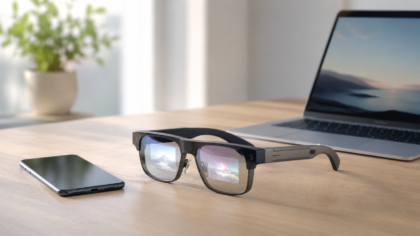
The competition is already forming. Meta has smart glasses in the market, Google and Samsung are developing Android XR-related glasses, and companies such as Xreal are pushing more affordable display glasses. The Verge recently reported that Xreal’s budget AR glasses will start at $299 and include swappable frames and anti-shake display technology.
That shows the category is becoming more varied. Some glasses will focus on cameras and AI assistants. Others will act as wearable displays. Some will target productivity, while others will focus on fitness, travel or everyday convenience.
Apple’s likely advantage is not being first. It is packaging a product in a way that feels understandable to regular buyers.
For smart glasses to break through, users need a simple answer to one question: why wear this every day? The answer cannot be “because it is futuristic.” It has to be something practical: easier directions, quicker translation, fewer phone checks, better reminders or hands-free capture of moments.
Privacy will be the other deciding factor. Cameras and microphones on glasses can make people uneasy. Companies will need clear indicators, strong controls and careful defaults. A wearable AI device that people do not trust will struggle no matter how polished it looks.
Apple’s reported smart glasses strategy suggests the category may be getting closer to a mainstream moment. Not because the technology is suddenly perfect, but because the industry may finally be focusing on the right question.
Smart glasses do not need to look like the future. They need to look and feel like something people are willing to wear today.


Comments
You can write your views about this story. Comments may be moderated according to site settings.