
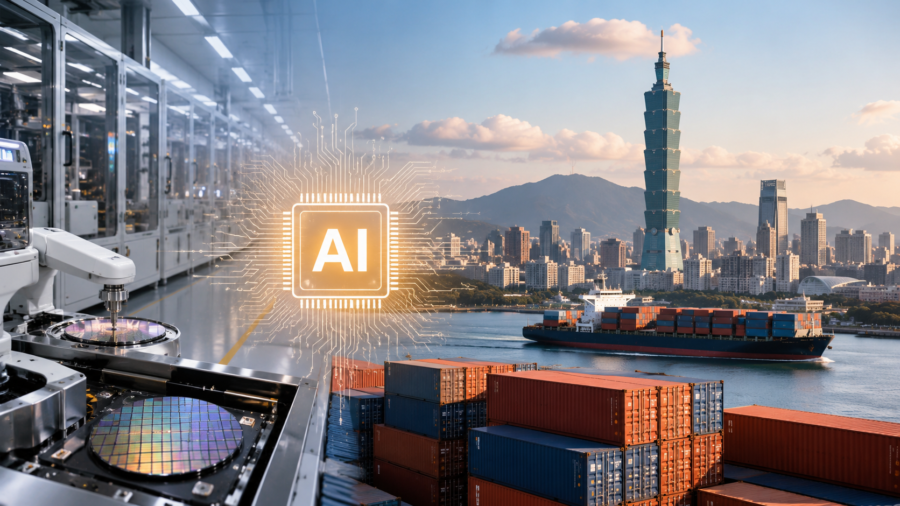
Taiwan’s artificial intelligence boom is no longer just a semiconductor story. It is becoming a whole-economy growth story, lifting exports, investment and expectations across one of the world’s most important technology hubs.
Taiwan’s government has raised its 2026 economic growth forecast to 9.64%, up from an earlier estimate of 7.71%, according to Reuters. That would mark the island’s fastest expansion in 16 years, driven largely by strong global demand for AI and high-performance computing.
The upgrade shows how deeply AI demand is now tied to Taiwan’s economic outlook. Taiwan is central to the global chip supply chain, with companies such as Taiwan Semiconductor Manufacturing Co. playing a critical role in producing advanced chips used by major technology firms.
But the impact goes beyond one company or one product category. AI infrastructure requires processors, servers, cooling systems, memory, networking equipment, packaging, testing, logistics and power support. Taiwan’s economy touches many of those areas, which means AI demand can spread through multiple layers of business activity.
Reuters reported that Taiwan’s first-quarter 2026 growth was revised up to 14.55%, the fastest quarterly pace in nearly 48 years. The government also expects exports to rise by 39.77% in 2026, the strongest export growth in 50 years.
Those numbers show why Taiwan’s AI boom is being watched far beyond financial markets. When AI companies and cloud providers expand infrastructure, they need more hardware. That demand flows through Taiwanese chipmakers, electronics suppliers, server manufacturers and logistics networks.
For consumers, the connection may not be obvious. People interact with AI through chatbots, phones, search tools, workplace software and image generators. But behind those services are data centers filled with chips and servers. Taiwan is one of the places where much of that hardware ecosystem begins.
That gives the island a powerful position in the AI economy. It also creates pressure. When a country becomes central to a global technology boom, it benefits from rising demand, but it also faces higher expectations around production capacity, energy use, talent, infrastructure and supply-chain resilience.
The latest growth forecast suggests Taiwan is benefiting from a strong investment cycle. Cloud service providers are spending heavily on AI capacity, and hardware demand remains high. That can increase orders for chips and related components, while encouraging companies to invest in factories, equipment and advanced manufacturing.
The boom may also support wages, corporate profits and government revenue. Strong exports can help the broader economy, especially when demand comes from global customers rather than only domestic consumption.
But the story is not risk-free. Taiwan’s dependence on technology exports means its economy can be sensitive to changes in global demand. If AI investment slows, if major customers delay spending or if chip supply chains face disruption, growth expectations could change quickly.
There is also a geopolitical layer. Taiwan’s role in advanced semiconductor production has made it a strategic focus for governments and companies around the world. The stronger the AI hardware cycle becomes, the more important Taiwan’s stability and manufacturing capacity become to the global technology industry.
That is why Computex 2026 is attracting so much attention. Reuters has reported that Nvidia and Taiwan’s expanding role in AI infrastructure are expected to be central themes at the Taipei technology event. The timing reinforces the broader message: Taiwan is not only supplying the AI boom; it is becoming one of its main stages.
For businesses, Taiwan’s growth story is a sign that AI is moving from software excitement to industrial reality. Companies are not only launching AI tools. They are building the physical systems that make those tools possible.
For investors and policymakers, the question is whether this pace can continue. AI infrastructure spending is intense, but booms can also create bottlenecks. Power demand, land use, supply concentration and competition for advanced manufacturing capacity may become bigger issues if growth remains this strong.
For Taiwan, the opportunity is clear. The island’s technology sector is in a position to benefit from one of the most important industrial shifts of the decade. The challenge will be turning AI demand into durable, balanced growth rather than a short-lived surge.
The latest forecast suggests Taiwan is entering 2026 with extraordinary momentum. AI may have started as a chip story, but in Taiwan it is now becoming an economy-wide force.





Comments
You can write your views about this story. Comments may be moderated according to site settings.