
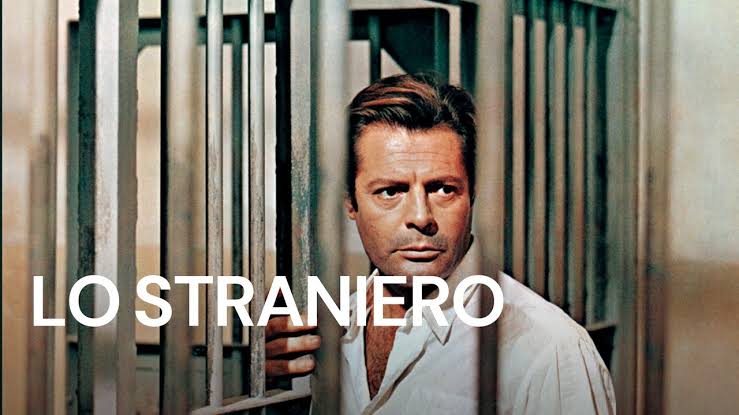
When I started watching this movie after reading Albert Camus’ The Stranger, the fact that a giant like Visconti was sitting in the director’s chair increased my expectations. When the movie ended, I was left with exactly this feeling: I found in front of me a loyalty that was not enough, a yellow and dirty atmosphere. How Loyal Is He to the Book? If what we are looking for in an adaptation is “fidelity to the text”, Visconti tried to achieve this but failed.
In any case, under the conditions of the period, Camus’s widow, Francine Faure, did not allow any radical changes in the script, so neither the film nor Visconti could make his own film. Meursault’s (Marcello Mastroianni) icy unresponsiveness at his mother’s funeral, his mechanical relationship with Marie (Anna Karina) and the absurd trial process in the court are all conveyed faithfully to the spine of the book. So What Are the Differences?
Although efforts are made to remain faithful to the text, there are some inevitable differences in nuance brought about by Visconti cinema and language: Opening Choice: The novel’s famous line “My mother died today. Maybe it was yesterday, I don’t know.” It starts with Meursault’s inner voice with the following sentence: Visconti, on the other hand, takes us directly into the story through the atmosphere of imprisonment and then returns to the past.
From Absurdity to Social Criticism: Camus’ Meursault is a philosophical “absurd” (absurd) figure; He has an intellectual and existential distance from life. Visconti, on the other hand, portrayed the character more as a social outsider who is “a victim of society’s hypocrisy.” The presence of a charismatic actor like Mastroianni inevitably makes Meursault a little more “lively” and watchable compared to the one in the book.
Language Barrier: The fact that Italian is spoken in a story set in Algeria and about the French colonial period blurs the local and political tension in the book a bit. Direction and Cinematography: Let’s talk about the main part of the film, the most discussed technical aspect of the film. Visconti’s direction is very strong in general; It succeeds especially well in conveying the scorching nature, heat and atmosphere of Algeria to us on the screen.
The Power of the Sun and the Landscape: The outdoor shots and landscape scenes created by Giuseppe Rotunno are simply perfect. The infinity of that Mediterranean coast, the blinding, pure white brightness that dazzles the eye and causes Meursault to commit murder, is a cinematographic feast. Set designs and wide angles convey Algeria. Let me give you some information: Albert Camus was born in Algeria and spent his childhood in Algeria.
However, the constant close-ups and sudden zooms that follow this visual success really hinder the fluidity of the film. The camera constantly zooms in hard on Mastroianni’s or other characters’ faces from a wide angle. Visconti’s aim here is to confront us with the stuckness, helplessness and narrowing of options in Meursault’s inner world. But after a certain point, this technique turns into an annoying visual insistence that tires the eyes and distracts people from the story, rather than a cinematographic intelligence.
Constantly going into the smallest detail of the character’s face just to see his famous “emotionlessness” damages the fascinating distance of the cinema. Conclusion: Lo Straniero is a work in which an attempt was made to literally translate a literature lesson into cinema, but failed. While you are mesmerized by the beauty of the landscapes, you become exhausted by the camera’s insistent and suffocating close-ups on faces.
Still, for Camus lovers, watching Mastroianni and Anna Karina under the burning sun is a unique experience, despite their cinematographic flaws.




Comments
You can write your views about this story. Comments may be moderated according to site settings.