
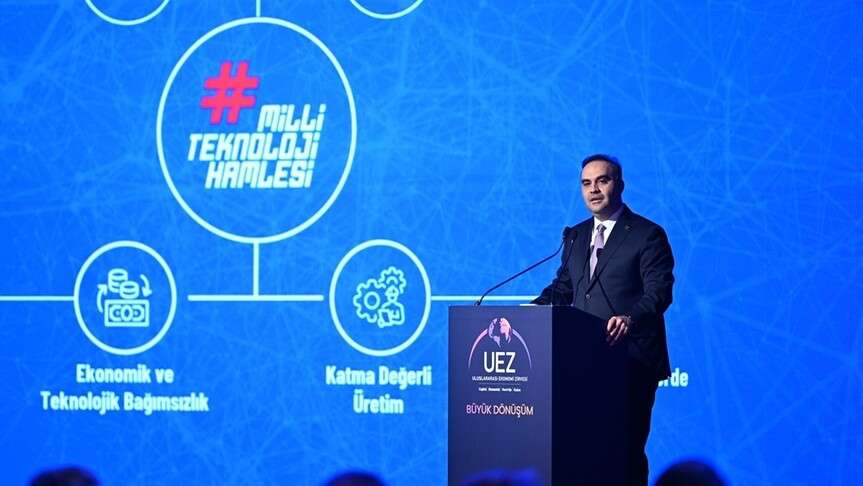
Minister of Industry and Technology Mehmet Fatih Kacır stated that the Turkish defense industry is among the top 5 countries in the world in many elements that change the warfare paradigm. Kacır touched upon global developments in his speech at the International Economic Summit (UEZ 2026) held in Sapanca district of Sakarya. Stating that Turkey managed to double its share in global trade from 0.55 percent to 1.07 percent, and its share in global production added value from 0.69 percent to 1.38 percent, Kacır said, “Turkey could only produce 41 billion dollars of manufacturing industry added value in 2002.
Last year, Turkish industry created 246 billion dollars of added value. 23 years have passed since 2025, the world has changed a lot. But if we had gone at the same pace as the world, we would have produced only 123 billion dollars of industrial added value. In other words, thanks to the advanced performance we demonstrated, we managed to produce 246 billion dollars of manufacturing industry added value.” he said. Kacır pointed out the export ability of the sectors and emphasized that two-thirds of the military unmanned aerial vehicle market globally is in the hands of Turkish companies.
Pointing out that Turkey is among the top 5 producing countries in Europe in many areas, Kacır said that they aim to increase their production capabilities to further levels with the steps to be taken in the coming period. Stating that Europe’s largest industrial countries are still far behind the pre-pandemic production levels, Kacır said, “In France, the production level is still 3 percent below the pre-pandemic January 2020 level.
In Italy, it is 5.4 percent lower. In Germany, the production level is still 11.8 percent lower than the pre-pandemic January 2020 level, that is, 6 years ago today. In Turkey, the industrial production level is still 11.8 percent below the pre-pandemic January 2020 level, that is, before the pandemic.” “It is 31 percent higher than before.” he said. “We are the exporting country with the fastest rising competitiveness after China.” Kacır underlined that Turkey managed to become one of the winning countries of the epidemic period and its aftermath, thanks to the strong industrial infrastructure it established and the dynamism and entrepreneurs in the production, technology, R&D and innovation ecosystem it achieved, and stated that the gains achieved at the technology level had a large share in this story.
Stating that 112 billion dollars of high-tech and medium-high technology products were exported last year, Kacır made the following evaluations: “When we look at our exports in 2025, we see that we have increased by 12.5 percent in high-technology products and 10.6 percent in medium-high technology products. When we look at the last 5 years, we can also state that all of Turkey’s increase in exports comes from high and medium-high technology products.
Turkey’s product portfolio has expanded a lot, the number of products we export competitively.” It has increased a lot, but beyond that, we have managed to make effective use of our geographical position, thanks to the right logistics investments and connectivity steps, and we have increased the number of countries we export to competitively, more than twice as much as 30 years ago. “Türkiye has become the exporting country with the fastest rising competitiveness in the wide geographical zone extending from China to mid-Europe.” “We allocated 1.5 percent of the national income to R&D.” Kacır explained that they allocated 1.5 percent of the national income to R&D, and that this rate is at similar levels to the leading industrial countries in Europe, and noted that the resources allocated to research and development have reached 20 billion dollars.
Stating that the Turkish private sector invests nearly 14 billion dollars in research and development every year, Kacır stated that the number of patent applications made in a year exceeds 11 thousand and that more than 12 thousand 800 technology enterprises in 114 technoparks continue their R&D and innovation-oriented works. Underlining that one of the main elements that differentiates us from similar countries in this success story is the defense industry, Kacır continued: “When we look back 23 years ago, we see that our entire defense and aerospace sector in Turkey had an economic size of 1 billion dollars a year, but now the Turkish defense and aerospace industry generates a sales income of over 20 billion dollars a year.
Our exports increased from 248 million dollars to over 10 billion dollars. Türkiye rose to 11th place in the world in defense and aerospace exports. “Currently, more than 1400 research and development projects are being carried out by the Turkish defense industry, and with a contract size of nearly 150 billion dollars, the defense and aerospace sector continues to grow with a perspective targeting the next 20 years.” “Achievements in the defense and aviation sector were not presented on a silver platter” Kacır said that this journey was not easy for Türkiye and that the successes achieved in the defense and aviation sector were not presented on a silver platter by others.
Explaining that Turkey often develops all subsystems, down to their core technologies, with its own means, Kacır said: “This may of course extend the duration of our projects, perhaps increase our costs, but ultimately it gave us such a capability that the Turkish defense industry has now become one of the top 5 countries in the world in many elements that change the war paradigm.” All these difficulties have actually brought Turkey to a level of capability in new generation defense industry technologies that many peer countries do not have on their own.
Our goal is to continue this journey strongly in the defense industry and to continue our efforts to successfully complete more than 1400 projects, while at the same time making all these opportunities and capabilities more interactive with other sectors of the industry.” “Large-scale investments are strongly supported” In his speech at the International Economic Summit (UEZ 2026) held in Sapanca, Kacır stated that they encouraged high technology investments much more strongly, that they launched the Investment Committed Advance Loan program together with the Central Bank, and that the scale of the program was 500 billion lira.
Stating that they have supported 77 projects within the scope of the program so far, Kacır emphasized that the total size of the projects is over 400 billion liras. Referring to the HIT-30 program, Kacır explained that large-scale investments to be realized in Turkey are strongly supported in areas such as mobility, healthy living, digital technologies, communications, space, green energy and semiconductors, for which 30 billion dollars of state support is expected until 2030.
“2026 will be the year when Turkey starts to benefit from nuclear energy.” Kacır pointed out that the navigation infrastructure and map software were developed domestically and nationally, and said that they aim to reach a level where domestic applications are used by the end of the year. Pointing out that the domestic nuclear reactor development project is one of the most strategic steps they have taken in the civilian field, Kacır reminded Turkey’s nuclear energy story.
Reminding that Turkey has taken an important step in this field with the Akkuyu Project, Kacır said, “2026 will be a year when Turkey starts to benefit from nuclear energy, and then the second, third and fourth phases of Akkuyu will hopefully be built, and hopefully Türkiye will implement the second and third major nuclear power plant projects.” he said. Kacır noted that they are carrying out a program for Turkey to develop its own nuclear modular reactor by 2030, thus a very critical step will be taken towards becoming a country that can produce its own nuclear energy.
“We have created the growth map of the Turkish industry for the next 30 years” Stating that the Technology Move Program is one of the main elements of the incentive system, Kacır underlined that they have supported 216 projects so far and that when these projects, with an investment size of approximately 200 billion liras, are completed, they will contribute 12 billion dollars annually to the trade balance. Referring to the local development move, Kacır emphasized that they aim for the total development of 81 provinces by evaluating the opportunities in different sectors such as agriculture, animal husbandry, tourism, health, mining and by taking action in new investments in areas such as creative industries in cities with more advanced development levels.
Reminding that they provided financial support of up to 301 million lira for each project in the new incentive system they announced last year, Kacır stated that they introduced direct grant support. Explaining that they continue to prioritize employment in cities with lower socioeconomic development levels, Kacır stated that the ministry covers the insurance premiums of employees working for up to 14 years in investments made in 24 cities.
Kacır pointed out that they created the growth map of the Turkish industry for the next 30 years by paying attention to many parameters in transportation, railway and port investments, and pointed out that Turkey has a planned industrial area of approximately 160 thousand hectares. “We will open a small phase of Terminal Istanbul in June” Kacır stated that they have recently started to provide very strong support to SMEs with the help of KOSGEB and said, “We have enabled 115 thousand SMEs to access approximately 64 billion liras of favorable financing in the last 2 years.
We have increased the support we offer to new enterprises established in Turkey several times. We have provided nearly 3.5 billion liras of resources to nearly 40 thousand entrepreneurs in the last 2 years.” he said. Kacır stated that they have launched other programs to reduce the difficulties that the industry may experience in accessing finance due to the recent tight monetary policy, and that they have announced a 100 billion lira selective loan program with the participation of 15 banks, and that they have offered financing opportunities to industrialists in all industrial sectors with a cost of 33 points, a grace period of 6 months and maturities extending up to 3 years, and that they will further diversify these opportunities in the coming period.
Explaining that they have transformed the Atatürk Airport terminal buildings into the world’s largest technology entrepreneurship center with the Terminal Istanbul brand, Kacır said, “We will hopefully complete a small phase at the end of May and open it in June. Hopefully, a year later, we have completed 50 percent of the Terminal Istanbul project and put it into service, and within two years, we have transformed all Atatürk Airport terminal buildings into Turkey’s largest technopark and at the same time the world’s largest technology entrepreneurship center, where incubation and acceleration programs will be implemented predominantly.” “We will be.” he said.
Emphasizing that the investment volume is very important for technology startups, Kacır pointed out that while in the previous period, an average of 100-150 million dollars of venture capital investment was made annually, in the last 5 years, the average size of investments in technology startups in Turkey increased to 1.1 billion dollars annually. “Turkey is among the top 4 countries in the world in hybrid rocket technology.” Referring to the Turkish Space Port they built in Somalia, Kacır stated that the work has started and construction has started, and that the port will begin to provide services when the first stage is completed.
Pointing out that they aim to create new opportunities with the unique capabilities in some technologies, Kacır continued as follows: “Turkey is among the top 4 countries in the world in hybrid rocket technology. If we can evaluate this technology in different applications in space and give history to this technology, we can competitively produce space vehicles that will provide inter-orbital transfer of satellites and market them to the world.
We can market both these vehicles and these services. Here, in addition to strategic gains, there is also a great economic value. The space economy is growing annually.” “It will approach 1 trillion dollars. In order for Turkey to become an assertive player in this field, it needs to do things different from what others do and make a difference in new technologies.” Sharing the latest developments regarding the artificial intelligence strategy, Kacır said, “We will hopefully share our 2030 Artificial Intelligence Strategy with the public in June.
We made a call for the participation of the society in this process, and yesterday, our call was completed and received tremendous attention. Thousands of ideas and projects were shared. “We will evaluate them effectively and hopefully we will announce Turkey’s new artificial intelligence road map by sharing with the public the new fund structures that will support artificial intelligence initiatives more strongly, including topics such as infrastructure, human resources, sectoral application perspective, original major language models.” he said.
Source: AA





Comments
You can write your views about this story. Comments may be moderated according to site settings.