
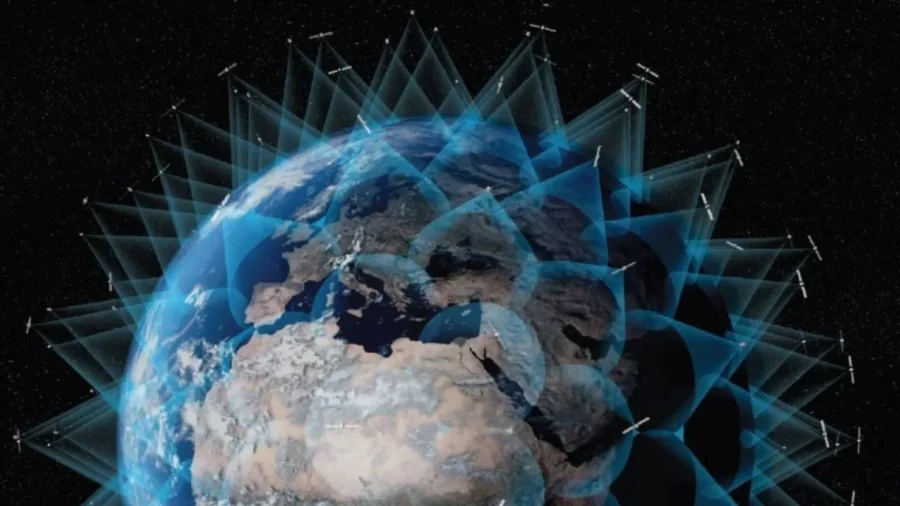
Satellite internet networks and megaconstellation projects have accelerated the growth of the space industry and opened a new debate on the atmosphere. Pollution from rocket launches, satellite returns and re-entry of space debris will account for 42 percent of the space sector’s total climate impact by 2029, according to a new study by UCL researchers published in Earth’s Future. Satellite megaconstellations accumulate soot in the atmosphere.
Large satellite networks in low Earth orbit, especially SpaceX Starlink, have significantly increased rocket launch traffic in recent years. According to the Satellite Industry Association’s 2026 report, 4,434 satellites were placed into Earth orbit with 296 launches in 2025. In other words, there is a 65 percent increase compared to 2024. The same report also included information that the commercial satellite industry will account for 71 percent of the global space economy with a revenue of $303 billion in 2025.
The new research focuses on the impact of this growth on the atmosphere. Using data from rocket launches and satellite deployments from 2020 to 2022, the UCL team modeled emissions from the megaconstellation until the end of the decade. Rocket launches, abandoned rocket bodies, satellites that have completed their useful life, and pollutants formed during re-entry were included in the calculation. According to the study, the share of these systems in the total climate impact of the space sector was approximately 35 percent in 2020.
It is calculated that this rate will increase to 42 percent in 2029. Researchers state that this estimate may remain conservative as the number of rocket launches in the 2023-2025 period exceeds the initial projections. The most striking element is the carbon black, or soot particles, that kerosene-based rocket fuels leave in the upper atmosphere. Rockets that use kerosene, such as the Falcon 9, carry these soot particles into the upper atmosphere during launch.
These particles remain in the atmosphere much longer than ground-based emissions such as automobiles and power plants because they are not quickly cleared by weather events such as precipitation. According to the UCL team, the climate-changing impact of rocket-generated soot is therefore approximately 540 times higher than that of soot from near-Earth sources. The research calculates that by 2029, the space sector will release approximately 870 tonnes of soot into the atmosphere per year.
This amount is shown to be close to the same scale as the 728 tonnes of soot emissions from all passenger cars in the UK. However, since the rocket-induced soot is carried directly to the upper atmosphere, its effect is felt more strongly than the same amount of terrestrial emissions. Scientists warn that this effect is based on a different mechanism than classical greenhouse gas warming. Soot accumulating in the upper atmosphere creates a slight cooling effect by reducing some of the sunlight reaching the Earth’s surface.
However, according to researchers, this effect is small compared to the overall temperature increase of global warming. Despite this, the process is considered a risky area as it is similar to geoengineering ideas that envisage cooling the planet by releasing particles into the upper atmosphere. The ozone layer was also examined in the study. Based on current trends, the impact of megaconstellation launches on ozone remains low for now because commonly used kerosene-fueled rockets do not emit chlorine.
According to the research, it is calculated that all rocket launches in 2029 will reduce global ozone by 0.02 percent. This rate is quite low compared to the 2 percent effect caused by ozone depleting substances regulated under the Montreal Protocol. However, the picture is not completely risk-free. Tens of thousands of new satellites are expected to be placed into orbit with projects such as Amazon’s Leo satellite network and China’s Guowang.
UCL researchers point out that some launch agreements may use solid-fuel rockets containing chlorine. Therefore, the future ozone impact may vary depending on which rockets and which fuel types will be used. The main message of the research is that the growth in the satellite industry should be considered not only in terms of orbital crowding and astronomical observations, but also in terms of atmospheric chemistry and climate impact.
The UCL team emphasizes that pollution from rocket launches and re-entry needs to be better measured, monitored and regulated.






Comments
You can write your views about this story. Comments may be moderated according to site settings.