
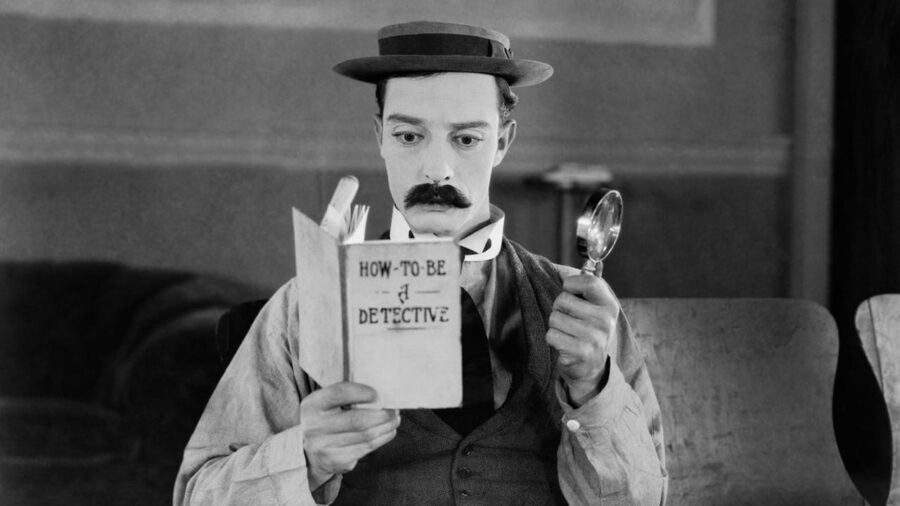
Sherlock Jr. was not only an early example in the history of cinema, but also one of the most concrete proofs of how editing and shooting techniques turned into narrative tools. In 1924, at a time when today’s digital possibilities were not even close, Buster Keaton tested the physical limits of cinema by using the camera and editing table like an engineer. When we leave aside the comedy elements of the film, we find a technical structure built entirely with mathematical calculations.
Spatial Editing and Cinema Ontology The sequence, which begins with the character falling asleep in the projection booth and continues with him stepping onto the big screen, is one of the first moments where cinema discusses its own nature. Here, Keaton does not just construct a dream sequence; It shows the audience the conflict between the two-dimensional world of cinema and the three-dimensional structure of reality.
Layered Shot: The hesitation the character experiences while entering the screen actually tells us that the frame is a universe independent of the outside world. The “double exposure” technique used in the shooting of these scenes required workmanship that did not allow any margin of error at that time. Destruction of the Perception of Place: The character inside the screen is constantly thrown into different places as the film changes.
This is the most raw and honest demonstration of how the concept of “unity of space” in cinema can be manipulated through editing. Engineering Precision in the Match-Cut Technique The continuity in the most talked about scenes of the film, where Keaton moves from the garden to the sea, from the sea to the land, from the snow to the desert, is not a coincidental success. Measurement and Stabilization: While shooting these scenes, the distance between the camera and Keaton at each new location was measured to the millimeter with surveying tools.
The aim is to keep Keaton’s coordinates within the frame constant, no matter how much the background changes, and not to disrupt the perception of continuity in the viewer. Visual Rhythm: The speed of the changes and Keaton’s physical lack of reaction to these changes prove how fiction can bend time. This sequence laid the foundation stones of action fiction in modern cinema 100 years ago. Physical Choreography and Practical Solutions Keaton’s physical performances in the film contain knowledge of physics beyond the actions called “stunts” today.
Motorcycles and Stability: There are no rear projections or trick shots in the driverless motorcycle scene. It is an illusion created entirely by the speed of the motorcycle, the slope of the road and the positioning of the camera. Keaton becomes part of a mechanical system, using his own body as a lever. Water Tower and Risk: In the scene where the water emptied from the water tower threw Keaton onto the rails, the force of the water caused Keaton’s neck to break (which he would learn years later during x-rays).
This is a stark example of how far practical effects can be pushed in the name of realism in cinema. Camera Manipulation and the Technical Significance of the Finale Keaton does not see the camera merely as a recording device; It positions it as an “eye” that can suspend the laws of physics. From the movement of the balls on the billiard table to the perspective games in the chase scenes, everything is based on pushing the limits of the frame.
In the final scene, the character approaches the woman he loves in real life by imitating the movements of the actor on the big screen second by second, which is a technical commentary on how cinema can manipulate human behavior. Here, rather than romanticism, we see how an “imitation” and “learning” mechanism is processed through visual fiction. In conclusion: Sherlock Jr. is the manifesto of cinema as a technical art form.
When we put storytelling aside and focus only on the technical layers, we can clearly see that Keaton actually used cinema as a laboratory and the camera as an experimental tool. The film remains one of the most solid fiction and visual mathematics lessons to survive from 1924.




Comments
You can write your views about this story. Comments may be moderated according to site settings.