
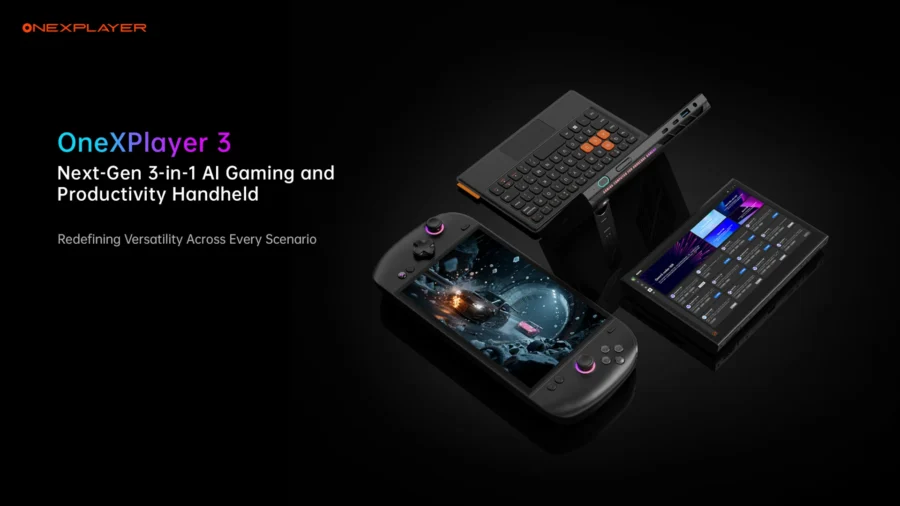
ONEXPLAYER announced its new Windows-based handheld console ONEXPLAYER 3 model. The device comes with Intel’s new Arc G3 Extreme processor, 8.8 inch OLED screen, 144 Hz refresh rate, VRR support, 85 Wh battery and detachable controllers. In addition to the handheld gaming experience, the handheld console is also prepared with a body structure suitable for tablet and laptop-like usage scenarios.
What does ONEXPLAYER 3 powered by Intel Arc G3 Extreme offer?
ONEXPLAYER 3 is listed as one of the first models to use the Arc G3 Extreme processor in the Arc G-Series family announced by Intel for Windows handheld consoles. Intel Arc G-Series family is based on Intel Core Ultra Series 3, namely Panther Lake architecture. The series consists of Arc G3 and Arc G3 Extreme processors for Windows 11-based portable gaming devices. Intel’s first partners include Acer Predator Atlas 8, MSI Claw 8 EX AI and OneXPlayer.

Intel Arc G3 Extreme in the device comes with a 14-core processor structure. This structure consists of 2 performance cores, 8 efficiency cores and 4 low power consumption efficiency cores. The processor has 14 threads, 12 MB Intel Smart Cache memory and a maximum turbo frequency of up to 4.7 GHz. According to Intel’s technical data, on the processor side, there is 25 W base power, 80 W maximum turbo power and 15 W minimum guaranteed power value.
On the graphics side, Intel Arc B390 GPU is used. This GPU comes with 12 Xe cores, 2.3 GHz maximum dynamic graphics frequency, DirectX 12 Ultimate support, ray tracing, AV1 encode/decode and Intel Quick Sync Video support.
Intel also offers XeSS 3, XeSS Super Resolution, XeSS Multi-Frame Generation and Xe Low Latency technologies in the Arc G-Series family. The new platform also includes titles such as precompiled shader files, Day-0 driver support, Xbox Mode, Thunderbolt 4, Wi-Fi 7 and Bluetooth 6.
An 8.8-inch OLED panel is used on the screen side of ONEXPLAYER 3. The screen has natural horizontal orientation, 144 Hz refresh rate, VRR support and HDR support. VRR support on the screen side of handheld consoles provides a more balanced viewing experience, especially at variable frame rates. ONEXPLAYER combines this panel with a high refresh rate and OLED display structure.
On the design side, the device differs from classical handheld consoles with fixed controllers. ONEXPLAYER 3 has detachable controllers. This structure allows the device to be used as a handheld game console as well as positioned as a screen on the table. With its Nintendo Switch-like stand structure and magnetic keyboard support, the device can also be used in tablet or small laptop form.
Hall Effect joysticks are used on the controller side. The Hall Effect structure works with a system that reduces wear caused by physical contact compared to traditional potentiometer-based joysticks. ONEXPLAYER 3 also has a built-in touchpad in the controller connection section. This detail makes it easier to control the mouse cursor in the Windows interface.
Connection and expansion options include USB4, USB Type-A, microSD card slot, mini SSD expansion space and 3.5 mm headphone jack. Battery capacity was announced as 85 Wh. This capacity is among the values that can be considered high in current Windows handheld consoles. Actual usage time will vary depending on game, power profile, screen brightness, TDP setting and performance mode.
ONEXPLAYER 3 comes as a model that uses an internal battery. This detail offers a different structure from some modular battery approaches that the brand has previously introduced. The device combines detachable controllers, OLED screen, large battery and Intel’s new handheld console processor in the same body.
The global release schedule for ONEXPLAYER 3 is given as June 2026. The device’s Indiegogo campaign is expected to start between mid-to-late June. Price information has not been shared yet. Therefore, the competitive level at which the device will be positioned will become clear with the final pricing and hardware configurations on the campaign page.
ONEXPLAYER also announced the ONEXPLAYER X2 Mini Pro model during the same period. This model uses the AMD Ryzen AI Max 395 platform. ONEXPLAYER 3 is distinguished by the Intel Arc G3 Extreme side. Thus, the brand expands the same design approach with two different high-end portable gaming devices based on Intel and AMD.



Comments
You can write your views about this story. Comments may be moderated according to site settings.