
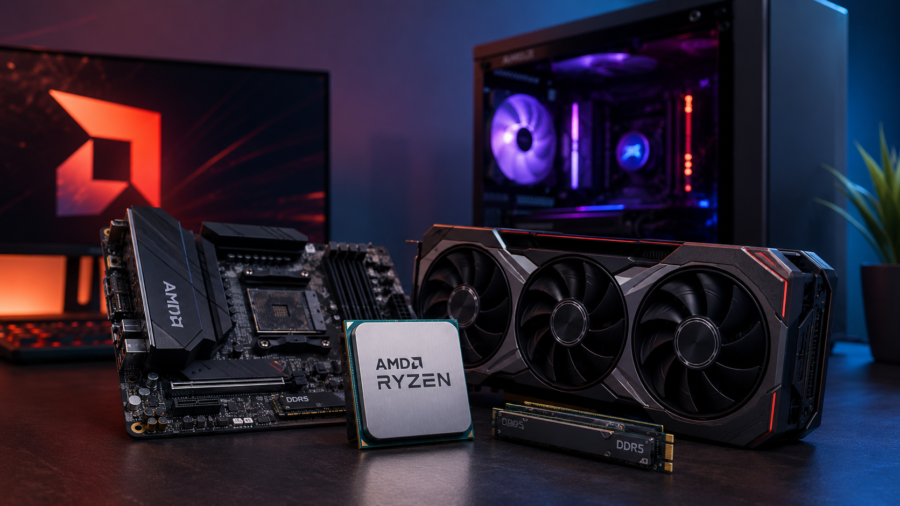
AMD’s Computex 2026 announcements show a different kind of PC hardware strategy. Instead of only pushing users toward the newest and most expensive systems, the company is also leaning into a practical message: many older gaming PCs still have room to grow.
That approach matters at a time when PC upgrades are becoming more expensive. Memory prices, high-end graphics cards and new platform costs can make a full rebuild difficult for many gamers and home users. AMD’s latest announcements suggest the company sees value in keeping older platforms alive while still offering new performance options.
At Computex, AMD highlighted the return of the Ryzen 7 5800X3D, new Ryzen 7 7700X3D processors, AMD EXPO Ultra Low Latency DIMMs and the global availability of the Radeon RX 9070 GRE. AMD Gaming listed those announcements together as part of its Computex update.
The most interesting part is the return of the Ryzen 7 5800X3D. That chip became popular because it brought AMD’s 3D V-Cache technology to the AM4 platform, giving many older systems a major gaming performance boost without requiring a full motherboard and memory upgrade.
For users still running AM4 systems, that kind of chip can be attractive. A full platform jump often means buying a new CPU, motherboard and RAM. A drop-in upgrade, where supported, can be much cheaper and simpler.
This is why AMD’s move has a strong consumer angle. Not every PC user wants to chase the newest socket or build a system from zero. Many people want to extend the life of a PC they already own.
The Verge described AMD’s Computex message as a pitch that its older technology is still good enough to keep using, especially as the wider PC market deals with expensive components and memory pressure. The outlet also noted that AMD is promising support for AM5 through 2029.
That platform-support message is important. PC builders often choose AMD or Intel based not only on today’s performance, but also on upgrade path. A platform that supports multiple CPU generations can make a build feel safer and more cost-effective over time.
For gamers, the X3D chips remain especially interesting because many games benefit from larger cache. That does not mean every game will see the same improvement, and users still need to check motherboard compatibility, BIOS support and cooling needs. But X3D processors have become one of AMD’s clearest gaming strengths.
The new Ryzen 7 7700X3D also fits into that story. It gives AM5 users another X3D option below the very top-end chips. That could appeal to people who want strong gaming performance but do not need the most expensive CPU in the lineup.
AMD’s Radeon RX 9070 GRE is another piece of the update. AMD Gaming says the card is now available globally, after previously being more limited.
For buyers, this matters because the graphics card market is still highly price-sensitive. Many gamers are not shopping for the absolute fastest GPU. They are looking for a card that offers solid performance at a price that does not force a full system rebuild.
That is where midrange and upper-midrange GPUs can become important. If a card fits between lower-end and higher-end models, it can give users another option for 1440p gaming, content creation or general performance without jumping into flagship pricing.
The bigger story is that AMD is trying to compete on upgrade flexibility. Nvidia is pushing deeper into AI PCs and consumer chips, Intel is trying to rebuild confidence with new platforms, and Qualcomm is targeting thinner, more efficient laptops. In that environment, AMD’s message is more grounded: your current PC may still have life left.
That can be a powerful message for ordinary buyers.
A gamer with an older AM4 system may not care about the most advanced AI laptop chip. They may care about whether a CPU upgrade can make their existing desktop feel faster. A creator with a midrange GPU may care about whether a new card gives enough performance without requiring a new power supply or full rebuild.
AMD’s strategy also fits the mood of the PC market. Many users are more cautious with spending. A practical upgrade can feel more appealing than a complete replacement. If AMD can show clear upgrade paths for both AM4 and AM5 users, it can keep more customers inside its ecosystem.
There are still limits. Older platforms cannot last forever. Newer memory, storage, I/O and chipset features will eventually matter. Users who need cutting-edge performance, professional workloads or next-generation connectivity may still benefit from a full platform upgrade.
But for gaming and everyday performance, the picture is more nuanced. A well-chosen CPU or GPU upgrade can extend a desktop’s useful life by years.
That is why AMD’s Computex announcements are not just hardware news. They reflect a wider shift in how people think about PC value.
The best upgrade in 2026 may not always be the newest platform. For many users, it may be the part that makes an existing PC good enough for longer.
AMD appears to be betting that this message will resonate. In a market full of expensive AI PCs and premium hardware, “keep your old PC alive” may be one of the most practical pitches of the year.





Comments
You can write your views about this story. Comments may be moderated according to site settings.