
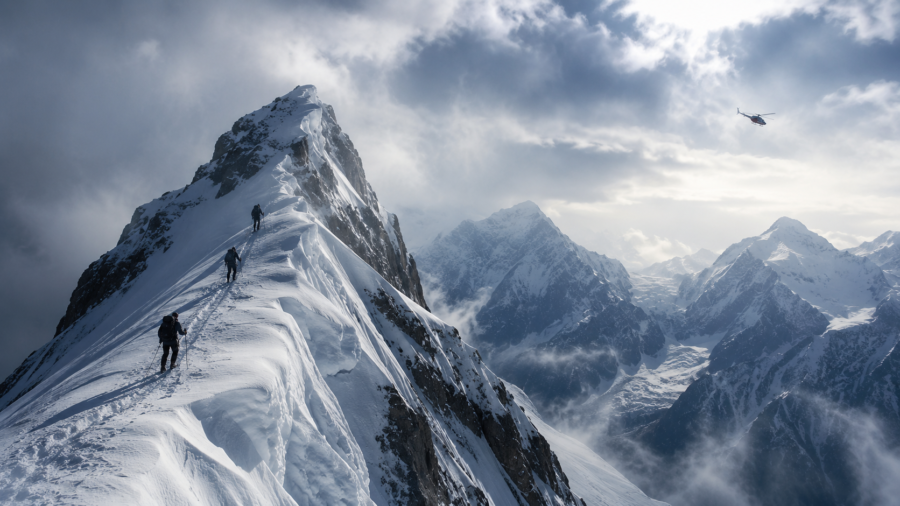
The deaths of three climbers near Denali Pass in Alaska are drawing renewed attention to how quickly high-altitude mountain conditions can turn dangerous, even for organized expeditions.
Three Latvian climbers died after falling near a treacherous section of Mount McKinley, also known as Denali, according to the Associated Press. A fourth climber was rescued by helicopter after the fall, which happened around 18,200 feet on the West Buttress route.
The West Buttress is the mountain’s most commonly used route, but that does not make it easy. Climbers still face severe altitude, glaciated terrain, hard ice, steep traverses and weather that can change rapidly. The area near Denali Pass is one of the most serious sections of the climb.
AP reported that the incident occurred near a part of the route known as the Autobahn, a steep traverse between high camp and Denali Pass. The section has a history of serious accidents, many involving unprotected falls during descents.
That detail matters because descents can be especially dangerous. Reaching a summit often receives the most attention, but climbers are frequently tired, dehydrated and exposed when coming down. At high altitude, judgment can weaken, weather can shift, and a hard icy slope can leave little room for recovery after a slip.
Denali is North America’s highest peak, and its conditions are more severe than its elevation alone suggests. The mountain rises from low surrounding terrain, creating extreme weather exposure. Climbers can face intense cold, high winds, whiteout conditions and oxygen-thin air.
Reuters reported that the fall occurred just under 2,100 feet below the summit. The outlet also said the fourth climber was rescued and was in critical condition.
The rescue itself shows the difficulty of responding to emergencies on Denali. Helicopter operations at high altitude are complex, and terrain can limit where aircraft can safely reach. In this case, AP reported that the rescued climber had to be lifted by long line because of difficult conditions.
For climbers, Denali requires more than fitness and technical skill. Teams must manage acclimatization, rope systems, weather windows, avalanche risk, glacier travel, camp logistics and descent timing. A mistake or sudden change in conditions can become serious quickly.
The tragedy is also a reminder that familiar routes can still be deadly. Popular climbing routes often have established camps, known hazards and regular traffic, but that can sometimes create a false sense of security. Conditions on a mountain can change from one day to the next.
For expedition teams, the key safety questions often involve timing and protection. Are climbers moving when weather and visibility are stable? Are they roped appropriately for the terrain? Are fixed lines or running protection being used where a fall would be difficult to stop? Is the team still strong enough for the descent?
Those decisions are complicated by altitude. At more than 18,000 feet, the body is under significant stress. Fatigue can build slowly, and small problems can become harder to solve. Cold hands, poor visibility, low energy or a delayed descent can all raise risk.
For the public, the Denali accident may seem distant, but it carries a broader outdoor safety lesson. Dangerous terrain does not always look dramatic in advance. Snow, ice and exposure can turn a routine section of a route into a high-consequence zone.
That is why mountain rescue professionals and experienced climbers emphasize preparation, conservative decisions and the willingness to turn back. The safest summit attempt is the one that leaves enough strength and daylight for the descent.
The deaths near Denali Pass will now be part of the mountain’s long record of serious accidents. AP noted that more than 130 climbers have died on the mountain historically, and fewer than half of the 1,000 to 1,200 climbers who attempt it each year reach the summit.
For the families and teammates affected, the loss is immediate and personal. For the wider climbing community, the incident is another painful reminder of Denali’s seriousness.
High-altitude climbs can turn fast because the margin for error is small. On Denali, that margin can shrink even further near exposed passes, hard ice and rapidly changing weather.


Comments
You can write your views about this story. Comments may be moderated according to site settings.