
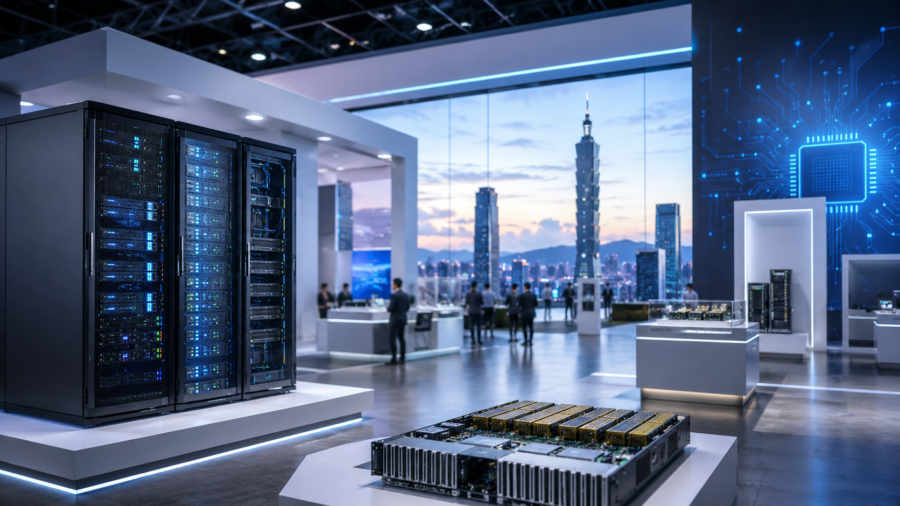
Computex 2026 is shaping up to be more than a hardware trade show. This year, the Taipei event is becoming a global stage for the infrastructure race behind artificial intelligence.
The annual technology show, held in Taiwan from June 2 to June 5, is expected to put Nvidia and Taiwan’s expanding role in AI infrastructure at the center of the industry conversation. Reuters reported that Nvidia CEO Jensen Huang is set to dominate proceedings, while deeper ties between Nvidia and its Taiwanese partners could become a key theme.
That focus reflects a broader shift in the AI boom. The public often sees artificial intelligence through chatbots, image generators, search tools and workplace software. But behind those tools is a physical supply chain of chips, servers, cooling systems, networking equipment and data centers.
Computex is where that supply chain becomes visible.
Taiwan has long been central to the global semiconductor industry. But its role is expanding from chip manufacturing into the wider AI infrastructure ecosystem. Reuters noted that the island now has a diverse network of AI server manufacturers, packaging companies and component suppliers that are crucial for AI data centers.
That makes this year’s Computex especially important. AI demand has created a race not only to build better models, but to build the machines that can run them. Cloud providers, chipmakers and enterprise customers need more computing capacity, and much of that capacity depends on hardware supply chains connected to Taiwan.
Nvidia is expected to be the most visible company at the event. Its graphics processors remain central to AI training and inference, and its platform strategy increasingly extends into networking, data center systems and what the company describes as AI infrastructure. Nvidia’s official GTC Taipei program says the company and its partner ecosystem will showcase AI platforms, physical AI, AI compute and AI infrastructure during the Computex week.
That language is important. The AI market is no longer only about individual chips. It is about full systems: processors, server boards, racks, interconnects, cooling and software working together. Companies that control more of that stack may have a stronger position as demand rises.
The timing also comes as Taiwan’s economy is benefiting from AI-related demand. Taiwan recently raised its 2026 growth outlook, with strong AI and high-performance computing demand lifting exports and investment. That economic momentum gives Computex a larger significance than usual: the trade show is now tied directly to one of Taiwan’s main growth engines.
For visitors and businesses, this means Computex may feel less like a product showcase and more like a map of the next AI supply chain. Server makers, chip suppliers, motherboard companies, cooling providers and cloud infrastructure partners are all part of the same story.
The event may also highlight a new competitive phase for PCs. Reuters reported that Nvidia and Microsoft are expected to unveil the first Windows PCs powered by Nvidia chips next week, with the launch tied to Computex and Microsoft’s Build developer conference. That could mark a significant step in the push toward more energy-efficient chips for Windows devices.
That PC angle matters because AI is moving in two directions at once. On one side, companies are building larger data centers to handle massive AI workloads. On the other, chipmakers and software companies want more AI tasks to run directly on personal computers and edge devices.
Computex sits at the intersection of both trends. It can showcase powerful infrastructure for cloud AI while also introducing devices that bring AI features closer to users.
For the wider technology industry, the event is a reminder that AI leadership depends on more than software talent. It depends on manufacturing capacity, supply-chain coordination and the ability to turn demand into reliable hardware at scale.
That is why Taiwan’s role is so important. The island’s companies sit inside many of the world’s most important technology supply chains. If AI demand keeps rising, those companies will remain central to how quickly the industry can expand.
There are also challenges. AI infrastructure requires large investment, energy planning and reliable component supply. Any bottleneck in advanced packaging, server assembly or power availability can slow deployment. Computex may therefore reveal not only what companies want to build, but where the industry’s pressure points are forming.
For consumers, the announcements may eventually show up as faster AI tools, more capable laptops, better workplace software and new cloud services. But the first signs will appear in server rooms, chip roadmaps and infrastructure partnerships.
Computex 2026 is likely to be watched closely because it captures where AI is heading next. The excitement is no longer only about what AI can say or generate. It is about who can build the physical backbone that keeps it running.






Comments
You can write your views about this story. Comments may be moderated according to site settings.