
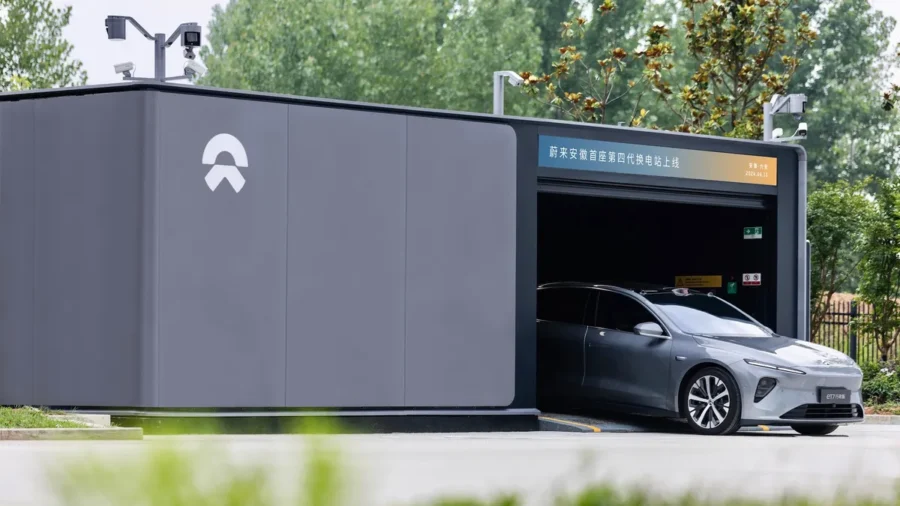
Chinese electric car manufacturer NIO showed with new data the scale reached by its battery replacement system during the May holiday period. The company’s 3 thousand 839 battery change stations in China provided a total of 1 million 31 thousand 469 battery change services between April 30 and May 6, 2026. This number revealed that the battery swapping system in electric cars is not just an experimental solution, but works as a high-volume infrastructure during peak travel periods.
The NIO battery swapping system has reached large scale in China. Fast charging times in electric cars have been seriously shortened in recent years. Despite this, NIO continues to grow in a different way. The company’s battery replacement stations automatically remove the empty battery of the vehicle and replace it with a charged battery pack. According to NIO’s own data, this process takes an average of three minutes.
Thus, the user can continue on his way without having to wait for the classic fast charging process. NIO’s latest data came especially during the May holiday period in China. 1 million 31 thousand 469 battery replacements made between April 30 and May 6 correspond to an average of approximately 147 thousand 350 transactions per day. The company’s busiest day was May 1. That day, 170 thousand 585 batteries were replaced through the NIO network.
This number was slightly below the daily record of 177 thousand 627 units that the company saw during the Spring Festival travel period in February. Behind this density is the long-distance traffic in China. May holiday is one of the periods when millions of people in the country go on intercity trips. According to NIO’s data, between May 1-5, the company’s charging and battery replacement facilities on the highway provided more than 15.43 million kWh of energy in total.
NIO announced that this amount corresponded to 16.3 percent of the total electric vehicle charging and replacement volume on Chinese highways in the same period. For NIO users, battery replacement on the long-haul side has become one of the main methods of getting energy. According to the company’s data, more than 75.8 percent of the energy received by NIO users in highway scenarios came from battery replacement services.
During the same period, more than 220 thousand users relied entirely on battery replacement services for long-distance trips. More than 130 thousand users traveled more than 1,000 kilometers during the holiday. This number increased by 70.5 percent compared to the same period last year. Another advantage of the battery replacement system is that it reduces the load on the energy network. The simultaneous high power consumption of many vehicles at fast charging stations creates serious demand on the local grid.
At battery replacement stations, empty batteries are charged at slower speeds within the station and the charged packs are installed in other vehicles. This structure offers a different model in terms of network management, especially during sudden demand increases during holiday periods. NIO has been investing in battery replacement for a long time. The company commissioned its first battery replacement station in 2018.
It completed its 100 millionth battery replacement on February 6, 2026. According to NIO’s statement, a total of 5.28 billion kWh of energy was provided to users with 100 million battery replacements. The company stated that these operations saved a total of 83.41 million hours compared to classical charging. NIO’s infrastructure does not only consist of battery replacement. According to data provided by CnEVPost, the company operates 5 thousand 10 charging stations and 28 thousand 806 charging units in China.
More than 87 percent of the energy provided at these charging stations during the May holiday period went to electric vehicle users of other brands. This data shows that NIO’s energy network is not limited to its own users. Although the strength of the battery replacement system is speed, the model has significant challenges. It is not enough for the manufacturer to just establish a station; Each station needs to have a large number of spare battery packs, manage these batteries and design the vehicle architecture in accordance with this system.
This means serious capital and operational costs. Additionally, battery replacement technology is not currently standardized on a wide scale. NIO’s system works mainly with NIO and Onvo models. Therefore, common technical standards are critical for battery replacement to gain wider coverage in the automotive industry. NIO is collaborating with the Chinese battery giant CATL in this field. The two companies made an agreement to develop a battery exchange network.
CATL will support NIO’s new Firefly branded models with Choco-Swap technical standards and network. Under the same cooperation, CATL will invest up to 2.5 billion yuan in NIO Power. The idea of battery replacement is not new in the automotive industry. Renault launched the Fluence Z.E. in 2011. He tried this model through the Better Place network. Tesla has also tested the idea of battery replacement in the past, but dropped out due to lack of interest.
NIO, on the other hand, continued to expand the same technology with large-scale infrastructure investment in China. At this point today, the company has made battery replacement not just a technical demonstration, but an active energy intake model for daily use and long road trips. NIO’s next step will be the fifth generation battery replacement stations. According to information previously shared by the company management, large-scale installation of new generation stations will begin in July and August.
These stations will come with a new architecture that supports vehicles with wider wheelbases and will be compatible with NIO, Onvo and Firefly models. The company is also expanding its long-haul network. NIO planned to complete the Hexi Corridor section of the Silk Road battery replacement route on May 10. The entire Silk Road battery exchange route is expected to be connected in the second half of the year. Once this is completed, users will be able to travel to all province-level regions in mainland China relying solely on battery replacement services.





Comments
You can write your views about this story. Comments may be moderated according to site settings.