
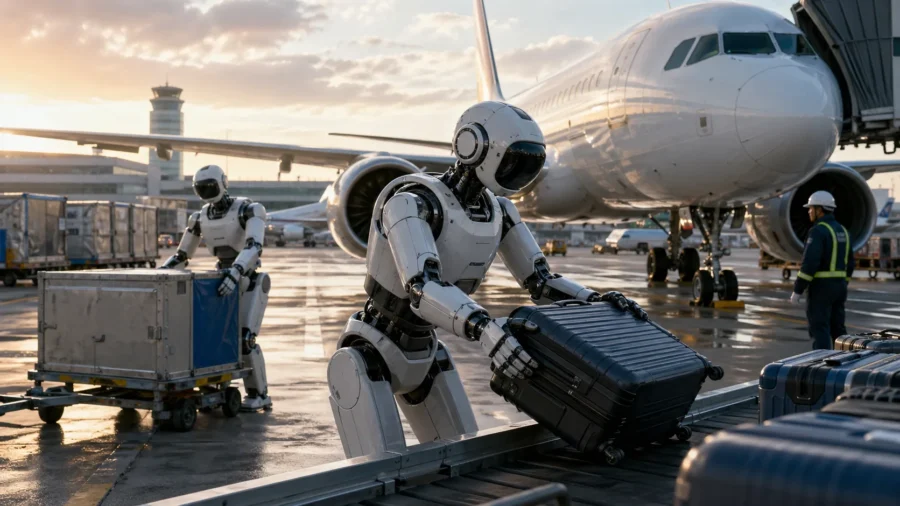
Japan Airlines is preparing to test humanoid robots in baggage and cargo handling operations at Tokyo Haneda Airport. The trial, which will start at the beginning of May, is seen as a search for a new solution against the increasing number of tourists and the deepening workforce deficit in the country. Summary in 10 Seconds Japan Airlines will begin trials of carrying luggage and cargo with humanoid robots at Tokyo Haneda Airport at the beginning of May.
The tests, which will last until 2028, aim to reduce the burden on human workers by taking on physically tiring tasks. The increasing number of tourists in Japan and the labor shortage due to the aging population make the use of robots in airport operations more important. Baggage personnel working in the background of airport operations in Japan are facing an increasingly heavy load due to intense physical tempo and increasing passenger traffic.
To alleviate this burden, Japan Airlines will include humanoid robots developed by China-based Unitree in the testing process at Haneda Airport. Humanoid robots will be tested at Haneda Airport. The project, which will be carried out in cooperation with Japan Airlines and Japan Airlines GMO Internet Group, will continue until 2028. During the trial period, robots will be used to carry passenger luggage and cargo in the apron area where the aircraft are located.
Tokyo Haneda Airport is one of the busiest airports in Japan, serving more than 60 million passengers annually. Therefore, the test to be carried out here is not only a technological demonstration, but also important to see the practical limits of the use of robots in airport operations. In the demonstration organized for the media, a 130 cm tall humanoid robot produced by Hangzhou-based Unitree was seen pushing the cargo towards the conveyor belt next to a JAL passenger plane.
It was stated that the robot can interact with its environment at a basic level during work and perform its task in a controlled manner. The aim is to reduce the burden of human employees. JAL Ground Service President Yoshiteru Suzuki stated that the use of robots in physically demanding jobs will reduce the burden on employees and provide significant benefits. However, according to Suzuki, critical tasks such as security management will continue to be carried out by human personnel.
This statement shows that robots will play a supporting role in airport operations rather than completely replacing humans. Particularly repetitive physical tasks such as baggage handling, cargo orientation and similar repetitive physical tasks will be among the first areas of use of robots. It is stated that the robots can work for approximately 2 to 3 hours on a single charge. In the future, companies plan to use these robots not only for luggage transportation but also for different tasks such as aircraft cabin cleaning.
Japan is looking for a solution to its labor shortage with technology. Japan is struggling with the tourism demand reaching record levels on the one hand, and with the labor shortage created by the aging and decreasing population on the other. More than 7 million people visited the country in the first two months of 2026. Last year, Japan broke a record with 42.7 million visitors. This density leads to the need for more personnel in tourism and service sectors, especially in airports.
According to estimates, Japan may need more than 6.5 million foreign workers to maintain its growth targets by 2040. However, immigration policies in the country are also under political pressure. For this reason, robotic solutions are not only a technological innovation for Japan, but also one of the strategic tools developed against the demographic crisis. The robot era is approaching at airports. Tomohiro Uchida, President of GMO AI and Robotics, said that although airports appear quite automatic and standard from the outside, background operations are still largely based on human labor.
According to Uchida, these areas are facing serious labor shortage. Japan Airlines’ humanoid robot trial at Haneda Airport will be one of the important tests that will show how effectively robots can be used in the aviation industry. If the trial is successful, it may be possible to see robots carrying luggage, directing cargo and cleaning cabins more frequently at airports in the coming years. Editor’s note Japan’s testing of humanoid robots in baggage operations at Haneda Airport shows that robot technologies are no longer just window displays but are starting to enter daily workflows.
However, the real striking point here is not that robots completely replace human workers; positioning it as a supportive solution against the aging population, increasing tourism pressure and physically tiring work. The success of the trial could determine how quickly robot use will spread in busy operational areas such as airports in the coming years. Do you think using humanoid robots in physical tasks such as baggage handling at airports is a good solution, or should these tasks still be left to human employees?
Share your opinions in the comments.





Comments
You can write your views about this story. Comments may be moderated according to site settings.