
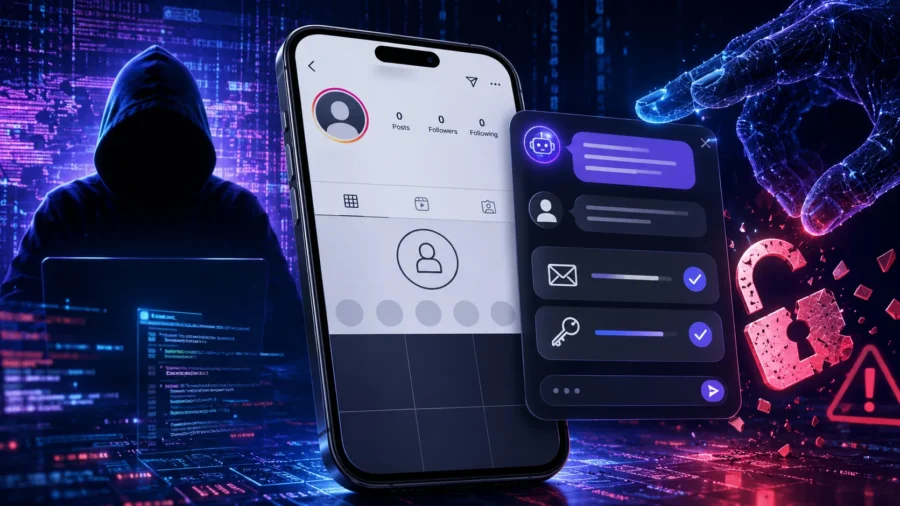
The security vulnerability that caused some user accounts to be compromised on Instagram has been closed. However, the striking aspect of the incident was that the attackers gained access to the accounts by deceiving Meta’s own artificial intelligence-supported help bot, rather than using a complex malware or classic phishing method. According to TechCrunch, the attack was carried out through Meta AI Support Assistant.
The attackers asked the support bot to add a new email address to the target Instagram account. The verification code was then sent to the email address controlled by the attacker, and this code was transmitted back to the bot. After this process, the bot showed the password reset option and the attacker took over the account by setting a new password. The Instagram vulnerability also affected high-profile accounts. Over the weekend, many users on Reddit and X reported that their Instagram accounts were compromised.
The affected accounts included the Obama-era White House Instagram account, the account belonging to U.S. Space Force Sergeant Major John Bentivegna, and some high-profile accounts. The Verge and The Guardian also reported that the Obama-era White House account and other well-known accounts were targeted in the incident. Security researcher Jane Wong also said that her Instagram account was compromised. Wong stated that his password was changed without his knowledge and that he received different password reset attempts throughout the day.
Instagram spokesperson Andy Stone announced that the problem was fixed in his response to Wong’s and other users’ posts. How was the Meta AI support bot deceived? According to the shared videos, the attackers used VPN to appear close to the target user’s location. With this method, they tried to reach the support process without triggering Instagram’s automatic security checks. Then, a conversation was started with Meta AI Support Assistant and a request was made to add a new e-mail address to the target account.
The attack chain proceeded as follows: The attacker used a VPN to appear close to the location of the target account. Meta AI support bot was asked to add new email to the target account. The verification code was sent to the email address provided by the attacker. The code was transmitted to the bot again and the password reset button was opened. The account was compromised by setting a new password. In this process, the attackers no longer needed to access the victim’s existing email account.
The most critical point of the problem emerged here. While additional checks such as existing email, phone number, device history or multi-factor authentication are normally expected to come into play in account recovery processes, it was claimed that the bot was able to advance the flow of adding new emails and resetting passwords without sufficient verification. New warning for artificial intelligence-supported customer services.
This incident shows that artificial intelligence-supported customer service tools need to be seriously tested not only in terms of user experience but also in terms of security. When support bots access critical operations such as account recovery, email change and password reset, they can become vulnerable to social engineering attacks from malicious users. Although the Meta side says that the problem has been resolved, it is not yet known how many Instagram accounts were accessed without permission.
It is stated that the company is working to secure the affected accounts. What should Instagram users do? To increase account security, Instagram users need to enable two-factor authentication, check connected email addresses and phone numbers, log out of unknown devices and examine whether there are any unexpected changes in account recovery information. Using only strong passwords is no longer enough, especially for accounts with high followers, brand accounts and corporate profiles.
Account recovery processes have become at least as important as login security. The fact that Meta has closed this gap is a positive development for users. However, the incident once again showed that AI-based support systems, when misconfigured, can become a new gateway for attackers.





Comments
You can write your views about this story. Comments may be moderated according to site settings.