
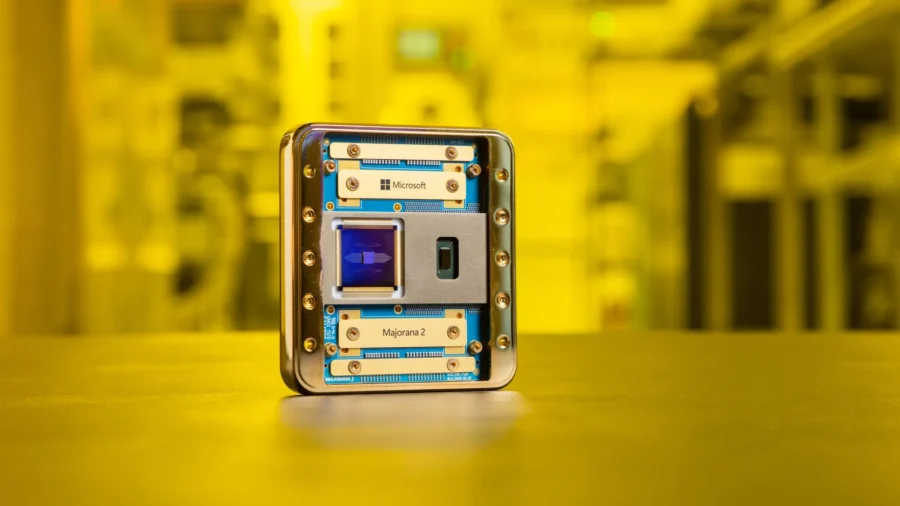
Microsoft announced the next generation topological quantum chip, Majorana 2. According to the data shared by the company, the qubits in the new chip work 1,000 times more reliably than the previous generation. While the average qubit lifetime in Majorana 2 exceeded 20 seconds, the quantum state was preserved for up to a minute in some measurements. With this development, Microsoft moved the scalable quantum computer calendar to 2029.
Majorana 2 came with a new material structure. Microsoft’s new step in the quantum hardware side was Majorana 2, built on Majorana 1. The company replaced the aluminum-based superconducting structure used in the first generation with lead in the new chip. In the semiconductor active region, a combination of indium arsenide and indium arsenide antimonide was used. This change ensured more stable operation of the topological phase.
According to the information shared by the Microsoft Quantum team, the new material structure has more than doubled the topological spacing that protects topological qubits against environmental noise and errors compared to the previous generation. This material update is at the center of the performance increase in Majorana 2. In Majorana 1, the qubit lifetime in the aluminum-based structure varied between 1 and 12 milliseconds.
In Majorana 2, the average lifespan increased to over 20 seconds. Microsoft announced that in some samples, qubits maintain their quantum state for up to a minute. The company shared this difference as a more than 1,000-fold increase in reliability. Processing times were also included in the technical information provided by Microsoft. In Majorana 2, operations occur on a microsecond scale. The qubit size is one hundredth of a millimeter.
The company pointed out the advantages of the topological qubit architecture in terms of low error rate, small physical size and digital control. The qubit structure in Majorana 2 consists of topological qubits called tetrons. This structure uses two superconducting nanowires and Majorana zero modes at their ends. In quantum computers, information is kept based on parity information depending on whether the number of electrons in the topoconductor wire is even or odd.
In topological quantum computing, basic operations proceed through measurement. In Microsoft’s architecture, parity measurement gives a result of 0 or 1, and these results are used in the calculation process. Quantum dots are connected and separated from nanowires with digital pulses. This control and reading method is also used for quantum error correction processes. Microsoft benefited from the Microsoft Discovery platform during the development process of Majorana 2.
Artificial intelligence agents, which the company calls agentic AI, were used in areas such as managing production processes, automating measurements, detecting production defects and preparing new solution suggestions. The data of the Microsoft Quantum team, spanning years, was analyzed with artificial intelligence agents working on Discovery. The company stated that data from different disciplines are reprocessed with correlations that a single researcher cannot see manually.
In this process, software, architecture, design, material stack, production steps and measurement data were considered together. The measurement side is one of the most complex stages in the quantum computer development process. Creating the topological state in Majorana 2 requires adjusting hundreds of parameters. According to Microsoft’s statement, these processes could previously take weeks. Special agents prepared on Discovery automatically ran measurement cycles and managed multiple voltage settings in parallel.
Artificial intelligence agents were also used to determine which state the qubit was in and analyze the electron distribution on the semiconductor wire. The system automatically scanned the operating conditions and created three-dimensional maps. Microsoft also used artificial intelligence agents to filter out noise in production data. In one of the examples given by the company, the agent detected a temperature sensor whose calibration was disrupted during the production process.
A separate announcement was also made by Microsoft Discovery. Platform, Frontier R According to Microsoft’s statement, the application can be downloaded for free and works with the GitHub Copilot account. Microsoft has also updated its scalable quantum computer calendar with Majorana 2. The company halved the previous timeline and pointed to 2029. This schedule was announced for the development of a fault-tolerant quantum computer with commercial use value.
Majorana 2 is also progressing in connection with the quantum evaluation process carried out by Microsoft with DARPA. DARPA’s Underexplored Systems for Utility-Scale Quantum Computing program and Quantum Benchmarking Initiative studies are carried out to verify and evaluate quantum systems that can be used on an industrial scale. In this process, Microsoft is working on a topological qubit-based fault-tolerant prototype.
In Microsoft’s statement, it was stated that quantum computers can be used in problems that are very difficult to solve with classical computers in global health, food supply, sustainability, energy production and different scientific fields.



Comments
You can write your views about this story. Comments may be moderated according to site settings.