
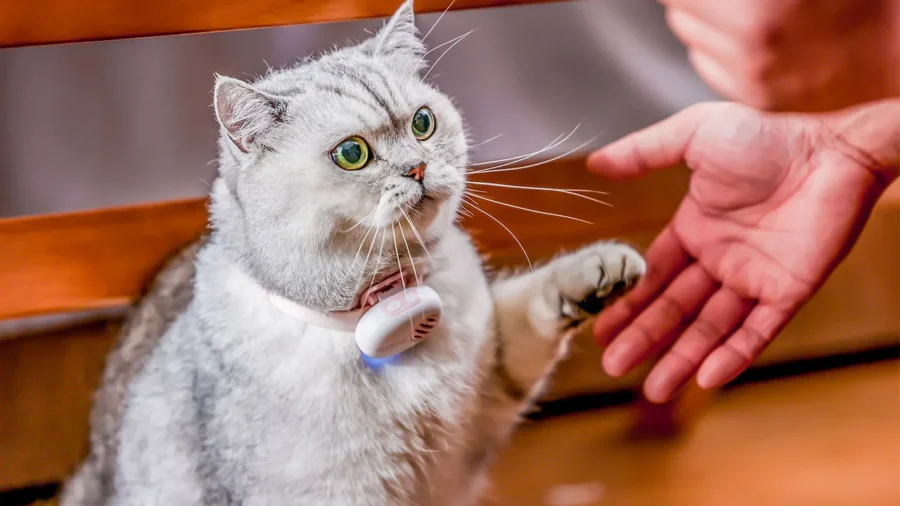
PettiChat has launched its new translation device on Kickstarter, which interprets pets’ voices with artificial intelligence and turns them into understandable sentences on the phone. The small device attached to the cat and dog collar analyzes sounds such as meowing and barking, processes them with movement data and shows them as text to the user through the application. PettiChat interprets pet sounds with artificial intelligence.
The collar-mounted device analyzes the pet’s voice, rhythm, tone and physical behavior together with its built-in microphones and motion sensors. The basic operating logic of the device is based on combining sound data with movement and context information, rather than reading a meow or bark alone. According to the technical information shared by the company, PettiChat turns pet sounds into short sentences that can be seen in the application within a few seconds.
The device is not limited to animal-to-human translation, it is stated that it also translates verbal commands from the user into sounds that pets can instinctively recognize. For this reason, the product comes to the market with the claim of two-way communication, unlike classical pet translator applications. The weight of PettiChat is approximately 27 grams. This structure allows the device to be used by clipping it directly to the collar.
The product works with an artificial intelligence model that was announced to be developed for cats and dogs. It was shared that the model was trained with more than a million sound and behavior examples, and more than a thousand real cats and dogs were used during the two-year testing period. In the technical description of the device, the accuracy rate of 94.6 is highlighted. However, this rate is based on the company’s own test data.
A peer-reviewed scientific publication or public data set that independently verifies PettiChat’s accuracy claim has not yet been shared. For this reason, the performance of the device in the real home environment is a topic that should be evaluated separately from laboratory or demonstration data. On the application side of PettiChat, there is also a learning system called AI Adaptive Learning. This feature allows the device to recognize the same pet’s vocal habits over time.
Users can view the conversation history in the application and access the translation records received on the device. The product also includes location tracking and safe zone alerts, and a notification is sent to the phone when the pet goes out of the designated area. The broader technology narrative behind PettiChat is shaped around the Animal Behavior World Model called PETTI. The company states that it processes pets’ sound, movement, visual and behavioral signals with a multi-modal artificial intelligence architecture.
It is stated that this model can be used not only in translation in the long term, but also in areas such as behavior prediction and health monitoring. It was announced that the development team of the product includes people with backgrounds from Singapore University of Technology and Design, Eindhoven University of Technology, University of Illinois Urbana-Champaign and Zhejiang University. PettiChat also announced that it received $1 million in angel investment.
It was shared that this investment was used for product development, data set creation and bringing the first hardware to market. In the Kickstarter campaign, the early supporter price for PettiChat was announced as 119 dollars. This price is included in the limited Super Early Bird package. For the pricing of the product on the Chinese side, 799 yuan, or approximately 118 dollars, was also brought to the agenda. The final table on the price and delivery side will become clear with the post-campaign production and shipping process.
The most controversial aspect of PettiChat is its claim to interpret animal communication at the full sentence level. In the field of animal behavior, inferences can be made about general situations such as tone of voice, frequency of repetition, stress, hunger, fear or desire to play. However, showing that a cat or dog says a certain sentence in a way that corresponds exactly to human language is still not a clearly proven field in today’s scientific literature.
At this point, a careful distinction is required between PettiChat’s claim and the existing scientific ground. The device provides a predictive interpretation by analyzing the pet’s voice and behavior. The real performance of the product will be understood more clearly with the results obtained in different home environments, different animals, noisy conditions and independent tests.




Comments
You can write your views about this story. Comments may be moderated according to site settings.