
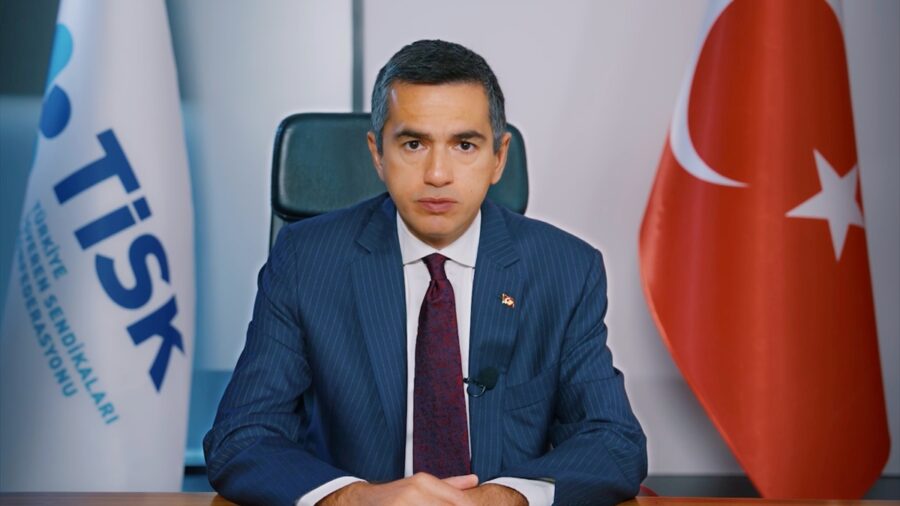
GENEVA (AA) – Özgür Burak Akkol, Chairman of the Board of Directors of the Confederation of Turkish Employer Associations (TİSK), stated that according to recent OECD research, 27 percent of jobs are at high risk due to artificial intelligence, and said, “By 2030, 40 percent of today’s skills will change significantly or become obsolete. As a result, 59 percent of the global workforce will need to acquire new skills in order to maintain competitiveness.
We, as TİSK, are preparing for this period.” he said. Akkol sent a video message in English to the General Assembly at the 114th International Labor Conference of the International Labor Organization (ILO) in Geneva, Switzerland. Stating that he believes that the conference continues to be a critical ground for shaping inclusive policies for working life, Akkol said: “This year’s theme raises a clear and urgent question; How can we use artificial intelligence to develop decent work?
We agree that the transformative effect of artificial intelligence is a challenge that must be actively managed.” “To understand why this period requires urgency, we need to look at the scale of the transformation.” – “27 percent of jobs are at high risk due to artificial intelligence” Akkol pointed out that the transition from Industry 3.0 to Industry 4.0 took more than 50 years and said: “Productive artificial intelligence reached its current level of impact in just a few months.
Artificial intelligence is expected to grow much faster than key sectors in the next 3 years. While the compound annual growth rate in traditional sectors is only 6 to 8 percent, this rate is predicted to be approximately 38 percent in artificial intelligence. I would particularly like to focus on the impacts on the labor market. According to recent OECD research, 27 percent of jobs are at high risk from artificial intelligence.
By 2030, 40 percent of today’s skills will have changed significantly or become obsolete. As a result, 59 percent of the global workforce will need to acquire new skills to remain competitive. “We, as TİSK, are preparing for this period.” – “We have also shown that artificial intelligence can save lives” Talking about the work of TİSK and its member unions, Akkol stated that they established the MEXT Technology Center, the world’s largest center in the field of digital transformation and competence development.
Stating that MEXT has provided training to more than 40 thousand people, from employees in the production area to board members, Akkol gave the following information: “MEXT has developed transformation road maps for more than 900 companies in 15 different sectors. Today we are also part of the European Union’s European Network of Digital Innovation Centres. We have also shown that artificial intelligence can save lives.
Our artificial intelligence-based occupational health and safety system processes 22 billion images daily. Since the system was put into operation, it has detected 90 million risky situations and prevented 500 possible deaths. “This is exactly the practical equivalent of responsible artificial intelligence implementation.” – “We are implementing the Women’s Empowerment in the Manufacturing Industry Project” Akkol, ILO Director General Gilbert F.
Stating that the report presented by Houngbo draws attention to the risk that the most severe effects of artificial intelligence may be seen on women and young employees, he said, “We are taking this issue seriously. We are implementing the Women’s Empowerment Project in the Manufacturing Industry with our international partners and European Union financing. Within the scope of this pioneering project, more than 500 women have received training in digital and green skills and more than 300 have been employed.
A scalable national model has been developed to be implemented by key ministries next year in order to continue the empowerment of women.” he said. – “I respectfully commemorate the civilians who lost their lives” ILO Director-General Houngbo’s report asks: “Will this new page of technological progress advance human dignity, equality and social justice?” Emphasizing that it ends with the question, Akkol concluded his words as follows: “As employers, our answer is: Yes, it can.
We work for a future where technology empowers people. We are ready to be a part of the solution by investing in skills, supporting the responsible use of artificial intelligence and deepening social dialogue.” I would also like to thank our Minister of Labor and Social Security and our trade union partners for their strong cooperation. Meanwhile, I respectfully commemorate the innocent children, women and civilians who lost their lives in conflicts in different parts of the world.
Gaza stands before us as one of the most heartbreaking examples of this. I sincerely hope that peace, dialogue and respect for human dignity will guide our common future. “We remain determined to build a future of working life that is both productive and fair.”


Comments
You can write your views about this story. Comments may be moderated according to site settings.