
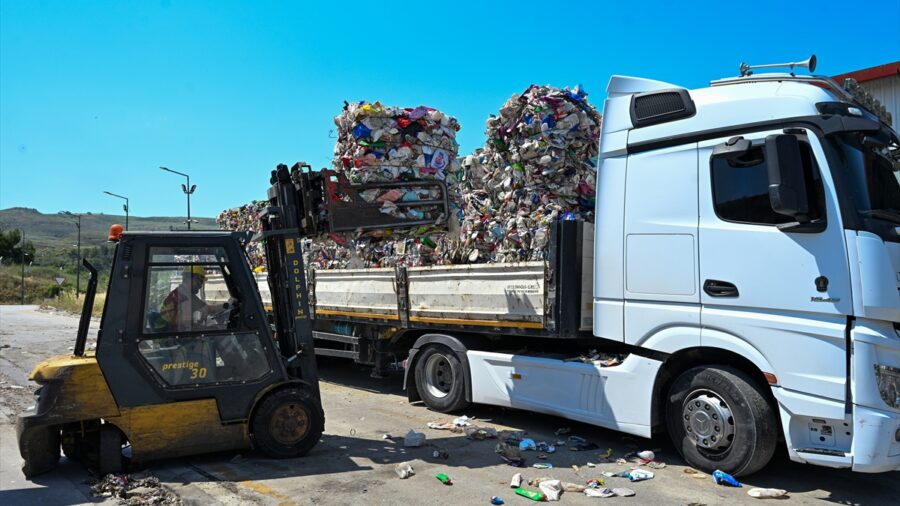
ÇANAKKALE (AA) – ÇİĞDEM ALYANAK – Approximately 100 thousand tons of waste is processed annually in the Full-Scale Integrated Solid Waste Management (ESWM) Facility of the Çanakkale Solid Waste Management Association (ÇAKAB), while energy and alternative raw materials are obtained from the waste. Domestic waste, packaging waste and medical waste from Çanakkale, Lapseki, Umurbey, Çardak and Kepez municipalities and 90 villages within the service area of the Special Provincial Administration are collected from the source and taken to the EKAY Facility in Döllüktepe, Kemel village, connected to the center for disposal.
EKAY Facility, which is one of the four environmentally licensed facilities in Türkiye that produces waste-derived fuel, also includes regular storage, mechanical separation, biodrying, packaging waste collection and separation, medical waste sterilization, leachate treatment and electricity generation facilities from biogas. ÇAKAB Manager Aysun Kavcar made a statement to the AA correspondent regarding the EKAY Facility, which was entitled to receive the Environmental Permit and License Certificate by the Ministry of Environment, Urbanization and Climate Change last year and continues its activities as one of the licensed integrated facilities in Türkiye.
Kavcar, who is also the Climate Change and Zero Waste Manager of Çanakkale Municipality, said that the foundation of the facility was laid within the scope of the European Union-supported Waste Management Project. Stating that the project for which Çanakkale Municipality applied to the European Union in 2004 was selected among 260 projects, Kavcar stated that the studies were carried out between 2004 and 2009. Kavcar stated that within the scope of an investment of approximately 17.5 million euros, not only a landfill but also a system covering the entire process from waste generation to disposal was established.
Explaining that municipalities came together and formed a solid waste union in order to solve the waste problem in the region, Kavcar noted that later the Special Provincial Administration also joined the union. Stating that significant investments have been made in the facility after 2019, Kavcar said that mechanical-biological separation, waste-derived fuel, biodrying, electrical energy production from gas and leachate treatment facilities have been put into operation.
– It is used as alternative fuel and raw material. Kavcar stated that the leachate is treated in accordance with environmental legislation using advanced treatment technologies and that the facility has completed its environmental permit and license processes. Stating that approximately 100 thousand tons of waste is managed in the facility annually, Kavcar said: The incoming waste is separated for the second time in the mechanical-biological separation facility.
Combustible wastes are passed through crusher systems and sent to biodrying halls. After the drying process, waste-derived fuel is obtained. This product is used as alternative fuel and raw material in cement factories. Aysun Kavcar said that approximately 11 thousand tons of packaging waste is separated annually in the facility, 20 thousand tons of waste-derived fuel is produced and an average of 10 thousand megawatt hours of electrical energy is produced annually with the gas obtained from garbage.
Stating that this amount corresponds to the annual electricity consumption of approximately 3 thousand households, Kavcar noted that approximately 20 thousand cubic meters of leachate is treated annually. Kavcar explained that the only medical waste sterilization facility in the city operates within ÇAKAB and stated that medical waste throughout the province, except Gallipoli, is sterilized and disposed of here. Pointing out that waste has economic value, Kavcar added that citizens’ correct separation of waste at the source will make a significant contribution to recycling and zero waste goals.
16There are 54 geographically registered foods among the products offered for sale at the Gastronomy House, where the traditional flavors of Hatay are introduced. 26There are 54 geographically registered foods among the products offered for sale at the Gastronomy House, where the traditional flavors of Hatay are introduced. 36There are 54 geographically registered foods among the products offered for sale at the Gastronomy House, where the traditional flavors of Hatay are introduced.
46There are 54 geographically registered foods among the products offered for sale at the Gastronomy House, where the traditional flavors of Hatay are introduced. 56There are 54 geographically registered foods among the products offered for sale at the Gastronomy House, where the traditional flavors of Hatay are introduced. 66There are 54 geographically registered foods among the products offered for sale at the Gastronomy House, where the traditional flavors of Hatay are introduced.
Comments
You can write your views about this story. Comments may be moderated according to site settings.