
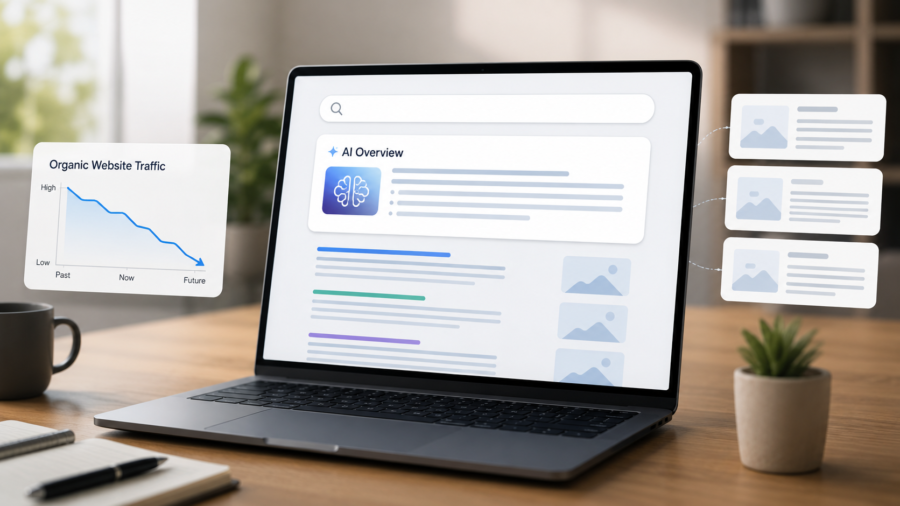
AI search is changing one of the internet’s oldest habits: people search, click a result, and visit a website.
That pattern is no longer guaranteed.
With AI Overviews, AI Mode and other answer-style search features, Google and other search platforms can now summarize information directly on the results page. For users, that can be convenient. For publishers, blogs and news websites, it creates a serious question: what happens when the answer appears before the click?
This does not mean websites are finished. But it does mean website traffic in 2026 may look different from the traffic publishers were used to in the old search era.
What AI search actually changes
Traditional search worked like a directory. A user asked a question, Google showed a list of links, and the user clicked one or more results.
AI search works more like an answer box. It reads information from multiple sources and gives the user a summary at the top of the page. Links may still appear, but the user may not need to click if the summary already answers the question.
That is the core traffic problem.
If someone searches “how to clean laptop screen” and an AI summary gives the steps immediately, they may not visit a website. If someone searches for a product explanation, quick definition or simple news background, the AI answer may satisfy the intent before the user reaches a publisher.
For simple informational queries, AI search can reduce clicks.
For deeper, timely or opinion-sensitive queries, websites can still matter.
What the data shows so far
The evidence is still developing, but the direction is clear: AI summaries can reduce traditional clicks.
Pew Research found that Google users were less likely to click traditional search results when an AI summary appeared. In its March 2025 analysis, users clicked a traditional search result in 8% of visits when an AI summary appeared, compared with 15% when no AI summary appeared.
A 2026 study listed on SSRN also found that AI Overviews reduced outbound organic clicks and increased zero-click searches when they appeared.
These numbers do not mean every website will lose the same amount of traffic. The effect depends on the topic, query type, search intent and whether the website is cited or visible in the AI result.
But the message for publishers is serious: ranking number one may not be enough if the answer is already summarized above the results.
Why news websites are especially exposed
News websites face a difficult situation.
They need Google visibility, but AI summaries can absorb parts of their work. A reader may search for a developing story, see the key facts in an AI answer and never click the original article.
That is one reason publishers are pushing for more control. In the UK, the Competition and Markets Authority announced a world-first requirement that Google must let publishers opt out of having their content used to power AI features in Search. The regulator also said it is monitoring AI developments in search and may take further action if needed.
This matters because publishers do not want to choose between two bad options: allowing AI systems to summarize their content, or blocking access and losing ordinary search visibility.
The UK rule suggests regulators are beginning to separate those choices.
Why Discover may become more important
As AI search answers more direct questions, Google Discover could become even more important for publishers.
Search is usually demand-driven. The user already knows what they want and types a query.
Discover is different. It shows stories based on interest, freshness and engagement. A reader may not search for a topic, but they may tap it when it appears in their feed.
That matters because AI summaries are strongest at answering direct questions. Discover is stronger for visual, timely and curiosity-driven stories.
For example, a simple definition article may lose traffic to AI search. But a clear, timely story about a new AI laptop chip, Android safety feature or gaming hardware trend can still attract readers through Discover because it feels fresh and visual.
This is why publishers should not only ask, “How do we rank?” They should also ask, “Would someone tap this if they saw it in a feed?”
What kind of content may lose clicks
AI search is most likely to reduce clicks for content that answers very simple questions.
Short definitions, basic how-to steps, quick facts, generic product explanations and thin rewritten news are vulnerable. If a page only gives the same answer available everywhere else, AI can summarize it easily.
That does not mean these topics should be avoided completely. But they need more value.
A basic article titled “What Is Local AI?” should not only define the term. It should explain why it matters, where users will see it, what the limits are and what buyers should check before paying for an AI laptop.
The same is true for news. A thin rewrite of a company announcement may be easy for AI to replace. A useful article with context, reader impact and clear explanation is harder to replace.
What kind of content can still win
Content that adds original value has a better chance.
That includes reporting, expert analysis, hands-on testing, comparisons, clear visuals, practical takeaways and local or niche context. AI summaries may mention the facts, but users still click when they need detail, trust or a better explanation.
For a news site, this means every article should answer three questions clearly:
What happened?
Why does it matter?
What should the reader understand or do next?
That structure is simple, but powerful. It makes the article more useful than a summary.
For technology content, it also helps to connect news to real user impact. A chip announcement is not only about specs. It is about laptop prices, battery life, AI tools, gaming performance and whether people should wait before buying.
How publishers should adapt in 2026
The best SEO strategy in 2026 is not to write only for Google. It is to write for readers in a way that search and Discover can understand.
Headlines should be clear, not vague. Meta descriptions should explain the value. Articles should use clean structure, strong subheadings and accurate sourcing. Images should match the topic and avoid misleading visuals.
Publishers should also build topic clusters. One article about AI search is useful. A connected group of articles about AI Overviews, publisher rights, website traffic, Discover and original reporting is stronger.
Internal links matter because they help readers move through the site and help search engines understand topical authority.
For Trend Arabul, that means AI Search content should link to articles about Google AI Overviews, publisher opt-out rules, Discover strategy and original reporting in the AI era.
What small websites should do now
Small websites should not panic, but they should stop publishing thin content.
The best move is to focus on helpful, specific articles that answer real user intent. Instead of writing generic news rewrites, small sites should explain what the news means for ordinary readers.
They should also watch Search Console more carefully. If impressions stay stable but clicks drop, AI summaries or changing search layouts may be part of the reason. If Discover clicks rise, that may show the site is doing better with visual, timely topics.
Publishers should track which topics still bring clicks and which ones are becoming zero-click searches.
That data should guide future content choices.
The bigger takeaway
AI search is not killing websites, but it is changing the rules.
Simple answers are becoming easier to get without clicking. That means publishers need to create articles that offer more than a quick answer. They need context, trust, clarity and reader-focused explanation.
The sites that struggle most will be those built on thin rewrites and generic information. The sites with stronger topic authority, original angles and useful explanations still have room to grow.
In 2026, website traffic may come from a more mixed system: traditional search, AI citations, Discover, direct readers, newsletters and social platforms.
The old search model was about being found. The new model is about being worth visiting.






Comments
You can write your views about this story. Comments may be moderated according to site settings.