
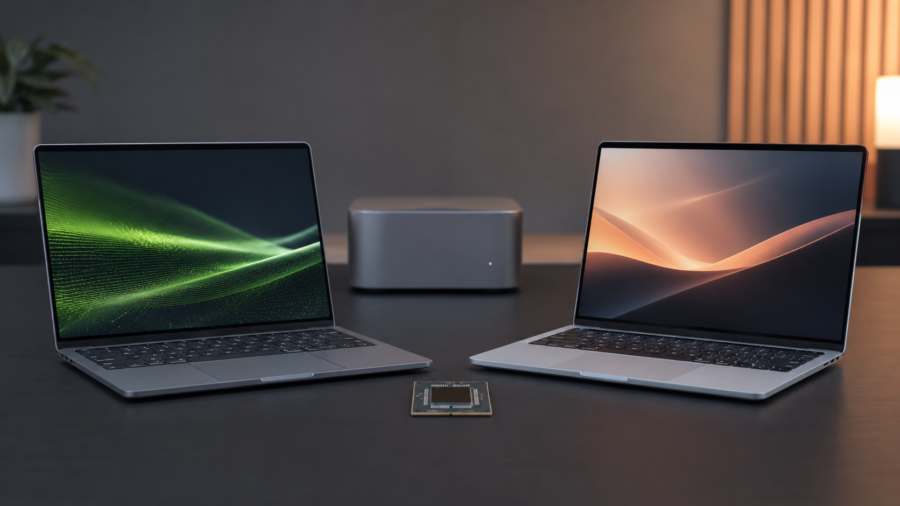
For years, Apple Silicon has been the clearest example of what a modern laptop chip can do when performance, battery life and software are tightly connected.
Now NVIDIA wants to bring a similar kind of ambition to Windows PCs, but with a different focus: local AI.
NVIDIA’s new RTX Spark platform is designed for Windows laptops and compact desktops that can run demanding AI, graphics and creative workloads directly on the device. It combines an Arm-based CPU with NVIDIA’s Blackwell RTX graphics technology, giving NVIDIA a much bigger role inside the PC than a traditional graphics card.
That immediately raises a big question: is RTX Spark a real challenge to Apple Silicon?
The answer is not simple. Apple still has the advantage of controlling the full Mac experience, from hardware to operating system. But NVIDIA has something Apple does not offer in the same way: a huge RTX software ecosystem, deep AI developer tools and a strong position in gaming and GPU-accelerated creative work.
This is why the comparison matters.
Why Apple Silicon changed laptop expectations
Apple’s M-series chips changed what many people expected from a laptop.
MacBooks became known for strong performance, quiet operation and long battery life. For many users, the biggest shift was consistency. A MacBook could often feel fast whether it was plugged in or running on battery.
That created pressure on Windows laptop makers. Traditional Windows laptops could be powerful, especially with dedicated GPUs, but they often had trade-offs: more heat, shorter battery life, louder fans or lower performance when unplugged.
Apple’s advantage came from integration. The CPU, GPU, memory and software were designed to work together closely. That helped Apple deliver efficient laptops without relying only on raw power.
RTX Spark appears to be NVIDIA’s attempt to bring a more integrated AI-focused approach to Windows PCs.
What RTX Spark brings to the table
NVIDIA and Microsoft say RTX Spark is built for the age of local AI agents on Windows PCs. Microsoft says the platform can deliver up to 1 petaflop of AI performance, with up to 20 Arm-based CPU cores, up to 6,144 Blackwell RTX cores and up to 128 GB of unified memory.
That sounds very technical, but the everyday meaning is easier to understand.
RTX Spark PCs are designed to run heavier AI and creative tasks locally. That could include AI assistants, coding tools, local language models, image generation, video editing, 3D work and gaming features powered by RTX technologies.
NVIDIA’s own product page describes RTX Spark desktops as small, efficient systems built to run personal AI agents at a desk while also supporting gaming and creative work.
That is the key difference from a normal laptop chip. RTX Spark is not only trying to make Windows PCs faster. It is trying to make them more capable at AI tasks that usually depend on the cloud.
Where RTX Spark could challenge Apple
RTX Spark could be especially interesting for three groups: AI developers, creators and gamers.
AI developers may care about local model testing. If a laptop or compact desktop can run larger models locally, developers can build and experiment without sending everything to cloud servers.
Creators may benefit from NVIDIA’s existing RTX acceleration in creative apps. Video editing, 3D rendering, image tools and AI-assisted workflows already use GPUs heavily. RTX Spark could make those workflows more portable.
Gamers may care because Apple Silicon still does not have the same gaming ecosystem as Windows. Even though Apple has improved gaming support, Windows remains the main platform for PC games. NVIDIA’s RTX technologies, including DLSS and Reflex, are already familiar to many gamers.
This is where RTX Spark has a real opening. It does not need to beat Apple Silicon at every task. It needs to make Windows AI PCs more attractive in the areas where Windows already has strengths.
Where Apple still has the advantage
Apple’s biggest advantage is control.
Apple designs the chip, the laptop, the operating system and many of the core software experiences. That makes optimization easier. It also reduces the number of compatibility problems users may face.
NVIDIA has to work through a more complicated Windows PC ecosystem. RTX Spark devices will come from different manufacturers, with different designs, cooling systems, screens, batteries and prices.
That variety can be good because buyers get more choice. But it can also make the experience uneven. One RTX Spark laptop may be excellent, while another may have weaker battery life or louder cooling.
Apple also has years of real-world trust with Apple Silicon. Users know what to expect from MacBook Air and MacBook Pro models. RTX Spark still has to prove itself in shipping products.
That means the first real reviews will matter more than the launch claims.
The Windows on Arm question
RTX Spark also brings Windows on Arm back into focus.
Arm-based Windows laptops have improved, especially with Qualcomm’s Snapdragon X devices. But Windows on Arm has still faced questions around app compatibility, drivers, gaming support and performance in older software.
NVIDIA’s entry could strengthen the Windows on Arm ecosystem because it brings serious GPU and AI credibility. Tom’s Hardware argued that RTX Spark could help NVIDIA take advantage of the Windows on Arm opportunity as Qualcomm’s earlier exclusivity window ends.
Still, compatibility remains important. If users buy an RTX Spark PC, they will expect their apps, games, plugins and accessories to work smoothly. AI performance will not matter much if everyday software causes problems.
For RTX Spark to compete with Apple Silicon, Windows on Arm needs to feel less like a special case and more like normal Windows.
Local AI may decide the next PC upgrade cycle
For years, many people did not have a strong reason to upgrade their laptops. Web browsing, streaming, office work and messaging do not require massive performance jumps.
AI could change that.
If more useful AI tools run locally, buyers may start caring about AI performance the way they once cared about CPU speed or storage. A laptop that can summarize documents privately, run a personal assistant, edit video with AI tools and generate content without constant cloud access may feel more valuable.
NVIDIA is clearly betting on that future. The Verge reported that NVIDIA is already planning future RTX Spark generations called N2X and N3X, suggesting the company sees this as a long-term PC platform rather than a one-time experiment.
Apple is also pushing on-device intelligence across its ecosystem. That means the next laptop race may not be only about battery life or benchmark scores. It may be about which computer can run the most useful AI features privately, quickly and reliably.
What buyers should watch
For ordinary buyers, the smartest move is to wait for real RTX Spark devices and independent testing.
The most important questions are practical.
How long does the battery last in normal use?
Does performance stay strong when unplugged?
Do Windows apps and games work smoothly on Arm?
Are AI features actually useful, or mostly marketing?
How much do RTX Spark laptops cost compared with MacBooks and Snapdragon PCs?
Does the device stay quiet and cool?
If RTX Spark PCs are expensive, they will need to deliver clear value. A high price may make sense for AI developers or creators, but not for everyday users unless the benefits are obvious.
The Apple comparison will also depend on use case. A writer, student or office worker may still prefer a MacBook Air or a standard Windows laptop. A 3D artist, AI developer or gamer may find RTX Spark more interesting.
There may not be one winner. Different users may simply need different machines.
The bigger takeaway
RTX Spark does not mean Apple Silicon is suddenly in trouble. Apple still has a strong ecosystem, proven laptop designs and years of optimization behind its M-series chips.
But RTX Spark does make the AI PC race more serious.
For the first time, NVIDIA is pushing deeper into the core PC platform with a chip that combines Arm CPUs, Blackwell RTX graphics and local AI performance. That gives Windows PC makers a new way to compete, especially in areas where NVIDIA is already strong: AI, graphics, gaming and creative tools.
The future of laptops may not be decided by one benchmark or one brand. It may be decided by how well each platform handles local AI, battery life, software compatibility and real daily work.
Apple Silicon changed the laptop conversation once. RTX Spark may be the clearest sign that Windows PCs are preparing a serious answer.





Comments
You can write your views about this story. Comments may be moderated according to site settings.