
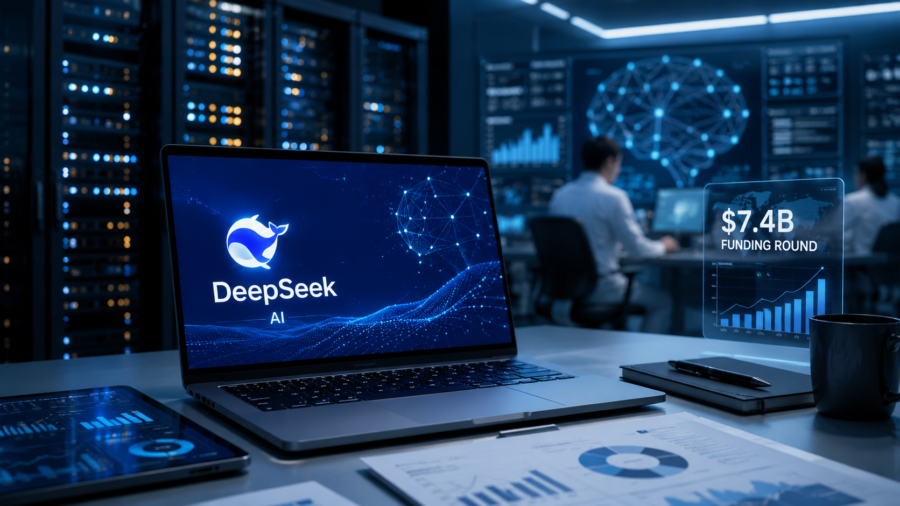
DeepSeek may be preparing one of the largest AI funding rounds in China’s technology sector, and the timing says a lot about where the global AI race is heading.
According to Reuters, the Chinese AI startup is set to raise about 50 billion yuan, or roughly $7.4 billion, in its first outside funding round. The report says the deal could value DeepSeek between 350 billion and 400 billion yuan, equal to about $52 billion to $59 billion.
The round has not been officially announced by the company, so it should be treated as reported information rather than confirmed final funding. But if completed near those figures, it would mark a major shift for DeepSeek, which had previously avoided outside investment and relied heavily on support from founder Liang Wenfeng’s quant hedge fund, High-Flyer.
Reuters reported that Tencent and CATL are among the potential investors, with NetEase, JD.com and China’s national AI fund also involved in discussions. Liang himself is reportedly committing 20 billion yuan of his own money to the round.
The details matter because DeepSeek became one of the most watched AI names after its models drew global attention in 2025. Now, the company appears to be moving into a more expensive phase: building enough computing power, talent and infrastructure to compete with the biggest AI labs.
Why this funding round matters
AI models are expensive to build, train and run. Even companies that release open-source or lower-cost models still need huge amounts of computing capacity, engineering talent and data center access.
That is why funding has become such an important part of the AI race. The companies with the strongest models often also need the deepest financial backing.
DeepSeek gained attention because it showed that a Chinese AI lab could compete strongly with much larger and better-known Western AI companies. Its earlier success challenged the idea that only the biggest U.S. firms could build advanced models.
But staying competitive is different from making a breakthrough once. AI development moves quickly. New models, agents, reasoning tools and multimodal systems are appearing constantly. A company that wants to remain near the front needs to keep investing.
A reported $7.4 billion funding round suggests DeepSeek is preparing for that next stage.
What DeepSeek could use the money for
The most obvious use is computing power.
Training advanced AI models requires powerful chips, servers and large-scale infrastructure. Running those models for millions of users can also become expensive, especially if the company offers low-cost or open-access tools.
Reuters reported that U.S. restrictions on advanced chip exports remain a challenge for Chinese AI companies. That means DeepSeek may need to spend more carefully on domestic computing resources, alternative chips, cloud partnerships and efficiency improvements.
The company could also use funding to hire researchers, expand model development, support enterprise clients and improve its open-source ecosystem.
Another likely priority is the next generation of DeepSeek models. Reuters noted that DeepSeek has been working on its V4 model, but the broader AI market is moving toward more advanced AI agents and systems that can complete tasks, not only answer questions.
That is important. The next AI competition may not be won only by chatbots that write better paragraphs. It may be won by systems that can code, browse, plan, analyze files, operate tools and support businesses more reliably.
Why investors are interested
The reported investor list is notable.
Tencent is one of China’s largest technology companies, with deep interests in cloud services, social platforms, gaming and AI. CATL is better known as a battery giant, but its involvement would show how AI is becoming important across industrial and manufacturing sectors, not only internet platforms.
NetEase and JD.com would also bring major consumer, commerce and digital infrastructure connections if they participate.
For these companies, investing in DeepSeek may be about more than financial return. AI models can become strategic infrastructure. They can power customer service, coding tools, search, recommendation systems, enterprise software, robotics and internal productivity tools.
If DeepSeek continues improving, major Chinese companies may want closer access to its technology and ecosystem.
That is why the funding round would matter beyond the startup itself. It could become part of a larger Chinese AI supply chain, connecting models, cloud services, hardware, enterprise users and industrial companies.
The open-source angle
DeepSeek’s open-source approach is one reason it gained so much attention.
Open-source AI models can be downloaded, studied, adapted and deployed by developers. They can help smaller companies build AI features without relying entirely on closed systems from large U.S. providers.
This does not mean open-source AI is free to operate. Running powerful models still requires hardware and technical skill. But open models can give developers more control and can speed up adoption across different markets.
If DeepSeek receives major funding while continuing to support open-source models, it could strengthen an alternative path in the AI industry.
Instead of every company depending on a handful of closed AI platforms, businesses may have more options. That could increase competition and push prices down for some AI services.
However, open-source AI also brings responsibility. Powerful models need safety testing, documentation and careful deployment. As open models become more capable, companies will face more pressure to balance openness with responsible use.
The global AI race is becoming more expensive
DeepSeek’s reported funding round fits a larger pattern. AI is becoming a capital-intensive industry.
OpenAI, Anthropic, Google, Meta, xAI and other companies are all spending heavily on chips, data centers and model training. Hardware suppliers such as NVIDIA, AMD and TSMC are central to that ecosystem. Cloud providers are also competing to host and distribute AI tools.
This means the AI race is not only about clever algorithms. It is also about energy, chips, data centers, software talent and long-term funding.
DeepSeek’s rise showed that efficiency can matter. A company may be able to build strong models with fewer resources than some competitors. But as AI agents and multimodal systems become more complex, even efficient labs need serious infrastructure.
That is the bigger message behind the reported funding: the next stage of AI will likely require both technical creativity and financial scale.
Why the China angle matters
DeepSeek is also important because it reflects China’s broader AI ambitions.
China wants stronger domestic AI companies, especially as U.S. chip restrictions limit access to some advanced hardware. A large funding round backed by major Chinese companies and state-linked funds would show strong domestic support for building AI capacity inside China.
That does not mean DeepSeek will automatically overtake U.S. rivals. The global AI market remains highly competitive, and hardware access is still a major challenge.
But it does mean the competition is not slowing down. Chinese AI labs continue to improve, investors remain interested, and domestic technology companies appear willing to support major model builders.
For global users, this could lead to more AI choices, faster innovation and more pressure on pricing. It could also increase regulatory and geopolitical scrutiny around how AI models are trained, distributed and used.
What ordinary users should take away
Most people will not care who invests in DeepSeek unless it changes the AI tools they use.
The practical impact could appear in a few ways.
If DeepSeek receives more funding, it may improve its models faster. That could lead to better coding tools, stronger chatbots, more capable open-source models and more competition for U.S.-based AI companies.
More competition could be good for users because it may push companies to lower prices, improve features and release models more quickly.
At the same time, users should be cautious about hype. A huge funding round does not guarantee better products. It only gives a company more resources. Execution still matters.
DeepSeek will need to turn funding into stronger models, reliable services and developer trust.
What is still unconfirmed
The most important caution is that the funding round is reported, not officially confirmed.
Reuters cited people familiar with the matter, and the details could still change. The final amount, valuation, investor list or timing may differ from current reports.
That is why the story should be read as a sign of momentum, not as a completed deal.
It is also unclear how DeepSeek will balance open-source development, commercial services and enterprise partnerships if the funding closes. Investors may want growth, while developers may want continued openness. Managing that balance will be important for the company’s reputation.
The bigger takeaway
DeepSeek’s reported $7.4 billion funding round shows that the AI race is far from settled.
The first wave of AI attention was dominated by U.S. companies and cloud-based chatbots. But the next phase is becoming broader. It includes Chinese AI labs, open-source models, enterprise tools, local deployment, AI agents and a growing battle over computing power.
If the reported funding is completed, DeepSeek would gain more financial strength at a time when AI competition is becoming more expensive and more strategic.
For ordinary users, the impact may not be immediate. But over time, stronger competition from DeepSeek and other AI labs could shape the tools people use for writing, coding, search, productivity and automation.
The AI race is not slowing down. It is becoming bigger, more global and more costly. DeepSeek’s reported funding round is one of the clearest signs yet.





Comments
You can write your views about this story. Comments may be moderated according to site settings.