
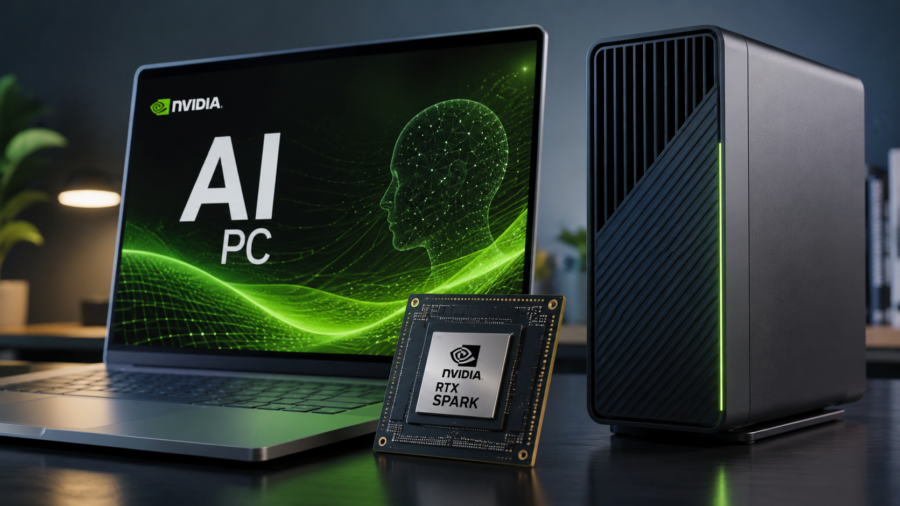
NVIDIA is no longer just the company behind powerful graphics cards and AI data center chips. With RTX Spark, it is moving directly into the heart of the PC market.
At Computex 2026, NVIDIA introduced RTX Spark as a new family of chips for Windows laptops and compact desktop PCs. The platform combines an Arm-based CPU with NVIDIA’s Blackwell RTX graphics technology, giving the company a much bigger role inside consumer computers than it has had before.
That matters because the PC market is changing fast. For years, Intel and AMD defined what most Windows computers looked like. Then Apple proved with Apple Silicon that a tightly integrated chip could deliver strong performance and long battery life. Qualcomm later pushed Windows on Arm with Snapdragon X laptops. Now NVIDIA is entering the same conversation with a different angle: local AI performance.
The question is not only whether RTX Spark laptops will be fast. The bigger question is whether NVIDIA can make AI PCs feel useful enough for normal people, creators and developers to care.
What NVIDIA RTX Spark actually is
RTX Spark is a PC chip platform that puts CPU, GPU and AI-focused hardware into a single system designed for laptops and small desktops.
According to NVIDIA, RTX Spark brings the company’s AI and graphics software stack to Windows PCs. The platform is aimed at creators, AI developers and gamers. NVIDIA says RTX Spark can help with large 3D scenes, high-resolution video editing, local AI models and modern games with RTX technologies such as DLSS and Reflex.
The Verge reported that the flagship RTX Spark configuration includes 20 CPU cores, 6,144 GPU cores and up to 128 GB of LPDDR5X memory. It also described RTX Spark as the first family of NVIDIA consumer PC chips arriving in laptops and mini PCs starting this fall.
In plain English, RTX Spark is NVIDIA’s attempt to build more of the computer itself, not just the graphics part.
That is a major shift. NVIDIA has been inside PCs for decades through GPUs, but RTX Spark gives it control over a much larger part of the experience.
Why this is different from a normal graphics card
Most people know NVIDIA because of GeForce graphics cards. Those GPUs help with gaming, video editing, 3D rendering and AI tasks. But in a traditional laptop or desktop, the main processor usually comes from Intel or AMD.
RTX Spark changes that structure.
Instead of adding an NVIDIA GPU next to another company’s CPU, RTX Spark combines an Arm-based CPU with NVIDIA’s Blackwell GPU technology in a more integrated design. This is closer to the kind of approach Apple uses with its M-series chips, where the CPU, GPU and memory system are designed to work closely together.
That kind of integration can improve efficiency. It can also make it easier to run AI tasks locally, because the system can move data between different parts of the chip more quickly.
For users, the benefit could be simple: thinner laptops with stronger graphics, better battery life and more capable local AI tools.
The key word is “could.” NVIDIA and its partners still need to prove this in real products, with real battery tests, real prices and real software support.
Why local AI matters
A lot of AI today runs in the cloud. When a user asks a chatbot a question, generates an image or summarizes a document, the hard work often happens on remote servers.
Local AI means more of that work happens directly on the device. That can have several advantages.
First, it can be faster for some tasks because data does not need to travel back and forth to a server. Second, it can help privacy because sensitive files may stay on the device. Third, it can allow AI tools to work even when the internet connection is weak or unavailable.
NVIDIA is clearly positioning RTX Spark around this idea. The company says RTX Spark PCs can run large AI models locally, and its DGX Spark product page says the related GB10 Grace Blackwell Superchip can deliver up to one petaFLOP of FP4 AI performance with 128 GB of memory for local model prototyping, fine-tuning and deployment.
For most everyday users, that sounds very technical. The practical version is easier to understand: future PCs may be able to run stronger AI assistants, creative tools and automation features without depending completely on cloud services.
That could change how people use laptops.
The Apple Silicon comparison
It is impossible to talk about RTX Spark without mentioning Apple Silicon.
Apple’s M-series chips changed expectations for laptop performance and battery life. MacBooks became known for being quiet, efficient and powerful enough for many creative users. That put pressure on Windows PC makers to improve.
Qualcomm’s Snapdragon X chips tried to bring a similar Arm-based efficiency story to Windows laptops. RTX Spark enters from another direction. NVIDIA already has a strong reputation in graphics, AI acceleration and developer tools. That could make its PC platform especially appealing to creators, AI developers and gamers.
The difference is that Apple controls the full Mac experience, from hardware to operating system to many core apps. NVIDIA has to work with Microsoft, PC makers and Windows software compatibility.
That is both an opportunity and a challenge.
If RTX Spark works well across Windows applications, it could give the PC market a serious new competitor. If compatibility, pricing or battery life disappoints, it could become another promising Windows on Arm effort that does not fully reach mainstream buyers.
Why Microsoft support matters
NVIDIA is not doing this alone.
NVIDIA and Microsoft announced work together to bring AI agents and RTX Spark capabilities to Windows PCs. NVIDIA says the platform is designed to support AI-powered workflows, creative software and gaming experiences on Windows.
This partnership is important because Windows needs strong hardware to make the AI PC idea feel real. Microsoft has already been pushing Copilot+ PCs and AI features in Windows. But AI features become more convincing when the hardware can handle more tasks locally.
RTX Spark gives Microsoft another path beyond Intel, AMD and Qualcomm.
It also gives PC makers a new way to build premium Windows machines. HP, for example, announced AI-ready PCs powered by NVIDIA RTX Spark at Computex 2026, including laptops and desktops aimed at creators, developers and gamers.
That does not mean every Windows laptop will suddenly use RTX Spark. But it does mean the AI PC market is becoming more competitive.
Why gamers should pay attention
RTX Spark is not only about AI developers.
NVIDIA says RTX Spark brings its RTX graphics technologies to these new PCs, including gaming features such as DLSS and Reflex. That could make RTX Spark laptops interesting for people who want gaming performance in slimmer machines.
The challenge is expectations. Gamers are used to comparing frame rates, thermals, screen quality and battery life. Marketing claims will not be enough. RTX Spark devices will need to prove that they can run real games well, not just AI demos.
Still, the idea is promising. If NVIDIA can deliver strong integrated graphics performance with better efficiency, gaming laptops could become thinner, quieter or longer-lasting.
That would matter because gaming laptops have often had a trade-off: great performance when plugged in, but weak battery life and heavy designs. RTX Spark may not solve that instantly, but it pushes the market in an interesting direction.
Why creators may be the first real audience
Creators may be the best early audience for RTX Spark.
Video editors, 3D artists, designers and AI creators often need strong graphics and memory. They also tend to benefit from hardware acceleration in apps like Adobe Premiere Pro, Photoshop, Blender and other creative tools.
NVIDIA says RTX Spark can support demanding creative workloads, including large 3D scenes and high-resolution video. The company also highlights its full RTX software stack, which is already familiar to many creative professionals.
This gives RTX Spark a clearer purpose than a generic AI laptop.
For a normal office user, the difference may not be obvious on day one. For a creator working with large files, AI tools and GPU-heavy apps, the value could be easier to see.
That is why the first RTX Spark devices may appeal most to power users before they reach the mainstream.
The price question
The biggest obstacle may be price.
The Verge noted that RTX Spark systems may start around high premium pricing, with early devices potentially aimed at users who need serious local AI power. If the first RTX Spark laptops are expensive, they may not compete directly with everyday laptops.
That is not unusual for a new platform. High-end hardware often arrives first, then cheaper models follow later. But price will decide whether RTX Spark becomes a major PC trend or remains a niche tool for developers and creators.
A laptop that costs much more than a standard Windows machine needs to deliver obvious benefits. Better AI performance alone may not be enough for most buyers unless the software makes those benefits clear.
This is where NVIDIA’s roadmap matters. The Verge reported that NVIDIA is already planning future RTX Spark generations called N2X and N3X. That suggests the company is not treating this as a one-off experiment.
A multi-generation roadmap gives PC makers and developers more confidence that the platform will continue.
What buyers should watch before getting excited
RTX Spark sounds important, but ordinary buyers should wait for real reviews before making decisions.
The key things to watch are simple.
Battery life matters. NVIDIA and PC makers may talk about efficiency, but independent testing will show whether RTX Spark laptops can really last all day.
Software compatibility matters. Windows on Arm has improved, but some apps, drivers and games can still behave differently from traditional x86 Windows PCs.
Performance matters beyond AI demos. Users should look at video editing, gaming, web browsing, multitasking and heat levels.
Price matters most. If RTX Spark machines are too expensive, many users may be better served by current laptops from Intel, AMD, Apple or Qualcomm.
In short, RTX Spark is exciting, but it has to prove itself in the real world.
The bigger takeaway
NVIDIA RTX Spark is one of the clearest signs that the PC is entering a new phase.
For years, the PC upgrade story was mostly about faster CPUs, better screens and stronger GPUs. Now the story is shifting toward AI performance, local models, unified memory, power efficiency and smarter software.
NVIDIA is entering the PC chip market at exactly the moment when that shift is happening. Its strength in GPUs and AI gives it a serious advantage, especially for creators, developers and gamers.
But success is not guaranteed. RTX Spark needs strong devices, fair pricing, good Windows support and useful AI software. Without those, it will be another impressive chip that feels ahead of everyday needs.
If NVIDIA gets it right, RTX Spark could make AI PCs more than a marketing label. It could help turn laptops and mini PCs into machines that run powerful AI tools locally, handle creative workloads more smoothly and compete more directly with Apple Silicon and Snapdragon PCs.
The future of AI PCs will not be decided by one chip. But RTX Spark may be the clearest sign yet that NVIDIA wants to shape that future from the inside.





Comments
You can write your views about this story. Comments may be moderated according to site settings.