
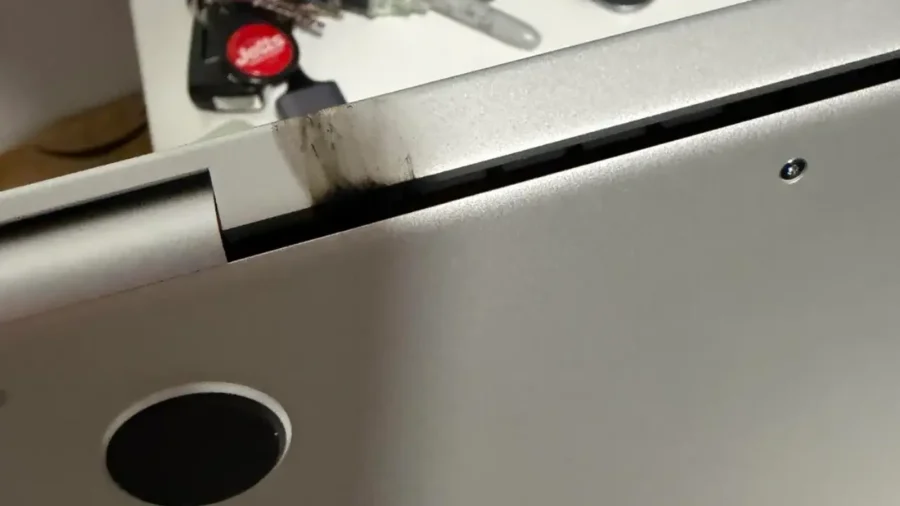
The claim that a new MacBook with an M5 processor stopped working in less than 48 hours became a trending topic on social media. In the post, it was claimed that during the hinge movement, a spark came out of the device, a short electrical sound was heard and the computer completely lost power. Spark claim after the hinge movement is on the agenda of Apple users. The incident reached a wide audience with a post on reddit.
The post stated that the New M5 MacBook died within 48 hours of purchase due to the hinge movement triggering a spark. In the photos, a darkened area can be seen on the back edge of the device, close to the screen hinge. When viewed from the outside, the scar resembles damage caused by heat or electrical arcing. However, this image alone is not sufficient for a definitive technical diagnosis. Therefore, it would not be correct to describe the incident as a chronic hinge problem on M5 MacBooks.
At this stage, there is a user claim, shared images and a growing debate on social media. From a technical perspective, it would be incomplete to consider the hinge alone as a source of electrical malfunction. In modern MacBooks, the display, sensors, antenna structures, flexible cables, power management and motherboard connections are placed in very narrow spaces in a compact case. In Apple’s M5 MacBook Pro repair documentation, parts such as the battery management unit flex cable, cover angle sensor, ventilation/antenna module, display hinge covers, display, motherboard, MagSafe 3 card and USB-C cards are listed as separate service titles.
This structure shows that the hinge area is not just a mechanical connection point. In this type of failure, several possibilities stand out. A stuck or incorrectly positioned cable may have moved during the hinge movement. One of the flexible connections may have been damaged during production. An internal connector may have touched the metal surface, creating a short circuit. A malfunction in the battery, power management or display line may also have caused sudden power loss.
But all of these remain at the level of technical possibility. It is not possible to say the exact reason without opening the device, performing a service inspection and seeing the fault report. The most striking point in the post is that the claim occurred within the first 48 hours after the purchase of the device. Such an early loss of power in a newly purchased computer directly brings up the service and replacement process for the user.
Especially if there are symptoms such as sparks, burn marks or electrical noise, the device should not be recharged or forced to turn on and should be examined directly by Apple or an authorized service. Apple’s own safety documents also state that a damaged MacBook should not be used, and that charging with damaged cables or adapters may pose a risk of fire, electric shock, injury or device damage. If such an incident occurs in Turkey, warranty and consumer rights also come into play on the user’s side.
In the two-year limited warranty text published by Apple for Türkiye, it is stated that the warranty rights do not replace the rights provided by the consumer law in Turkey, but are offered in addition to these rights. For this reason, a serious electrical fault that occurs in the first days of a newly purchased device may bring up different options within the scope of replacement, repair or consumer law, along with service inspection.
Therefore, remember that you can exercise your rights to the fullest if such an incident happens to you with any product in the future. Whether the incident will turn into a bigger problem for Apple depends on the number of similar cases and service reports. Currently, there are various user posts on social media regarding the hinge sound, clicking or lid movement regarding the M5 MacBook models. However, these posts are not in the same category as claims of electrical malfunction or sparks.
Hinge noise may remain a mechanical quality control discussion, while sparking and sudden power loss are evaluated under the heading of safety and hardware failure. This distinction is important.



Comments
You can write your views about this story. Comments may be moderated according to site settings.