
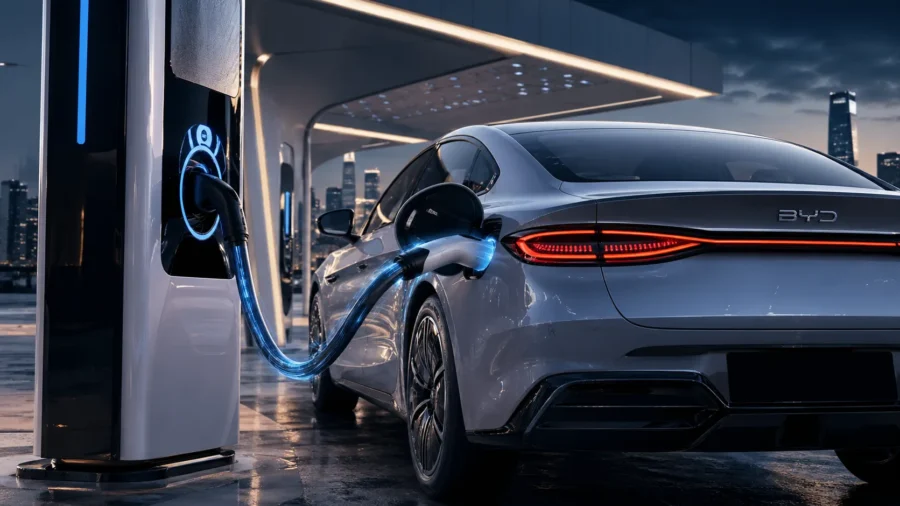
Electric cars are now much more visible on the roads. However, the biggest question on users’ minds still remains: How long will charging last? BYD gives a very assertive answer to this question with its new generation Blade battery and Flash Charging system. The new system developed by the company aims to turn electric car charging from a half-hour break into a short pause of a few minutes. What does BYD’s new charging system promise?
BYD’s new technology focuses on gaining meaningful range in a short time rather than completely charging the battery. According to the information shared by the company, the second generation Blade Battery can reach 10 percent to 70 percent in approximately 5 minutes and 97 percent in approximately 9 minutes with its Flash Charging infrastructure. These values are quite remarkable on paper. Because even at fast charging stations that are widely used today, going from 10 percent to 80 percent can often take 20 to 30 minutes.
BYD’s claim is to make electric car charging much closer to the experience of refueling with a gasoline vehicle. The real innovation is in the battery. BYD’s system is not just a more powerful charger. The company says the main difference is on the second-generation Blade Battery side. The new battery architecture has been redesigned to better manage high charging power, keep heat generation under control and reduce performance loss at low temperatures.
According to BYD, the system can maintain high charging speed in very cold weather conditions. According to information provided by Reuters, the new Blade Battery can charge from 20 percent to 97 percent in under 12 minutes, even at low temperatures. This point is important. Because if fast charging only looks impressive in a laboratory environment, it will be limited in daily use. Battery temperature, charging speed and loss of range are among the most common problems faced by electric car users, especially in winter months.
Single connection with 1,500 kW power. BYD’s Flash Charging system promises power transfer of up to 1,500 kW over a single connection. This value is well above the 350 kW fast charging infrastructure that is common today. Some new electric cars can approach 500 kW levels for a short time, but 1,500 kW is a threshold far beyond current infrastructure standards. The cable design in the charging station also focuses on ease of use.
Delivering the cable to the vehicle via an overhead rail system, rather than from the ground, reduces the feeling of weight and increases flexibility depending on which side the vehicle approaches the station. Such details show that high-power charging systems need to be solved not only on the technical side but also on the practical use side. Technology alone is not enough without growing the charging network. One of the points that makes BYD’s claim important is that the system does not remain just a demonstration of technology.
The company plans to install 20,000 Flash Charging stations in China by the end of 2026. BYD also aims to later move this network to global markets. However, the most critical question here will be infrastructure. Charging power of 1,500 kW requires serious capacity not only on the vehicle and battery side, but also on the electrical network to which the station is connected. Therefore, the real impact of the technology will be determined by how many models will support this system and how quickly the stations will spread.
The psychological threshold for electric cars may vary. For electric car users, charging time as well as range plays a big role in the decision process. Especially on long trips, “where will I charge?” as well as the question “How long will I wait?” The question is also important. If BYD’s new system becomes widespread, one of the biggest disadvantages of electric cars may be seriously weakened. Five to ten minute charging breaks can take the user experience to a completely different point from today’s fast charging perception.
However, for this, three things must happen at the same time: The number of vehicles supporting this battery must increase, 1,500 kW charging stations must become widespread, and the system must provide confidence in long-term battery health. For now, BYD’s move shows that a new speed race has begun in the electric car market. The winner of this race will not only be the brand that offers the highest kW value, but also the manufacturer that delivers this power to the user in a safe, accessible and sustainable way.






Comments
You can write your views about this story. Comments may be moderated according to site settings.