
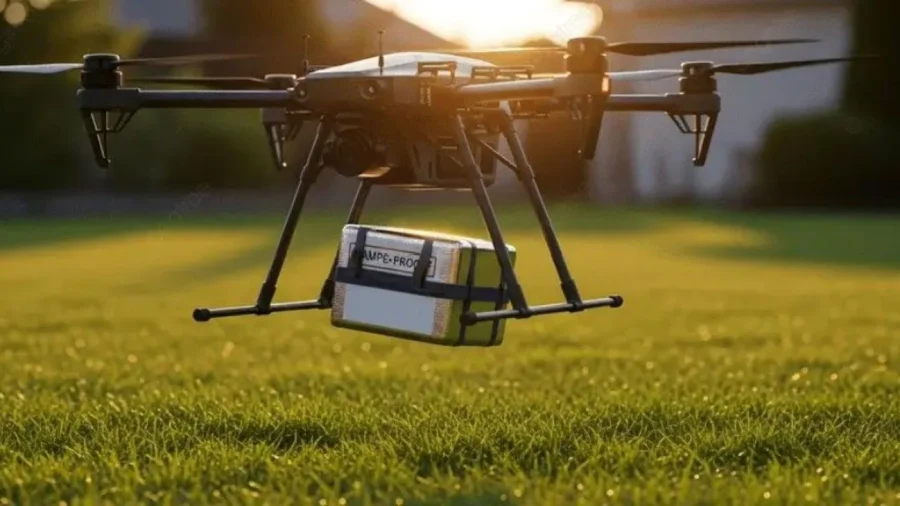
A new delivery trial with cargo drones has begun in one of New York’s busiest airspaces. Drones operated by British company Skyports fly over the East River every weekday between the southern tip of Manhattan and a pier in Brooklyn. For now, the program is progressing with light loads; But the real question of the test is bigger: Does urban delivery by drone really make sense? New York is testing cargo drones for healthcare deliveries.
The pilot program that started in New York is being carried out to see how cargo drones will adapt to busy city life and crowded airspace. Drones make short-distance deliveries over the East River on behalf of a healthcare system. The Port Authority of New York and New Jersey and the New York City Economic Development Corporation are behind the program. Drones operated by Skyports are used as six-propeller aircraft with a wingspan of approximately 2.4 meters.
Flights have been operating since the beginning of May. The initially planned schedule has been slightly delayed, but the trial process is now continuing with regular flights on weekdays. For now, the cargo carried consists of paper documents weighing several kilograms. The health system plans to carry non-biological and non-hazardous lightweight packages when there is sufficient confidence in the mechanism. These packages may also include deliveries of light medicines.
The name of the relevant health system was not disclosed for contractual reasons. The main goal of the pilot program is to see whether cargo drones really produce value in the city. The Port Authority will measure whether the number of regular flights provides a meaningful benefit for the healthcare system, whether deliveries are made faster and within cost limits than with existing carriers, and whether residents of the surrounding area find these flights disturbing.
The program will also evaluate the impact of deliveries on patient care. Drone delivery is still in its trial phase around the world. Most of the projects featured to date have focused on rural or suburban areas. This is because road access is more limited in these areas and the airspace remains quieter than in major urban centres. Since 2023, Skyports has been carrying mail in remote parts of Scotland and delivering cargo to offshore wind turbines in Germany.
Other examples in the sector are also focused on healthcare and logistics. Zipline states that it delivers to approximately 5 thousand healthcare facilities on four continents. One of the company’s oldest programs is based on the delivery of vaccines and blood products in Rwanda. In the US, Alphabet’s Wing initiative and Amazon Prime Air are expanding their delivery services, especially in suburban areas around Houston, Austin and Dallas.
In dense cities like New York, the picture is much more complex. There are three international airports in the city’s airspace. There are three public heliports in Manhattan alone. According to New York City Council data, approximately 9 thousand helicopter flights took place over the city’s land and water area in May 2023. This intensity directly highlights the issue of safety for the use of cargo drones in the city.
The demonstration of an electric vertical take-off and landing vehicle from the same heliport was also effective in postponing the start date of the program. In addition, the delay in obtaining the first NYPD permit also pushed the schedule back. In the pilot program, each flight is conducted with the approval of the US Federal Aviation Administration and a certified drone pilot supervises each flight. Flights operate on a fixed route, away from residential buildings.
The program requires a weekly NYPD permit. Officials also met with three local community boards before the drones were allowed to take off. This step shows that neighborhood acceptance is as much a part of the testing as technical testing. Because in urban drone delivery, it is not just about the package going from one point to another; Noise, security, permit processes and public reaction also come directly into the equation.
The issue of noise is one of the most sensitive topics of the program. Skyports’ drones, whose manufacturer has not been disclosed, produce noise in the range of approximately 60 to 100 decibels. This level is compared to a lawn mower. Other delivery drones generally operate in the range of 50 to 70 decibels, at the level of a vacuum cleaner or traffic noise. In an already noisy city like New York, this sound may be considered normal; However, how this will be perceived by the people living around will be one of the topics that will determine the outcome of the test.
Past examples also attract attention in this regard. Some residents in Texas compared the sound made by Amazon drones to a constantly running leaf blower and said that this sound disturbed pets and local wildlife. In New York, a special page was opened for complaints about the cargo drone pilot program via the 311 line. Healthcare deliveries stand out as one of the most meaningful areas of use of drones in the city. In a city like New York, where traffic, accidents and deadlock problems are common, air transportation of critical medical supplies can save time.
Therefore, it is not a coincidence that the test was carried out through medical logistics. However, the New York trial does not mean that cargo drones will be widely used in the city. The program is progressing as a one-year test and the data obtained will show under what conditions this technology works in dense urban centres. Delivery speed, cost, airspace safety, noise, permitting processes and neighborhood response will be measured simultaneously.



Comments
You can write your views about this story. Comments may be moderated according to site settings.